
AI for Chartered Accountants: What Works in India
See which tasks AI for Chartered Accountants can handle in Indian CA firms, where review stays essential, and how to adopt it safely in 2026.
Published 16 min read
82.8% of respondents in a national survey by the Institute of Chartered Accountants of India described AI's future role in the CA profession as either "essential" or "important." The same survey of approximately 1,100 members found that nearly half rarely or never used AI for routine professional tasks. Where it was used, the work sat in data entry, forecasting, client interaction, document analysis, and some auditing, not across the whole engagement. Training was uneven: 19.6% said their firm gave AI training, and 23.6% reported basic training, so roughly 43.2% had some formal exposure.
That split is the practical brief for AI for chartered accountants. Curiosity is not the constraint. A fluent draft you cannot tie to a notice PDF, a GSTR-2B line, or a judgment you have opened is not ready for sign-off. I would treat the model as a drafting and matching assistant, and keep the arithmetic, the source check, and the client-data decision with the firm.
Table of Contents
- Where Indian CA Firms Stand on AI Adoption
- What actually decides whether a firm starts
- Protecting Client Data and Consent in Your Firm
- Controls that belong in the file
- Which CA Tasks AI Handles and What You Must Check
- How to read the review burden
- How to Draft a Notice Reply with AI
- The sequence I would not reorder
- What a usable draft looks like
- How to Automate Bookkeeping and GST Matching
- What the match status tells you to do
- A weekly routine that stays small
- Measuring AI Accuracy Before You Rely on It
- Baseline, then sample
- The sign-off is still yours
- Choose Your First AI Workflow This Quarter
Where Indian CA Firms Stand on AI Adoption
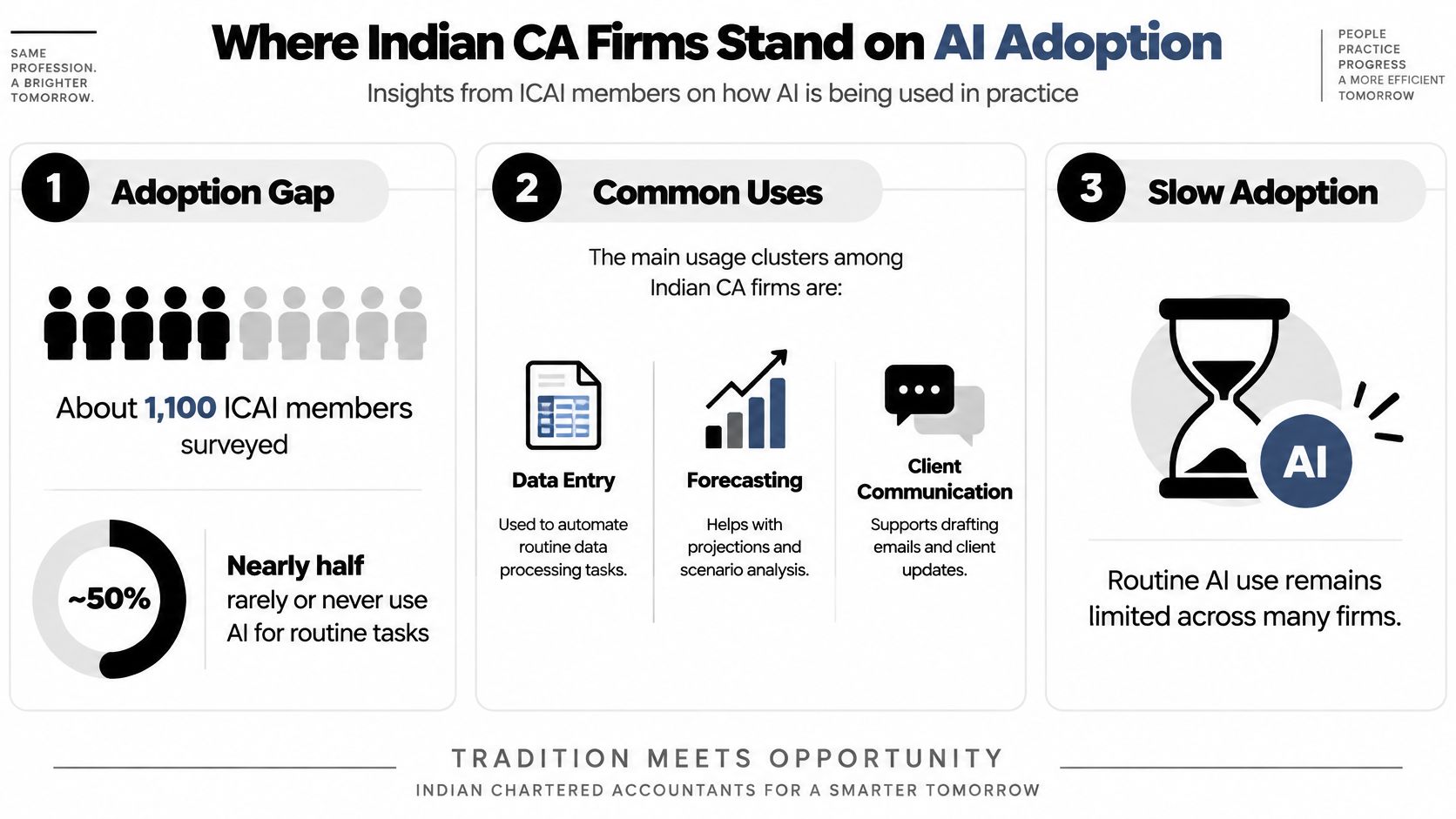
The adoption pattern is easy to misread. A practice can talk about AI in every partner meeting and still have almost no one who can reject a citation that sounds right. Pasting a notice into a public chatbot is not the same as changing how a GST file, a bank book, or a tax audit is finished. The survey work clusters where a wrong answer is annoying. It does not yet sit where a wrong answer is filed with the department.
What actually decides whether a firm starts
Three constraints matter more than the model name.
Training comes before volume. A one-hour demo does not teach an article assistant to drop a circular that a later notification has overtaken. Staff need a fixed check: open the source, match the figure, and note what they edited. Skip that, and the first draft is fast while the review queue gets longer.
Cost includes the review, not only the seat. A low monthly price is a poor bargain if every client PDF lands in a consumer account, or if the tool cannot show which notification it used. Price the partner hours you will spend correcting confident prose.
Confidence has to be checkable. Output belongs in the file only when a reviewer can point to the annexure line, the ledger, or the circular. Formatting is not evidence.
Scale makes the training gap harder to park. ICAI, established in 1948, now reaches approximately 1.25 million members and students, supported by 33 regional or representative offices, according to an ICAI institutional briefing. By November 2024, its CA GPT platform had more than 70,000 active members, 19 specialised GPTs, and over 250,000 member prompts. Profession-specific systems are already in daily use. They still do not sign the return.
Practical rule: Start on the task where a bad line is obvious against the source document, and refuse any workflow whose only control is that the draft looked finished.
Verification beats novelty. A tool earns its place when a named person can show what changed, which document was opened, and why the partner is willing to sign.
Protecting Client Data and Consent in Your Firm
A cheaper public chatbot can be the expensive choice. Confidentiality failures, remediation, and reputational damage sit on the other side of a free upload box, and Indian files are full of PAN, bank statements, invoices, GST data, and employee details.
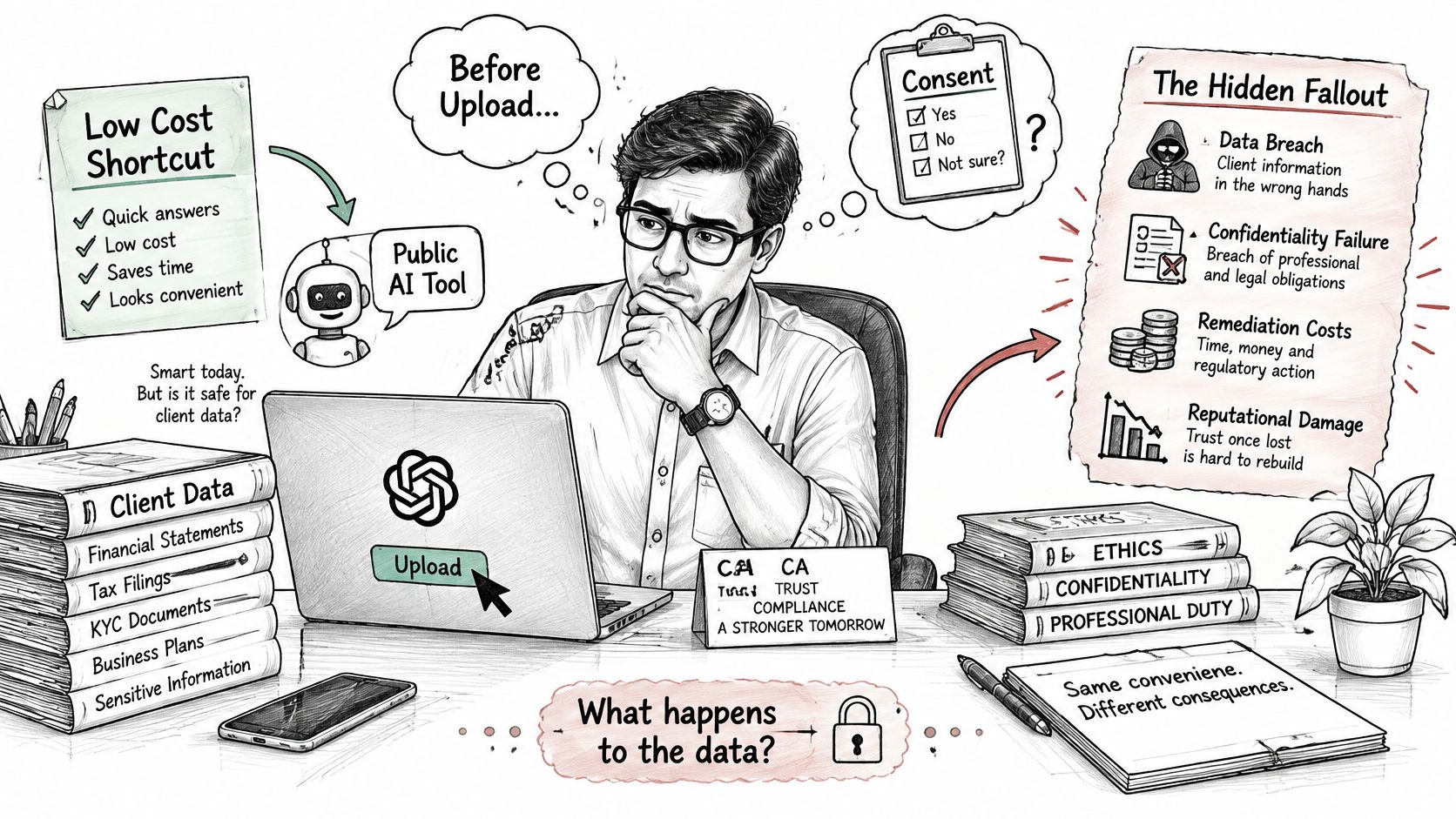
"Data is secure" on a vendor slide is not a record. Before anything is uploaded, the firm should be able to answer four questions on paper. What happens to each client document after upload? Is that data used to train a model for anyone else? Who can open the file, including the vendor's staff? How long is it kept, and who can delete it?
India-specific guidance on data privacy for AI in accounting is clear that DPDP implementation asks firms to map personal-data workflows, document processing purposes, review processor agreements, and keep auditable consent and transfer records. Client instructions are not the same thing as the firm's lawful processing duties. A client who emails a bank statement has not agreed that a third party may reuse it.
Controls that belong in the file
Mask what the task does not need. Hide PAN and bank account numbers when you are only classifying a ledger or summarising a notice heading.
Put the vendor terms in writing. Processor obligations, deletion rules, and a breach-notification timeline should be in the contract, not in a sales email. Encryption in transit and at rest, and role-based access, are the minimum technical pair.
Separate a low-confidence item from the draft. If the model is unsure, or two source documents disagree, route that line to the reviewing CA and log the decision. Do not let a smooth paragraph paper over the conflict.
The same duty shows up in ordinary work: a Tally import, a GST reconciliation, a notice draft. Each of those moves personal data. Our privacy commitments are one place to see how a practice-specific workspace states the no-resale and no-training position. You should still be able to produce your own pack.
A short video walk-through of the consent and upload questions is worth ten minutes in a partner meeting before anyone pastes a live GSTIN into a browser tab.
Keep a three-part pack you can hand over on request: a consent record, a map of personal-data workflows, and a one-page vendor review. If you cannot produce those three, you are not ready to upload.
Which CA Tasks AI Handles and What You Must Check
Read the table as a split of labour, not as a menu of things you can stop reviewing. The left side is drafting or retrieval. The right side is what still has to be true before anyone relies on it.
| Task | What AI Does | What the CA Must Check |
|---|---|---|
| Notice reply drafting (ASMT-10, GST and TDS notices) | Builds a first draft from the notice and annexures | Facts, figures, section references and deadline against the notice PDF |
| Legal research over statutes, circulars and case law | Retrieves candidate authorities with links to sources | Whether each authority is current and still controls the issue |
| Bank statement and invoice entry | Reads documents and suggests ledgers for each line | Ledger choice and voucher amounts before posting |
| Tax audit remark drafting | Drafts remark text for audit clauses | Each clause against the underlying records |
| Compliance calendar tracking | Lists GST and TDS due dates for each client | Registration type and any changed filing dates |
| Client document search | Finds documents within the client file | Access rights and confidentiality before sharing |
How to read the review burden
Notice replies carry the heaviest check. The model can arrange facts, a legal position, grounds, and a prayer. It cannot be trusted with the tax period, the rupee figure, or the last date to reply until those sit on the notice PDF in front of you. A section number that is one digit off is enough to embarrass the filing.
Research is a shortlist, not a holding. Candidate judgments and circulars are useful only after you open them. A later notification can change what "still applies" means. If the link does not open to a primary text, drop the citation.
Entry work fails. A suggested ledger looks harmless until a new party is posted at the wrong GST rate. Approve the suggestion only after the voucher amount matches the statement or invoice. Do not post from the suggestion screen alone.
Audit remarks and calendars look administrative and are not. Remark text has to follow the clause and the working papers, not a generic sentence about "no adverse observation." A compliance calendar is only as good as the registration type and any date the portal has shifted. Search inside a client vault still needs an access check before a document is forwarded to a colleague or the client.
The working principle is simple. The model reads documents and drafts text. Fixed rules and the CA handle arithmetic, statutory dates, and whether an authority still governs the issue.
A finished-looking paragraph is the riskiest output in the firm, because reviewers stop checking once the prose sounds like their own.
Start where an error is easy to catch: ledger suggestions and research leads. Move to drafts that will be filed with the department only after the review habit is boring and consistent. I would not begin a pilot on a notice that is already close to its deadline.
How to Draft a Notice Reply with AI
A notice reply is a good second workflow, not a first one. The draft can save a blank page. It cannot save a missed date or a figure that never appeared in the annexure.
The sequence I would not reorder
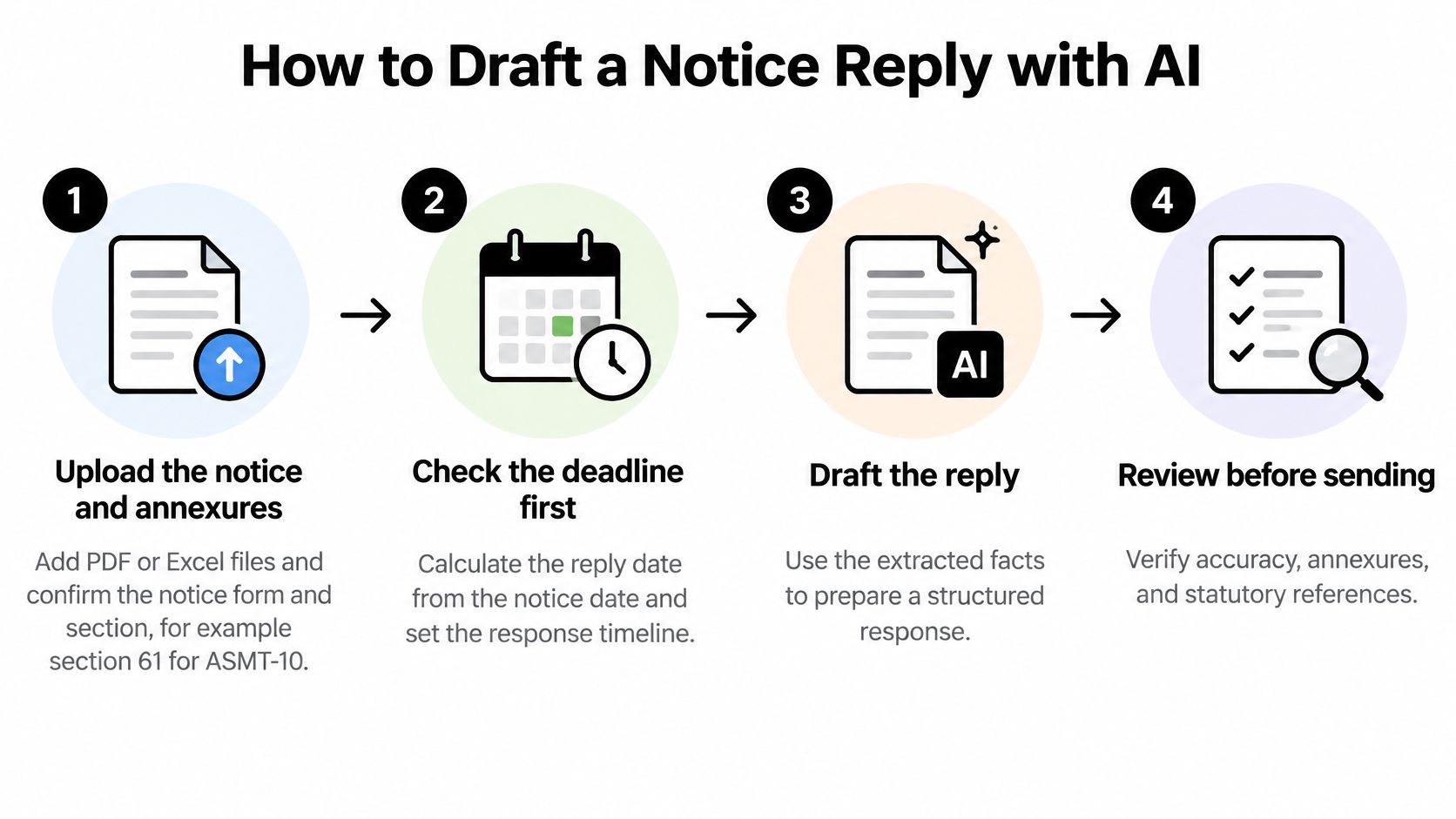
Upload the notice and annexures as PDF or Excel, and name the form. Confirm you are looking at ASMT-10 and section 61, or at the GST or TDS notice you received. A draft built on the wrong form will argue the wrong duty. The upload is also the moment to keep unrelated client files out of the workspace.
Fix the deadline before you write a word. Count it from the notice date and the response period, then put that date on the compliance calendar. A strong draft filed late is still late. A notice reply deadline calculator is a sensible cross-check against a hand count, not a substitute for the date printed on the notice.
Extract the facts and compare each one to the PDF. Tax period, tax amount, GSTIN, DIN or RFN, and the annexure lines that support them should be listed before any argument is written. If a figure in the extract does not match the source, correct the extract. Do not "fix it in the draft."
Reconcile when the notice is about a mismatch. Run the books against the registers and mark lines flagged as missing or mismatched. The reply should talk about those lines, not about mismatches in general. A generic explanation is how firms concede points they could have documented.
Generate the draft in a set structure. Facts, legal position, grounds, arguments, and prayer. Structure stops the model from burying the request in a long narrative the officer will not finish.
Open every cited judgment or circular. Confirm it still applies. Models cite positions that a later amendment has changed, and they do it in confident language. If you cannot open the authority, it does not go in the reply.
Edit in your own voice, record the changes, and wait for partner sign-off. Note what you rewrote and which annexure line you relied on. File only after the responsible partner has signed. The CA of record does not delegate that act to a model.
What a usable draft looks like
Every amount traces to an annexure line. Every authority opens. The prayer matches the notice, not a template from another client. The deadline in the covering letter matches the calendar. If any of those four fail, the draft goes back, even if the language is better than what the team would have written from scratch.
Say an ASMT-10 alleges a difference for a six-month window. The extract should show that window, the amount on the notice, and the lines in the annexure that add up to it. Only then does the legal position deserve a paragraph. Arguing the section before the arithmetic is how replies get long and wrong.
How to Automate Bookkeeping and GST Matching
Bookkeeping automation is a queue, not a posting button. Bank statements, invoices, and sales and purchase registers are read. A ledger is suggested for each bank line. The accountant approves the entry. Only then is a voucher posted, often as an export into TallyPrime.
AI reads and suggests. It should not be doing the arithmetic. Due dates, GSTIN and PAN checks, voucher balance checks, GST 2A/2B matching, and tax audit checks belong on fixed rules, with every limit, rate, and due date showing its source and the date that rule was last reviewed. If a match cannot show its source, it is a guess.
What the match status tells you to do
Match the books to GSTR-2A/2B and sort the file into three piles. Do not leave a fourth pile called "looks fine."
| Status | Meaning | Next Action |
|---|---|---|
| Matched | Entry agrees between books and GSTR-2A/2B | Accept and archive |
| Missing | Entry appears in only one source | Chase the vendor or client for the missing filing or invoice |
| Mismatch | Entry appears in both sources with differing values | Review amount, tax rate and period before deciding |
Matched lines can leave the active list. Missing lines need a person, usually the vendor or the client, not another model pass. Mismatch lines need a human comparison of amount, rate, and period before anyone decides to amend, accept, or write to the other side.
A weekly routine that stays small
Ingest the new bank lines at a fixed time each week, not on the morning a client asks for a balance.
Approve suggestions in batches only for ledgers you have already accepted for that party. A known rent ledger can move quickly. A new name cannot.
Open every new party before posting. The common slip is approving a suggested ledger for a new supplier without checking its GST rate. That single click pollutes both the books and the next 2B match.
Clear the exception list in the same week. A bank reconciliation check on the unposted lines keeps the queue honest. Aged exceptions become the month-end surprise.
The month-end test is blunt. No unexplained bank lines, and a short exception list that carries a date. If the list is long or undated, the automation has only moved the mess from the voucher screen to a spreadsheet.
Measuring AI Accuracy Before You Rely on It
A model's general accuracy score cannot tell a CA firm whether a batch is safe to sign. Measure how it performs on your work, including the errors it misses and the review time it creates.
| Metric | What It Measures | Why It Matters |
|---|---|---|
| Invoice-to-voucher processing time | Hours from document upload to approved voucher | Shows the real time saved per batch |
| GST records auto-matched | Share matched across books and GSTR-2A/2B without manual work | Shows how much reconciliation the tool covers |
| Mismatch false positives and negatives | Clean entries wrongly flagged, and real errors missed | Shows whether the flags can be trusted |
| Draft editing distance | Edits between the first and final notice draft | Shows drafting quality |
| Citation verification rate | Share of claims linked to an openable primary source | Shows traceability |
| Exception resolution time | Days taken to clear flagged items | Shows the remaining workload after automation |
Baseline, then sample
Record manual time for a month before switching on a batch. Then compare a similar batch using the tool, tracking hours and the exception list. Faster processing is not a saving if it leaves more unresolved work.
Measure research separately from drafting. Track whether the leading authorities are relevant, whether the controlling notifications or amendments appear, and whether the answer accounts for later developments. A citation can be genuine yet no longer apply.
Review twenty randomly selected items from each batch. Classify errors by type: wrong figure, wrong party, stale authority, or missed exception. This gives the review a repeatable scope without letting one unusually easy file determine the result.
The sign-off is still yours
Every draft, research answer, and citation is a starting point, not a filing. The Chartered Accountant of record remains solely responsible for reviewing, verifying, and signing off on every output.
Record the reviewer, changes made, and source documents opened for each item that leaves the firm. Keep access controls, client consent, retention, and permitted data use in the same review process. A blank sign-off record means the work is not complete.
Choose Your First AI Workflow This Quarter
Pilot one low-risk workflow for the next thirty days. Bank-statement ingestion or GSTR-2A/2B matching is the right size. Leave notice drafting until the review habit is already in place.
Baseline the metrics on that client group before the tool touches a live file. Confirm the data terms and the consent records before the first upload. Keep a CA sign-off on every output, including lines the model marked as matched.
At day thirty, compare the batch with the baseline. Expand, adjust, or stop. Do not extend a pilot because the interface felt modern.
Charter AI is one option that combines drafting, research, books, GST, Tally, and the compliance calendar in one workspace, which suits a firm that wants a single pilot rather than five logins. Judge it on the same hours, match rates, and exception times you would use for any other tool.
Charter AI is an Indian workspace for notice drafts, source-linked research, bookkeeping, GST matching, Tally export, and the compliance calendar, built so each figure can be opened against the document behind it. If your firm is ready to pilot one checked workflow this quarter, start with the task you can already review and see how Charter AI fits that file. Bring the sign-off log with you. The tool does not replace it.