
TDS Late Payment Interest: How to Calculate It Correctly
Learn how TDS late payment interest works under Section 201(1A), with 1% and 1.5% monthly rates, worked amounts and reporting steps.
Published 14 min read
TDS late payment interest is simple interest under Section 201(1A), charged at 1.5% per month or part of a month when deducted tax is deposited late, and 1% per month or part of a month when tax wasn't deducted on time. A single day past the deposit deadline can trigger a full month's interest, but the calculation period starts from the deduction date, not the missed deposit deadline.
You may be reviewing a challan that was paid just after the due date, with the accounts team expecting a negligible charge. Before approving the working, check whether the team has confused late deduction with late deposit, or counted only the days after the deposit deadline. Those mistakes can turn an apparently settled challan into an interest shortfall.
Table of Contents
- Late TDS Interest Rates at a Glance
- Match the default to the correct period
- Deadlines That Start the Interest Clock
- Separate the deadline test from the interest period
- How Many Months a Delay Counts As
- Count calendar months, not elapsed monthly blocks
- How to Calculate Interest in Two Stages
- Prepare the working in sequence
- Worked example with separate defaults
- Reporting Interest and Avoiding Penalties
- Reconcile the payment to the statement
- Keep interest review separate from penalty review
- Schedule Each Challan Before the Deadline
- Make payment status visible
- Use reminders with clear actions
Late TDS Interest Rates at a Glance
Classify the default before choosing the rate. Under the Income-tax Act's Section 201(1A), delayed deduction attracts 1% per month or part of a month until actual deduction, while delayed deposit after deduction attracts 1.5% per month or part of a month from deduction until actual government payment.
These are separate simple-interest liabilities. A transaction can require a late-deduction working, a late-deposit working, or both, depending on what the deductor did.
Match the default to the correct period
Late TDS interest rates by situation
| Situation | Rate | Counted from | Counted until |
|---|---|---|---|
| Tax deducted but deposited late | 1.5% per month or part | Date of deduction | Date of actual payment to Government |
| Tax not deducted on time | 1% per month or part | Date deduction was required | Date of actual deduction |
| Delayed deduction on purchase of goods | 1% per month or part | Date deduction was required | Date of actual deduction |
| Delayed deduction on purchase of immovable property | 1% per month or part | Date deduction was required | Date of actual deduction |
The purchase rows describe delayed deduction, not a separate rate for depositing tax after deduction. For immovable-property purchases, the Income Tax Department's property TDS guidance confirms interest at 1% per month or part of a month, from the required deduction date until actual deduction.
Don't calculate interest on the supplier's gross invoice merely because that's the amount visible in the purchase register. Use the relevant TDS principal, and preserve the underlying transaction reference so a reviewer can trace that principal to the deduction working.
Review rule: Ask whether the deductor failed to withhold tax, failed to remit withheld tax, or did both. A description such as “TDS paid late” isn't precise enough to choose the rate.
A useful working paper has a separate default-type column. Entries such as late deduction, late deposit, and both make the review clearer than a single interest column with an unexplained formula.
The practical trade-off is straightforward: a slightly more detailed transaction register takes longer to prepare, but it's easier to review than a consolidated interest total. Don't let the team select a rate before it has identified the event that started the liability.
Deadlines That Start the Interest Clock
A TDS deposit made one day after its due date is late, but the interest calculation does not start from that first late day. The due date tests whether payment was timely; the deduction date determines the start of interest on tax deducted but not remitted.
For deductions made from April through February, the ordinary deposit deadline is the 7th of the following month. The Income Tax Department's guidance on interest for late payment of TDS sets out this timetable. For example, TDS deducted in April is due by 7 May, and TDS deducted in February is due by 7 March.
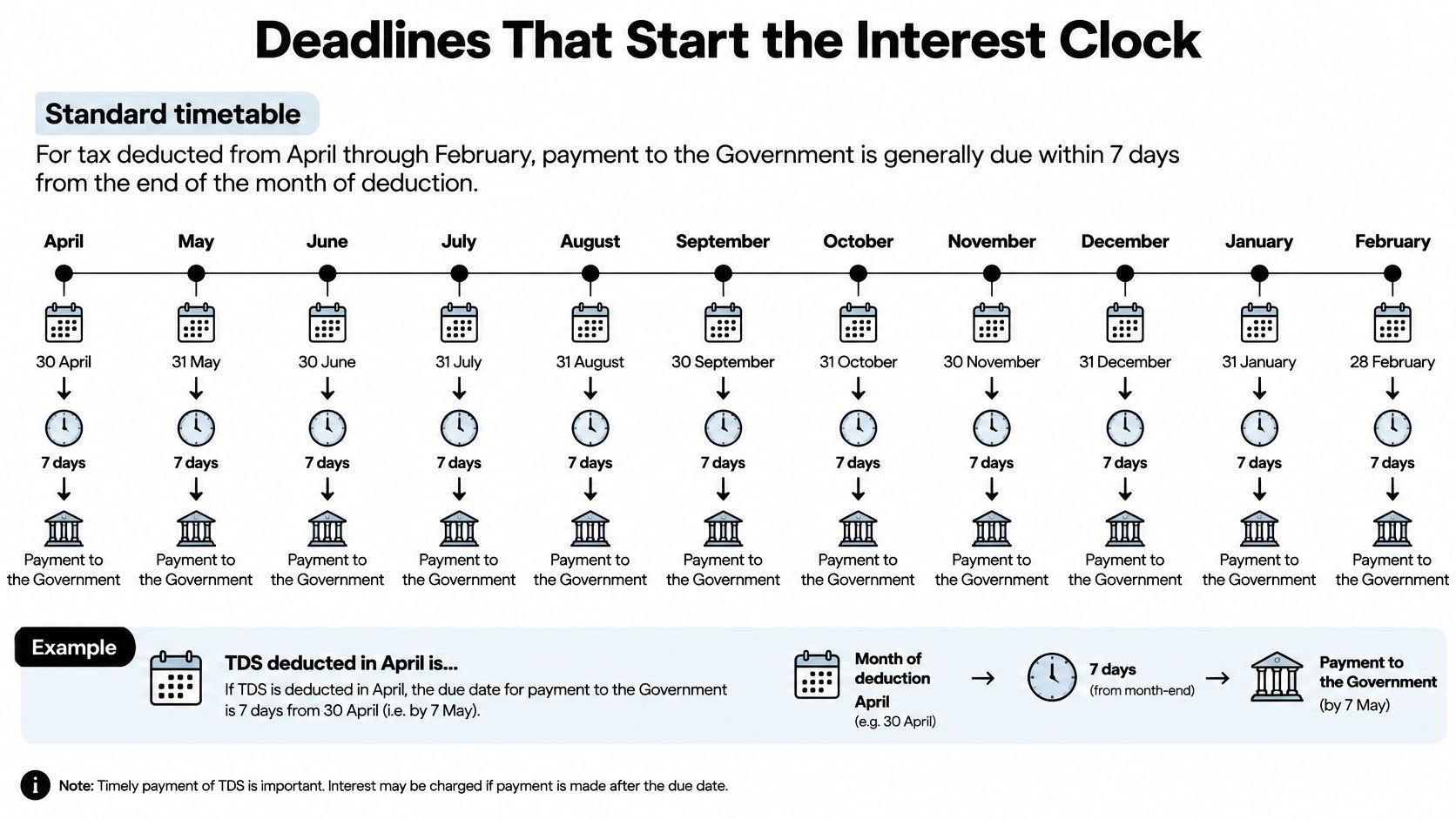
TDS deposit due dates that start late-payment interest
| Deduction month | Deposit due | First late day |
|---|---|---|
| April | 7 May | 8 May |
| February | 7 March | 8 March |
Separate the deadline test from the interest period
A preparer who enters the first late day as the interest start date measures the overdue payment period, not the statutory interest period. Keep the dates distinct: the due date establishes lateness, while the deduction date anchors interest on tax deducted and remitted late.
For example, interest of ₹7,500 on ₹2,50,000 for two chargeable months is calculated as ₹2,50,000 × 1.5% × 2. This is illustrative arithmetic, not a figure attributed to the department. Establish the chargeable month count from the relevant dates; “paid late” alone does not determine it.
The following video provides additional context for the payment workflow.
Record the due date when entering each deduction. Confirm the payment timetable for the deductor and transaction category rather than applying the standard monthly rule to every case.
Keep these dates against each deduction:
- Required deduction date: When tax should have been withheld.
- Actual deduction date: When the withholding was recorded and effected.
- Government remittance date: The payment date supported by the challan record.
Track the deposit due date separately as a compliance check.
How Many Months a Delay Counts As
Say a firm deposits ₹1,00,000 of TDS just after the deadline and expects to pay interest for only the overdue day. That's the wrong basis: the interest period must be established from the relevant statutory start date, then counted by calendar months touched.
The visual highlights the part-month rule, but the important review question is which months fall within the chargeable period.
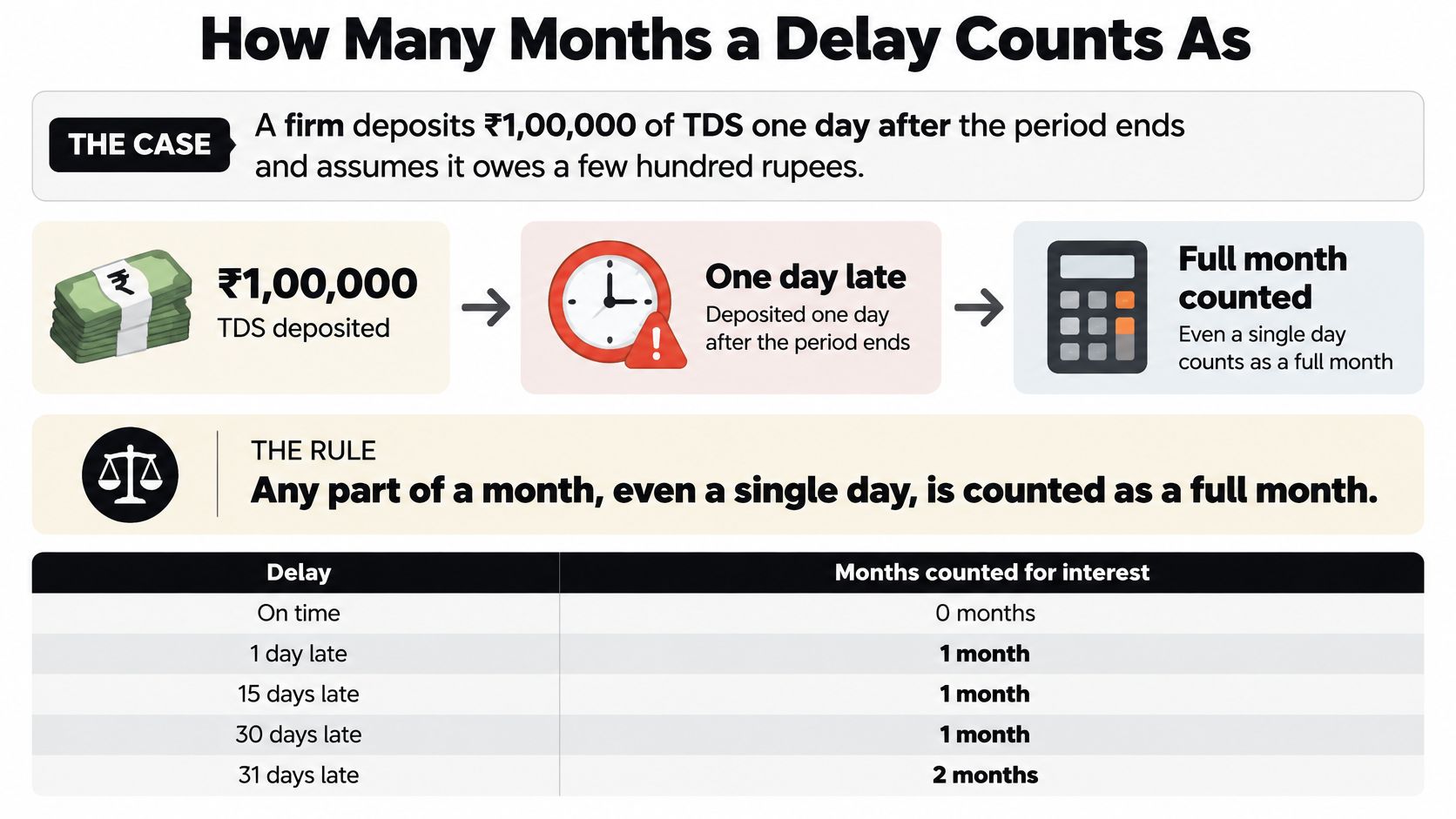
Count calendar months, not elapsed monthly blocks
A short interval can touch separate calendar months. Equally, a longer interval contained within the same calendar month doesn't become multiple chargeable months merely because many days have elapsed.
Delay length, months counted and interest on ₹1,00,000 at 1.5%
The following is an illustrative arithmetic table. Its elapsed-time descriptions assume the dates touch the calendar-month counts shown; elapsed duration alone doesn't establish the count.
| Delay after deduction | Months counted | Interest at 1.5% |
|---|---|---|
| 1 day to 1 month, contained within one calendar month | 1 | ₹1,500 |
| Just over 1 month, touching two calendar months | 2 | ₹3,000 |
| Just over 2 months, touching three calendar months | 3 | ₹4,500 |
| Just over 3 months, touching four calendar months | 4 | ₹6,000 |
Don't use this table to conclude that every short delay attracts only the first row. If the deduction and remittance dates fall in different calendar months, the dates, rather than the duration label, control the working.
For purchases of goods, the Income Tax Department's guidance confirms 1% per month or part of a month for failure to deduct until actual deduction. In a hypothetical working, ₹1,00,000 left undeducted across two chargeable calendar months produces ₹2,000 of interest; a delay described merely as 45 days is insufficient to confirm that month count.
Never divide elapsed days by a standard month length and round up. List the calendar months touched by the actual chargeable period.
A reviewer should be able to see the month names beside the interest formula. That small addition exposes incorrect start dates and missing part-months much faster than checking an unexplained total.
How to Calculate Interest in Two Stages
Build the working transaction by transaction before consolidating it by challan. The statutory text of Section 201(1A) separates 1% monthly or part-month interest for late deduction from 1.5% monthly or part-month interest for late remittance, and requires interest to be paid before furnishing the applicable TDS statement under Section 200(3).
The workflow below keeps the legal dates separate from the arithmetic.
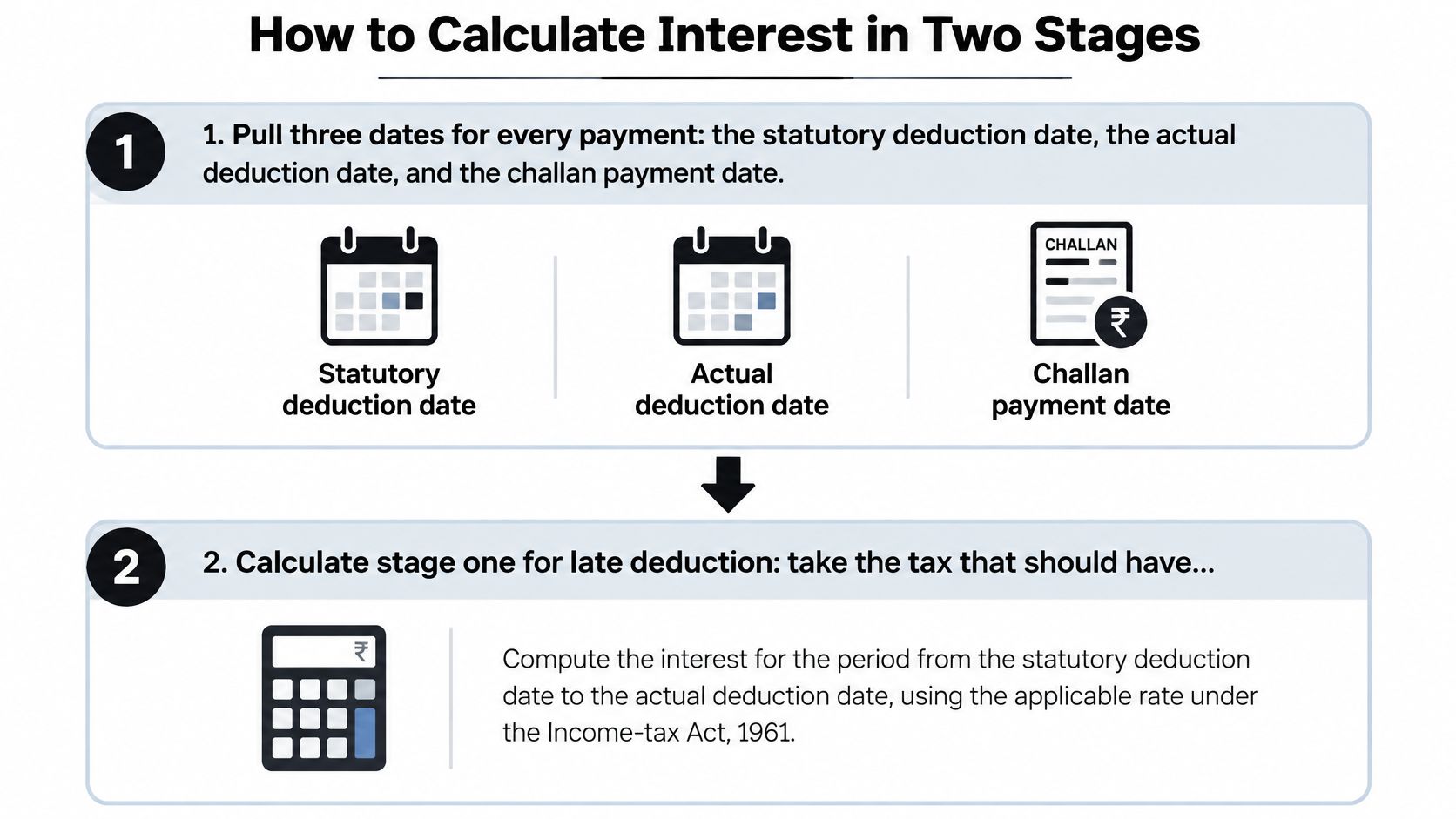
Prepare the working in sequence
Pull the supporting dates. Record the required deduction date, actual deduction date and government payment date. Reconcile these to the ledger, deduction records and challan evidence rather than relying on a manually typed summary.
Identify the late-deduction principal. Isolate the tax that should have been deducted but wasn't. Apply the lower statutory rate only to the period ending on actual deduction, with each applicable part-month counted.
Test the deposit separately. Check whether the deducted tax reached the Government by its applicable deadline. If the deposit was late, calculate the remittance-stage interest from actual deduction to actual payment using the higher statutory rate.
Show the calendar-month count. List the months included for each stage independently. Don't assume that the stages have identical periods merely because they concern the same underlying payment.
Calculate and review each amount. Multiply the relevant TDS principal by the applicable monthly rate and chargeable months. Apply the rounding required by the reporting workflow at the appropriate amount level, retaining the unrounded working for review.
Consolidate only after checking. Add the reviewed interest amounts and reconcile them to the interest payment and statement reporting. Keep unresolved date or principal differences out of the approved total until someone has investigated them.
Worked example with separate defaults
Consider a hypothetical review containing distinct deduction entries. These examples assume that the calendar-month counts have already been checked against the supporting dates.
| Entry | Assumed default | Calculation | Interest |
|---|---|---|---|
| TDS principal of ₹40,000 | Late deduction across one chargeable month | ₹40,000 × 1% × 1 | ₹400 |
| TDS principal of ₹60,000 | Timely deduction, late deposit across two chargeable months | ₹60,000 × 1.5% × 2 | ₹1,800 |
| Total | Separate reviewed entries | ₹400 + ₹1,800 | ₹2,200 |
The example doesn't imply that late deduction automatically means late deposit. Test the deposit deadline independently before adding a remittance-stage charge.
Don't apply the higher rate to the entire history of an undeducted amount. That substitutes the wrong liability for the period before withholding. Also, don't use a challan preparation date where the supporting payment record establishes a different remittance date.
Keep return-filing charges outside this working. Use a separate TDS late-fee computation working where the statement itself was filed late, rather than adding a filing charge into the interest formula.
Reporting Interest and Avoiding Penalties
Pay the interest before furnishing the TDS statement. Operationally, that means the reviewer should approve the working, confirm payment and then authorise filing. Preparing a challan isn't the same as completing payment, and filing shouldn't depend on an assumption that someone else will settle the interest later.
Keep tax deducted, interest paid, and any separately applicable filing charges distinct in the reconciliation. Combining them into a single payment total makes it harder to establish whether the tax principal has been fully deposited and correctly allocated.
Reconcile the payment to the statement
A useful review follows the money through the records rather than checking only whether the return preparation utility accepts the file.
- Match the tax principal: Tie the deduction register to the deductee-wise details and the tax component allocated against the challan.
- Match the interest separately: Tie the approved interest working to the interest component in the payment record.
- Verify payment evidence: Check the challan particulars against the actual remittance record and retain the receipt.
- Investigate differences: Resolve incorrect dates, allocation errors and unexplained balances before the statement is authorised.
A common workflow weakness is filing while the interest payment remains pending. That leaves the statement and payment records out of step and can require subsequent reconciliation or correction. Don't treat a successful upload as evidence that the underlying payment working was right.
Filing gate: No statement should be released while an identified interest liability remains unpaid, unrecorded or unexplained.
Keep interest review separate from penalty review
An interest computation doesn't settle every consequence of a TDS default. The team should separately examine late-statement filing exposure and whether an incorrect or missing statement requires correction or further legal review.
Don't label every demand as a penalty. First identify whether the communication concerns tax, interest, a filing charge or a separate proceeding, then reconcile the component disputed. A TDS assessee-in-default reply working should distinguish the alleged default, the supporting dates and the amount already paid.
Maintain a challan register with the approved interest calculation attached to each relevant payment. During the periodic return review, compare available tax-credit information, including relevant Form 26AS entries where appropriate, with the challans and filed deductee details; use discrepancies as investigation points rather than assuming the credit statement alone proves the calculation.
Assign an owner to each unresolved item. A register entry marked “difference under review” is only useful if someone is responsible for establishing the cause and retaining the resolution.
Use this sign-off wording before filing: “Tax principal reconciled, interest independently checked and paid, challan evidence retained, and statement allocations verified.”
Schedule Each Challan Before the Deadline
A challan generated on time is not proof that the tax was deposited on time. Start the payment routine when the deduction is recorded. Assign a preparer, approver and payment owner, combining roles where a small team requires it.
Record the due date in the client's live compliance register. A separate spreadsheet that is not updated after approval cannot show whether the bank transaction succeeded.
Make payment status visible
Use the monthly TDS challan due-date checklist to organise the applicable monthly workflow, and confirm whether the transaction follows a different payment timetable.
| Register field | What the team should record |
|---|---|
| Client and deduction month | The obligation being settled |
| Applicable due date | The payment deadline |
| Payment owner | The person responsible for remittance |
| Deposit status | Prepared, approved, paid or unresolved |
| Actual deposit date | The supported government payment date |
| Interest status | Not applicable, under review or paid |
| Evidence reference | Challan receipt and approved working location |
Keep prepared and paid as separate statuses. If a payment fails, return the item to the payment owner and leave it unresolved until payment is confirmed. Generating a challan does not complete the deposit.
Use reminders with clear actions
Set reminders early enough for the preparer to identify missing deduction details and the approver to arrange funds. The final reminder should request payment confirmation, not just repeat the due date.
Charter AI's compliance calendar keeps GST, TDS, ITR and client deadlines visible, with reminders 7 days before, 1 day before and on the due date. Close a task only after saving payment evidence.
If a deadline is missed, start the interest working promptly. Record the deduction and payment dates, assign the calculation for review, and keep the item open until the interest status is resolved.
Before month-end, review every unresolved challan. Separate items awaiting funds, failed payments, missing evidence and pending interest calculations so the partner can see the action required for each.
A reminder shows that work is due. Payment evidence shows that the deposit is complete.
Use fixed rules for arithmetic and statutory checks. In Charter AI's workflow, AI does not perform bookkeeping arithmetic or checks; due dates and specified statutory checks run on fixed rules, with each limit, rate and due date showing its source and last-reviewed date.
Finish with an exception list. For every open challan, require the payment owner to state the next action before the team begins the next compliance cycle.
Charter AI provides a client-wise compliance calendar and a source-linked tax workspace for organising TDS deadlines, payment evidence and interest-related notice work. Explore Charter AI for a client-centric workflow covering monthly challan tracking and TDS default review.