
Difference Between Gstr1 and Gstr 3b
Difference between gstr1 and gstr 3b. Learn the real difference between GSTR-1 and GSTR-3B, what each return contains, how they reconcile, and the mistakes
Published 15 min read
You've inherited a GST desk, the sales register agrees with the reported turnover, and the client wants confirmation that everything is settled. Then the reviewer asks why a customer can't see an invoice, why the ITC working differs from the return, and whether the tax was discharged. A turnover match won't answer those questions.
Table of Contents
- Why GSTR-1 and GSTR-3B Confuse Even Experienced CAs
- Stop reviewing only the final totals
- Give the inherited file a clear structure
- What Each Return Actually Does
- GSTR-1 and GSTR-3B at a Glance
- What the summary return must establish
- How the Two Returns Differ on Key Criteria
- Data detail and statutory function
- Recipient impact, timing and exception type
- Filing Sequence and the Auto-Drafting Link
- A Worked Example Through the Two Returns
- Three-Way Reconciliation and the Amendment Cut-Off
- Where Charter AI Fits in This Workflow
- Give the tool a defined assignment
- Decide whether the desk needs it
Why GSTR-1 and GSTR-3B Confuse Even Experienced CAs
The confusion starts when the preparer treats both returns as different presentations of the same spreadsheet. That approach encourages a superficial review: compare turnover, explain the difference, move on. It leaves the reviewer without a clear answer about invoice completeness, credit support or payment.
The useful distinction is control purpose: GSTR-1 is the recipient-facing outward-supply trail; GSTR-3B is the taxpayer's summary tax-discharge record. Don't ask whether the forms look alike. Ask what each form proves, and what evidence the reviewer still needs.
Stop reviewing only the final totals
A client may send a sales register and insist that its closing figure is correct. Your associate may then reproduce that figure in the working paper without checking whether the underlying documents belong to the correct recipients and reporting periods. The partner receives a clean summary, but not a defensible reconciliation.
Change the review conversation:
- Ask for the document population. Which invoices, credit notes and debit notes support the outward-supply figure?
- Separate credit from sales. Which purchase records and eligibility decisions support the ITC working?
- Demand closure evidence. Which retained records establish the final liability, payment and filing position?
These are review instructions, not interchangeable checks. Assign an owner to each, and don't let an unexplained difference disappear into a balancing adjustment.
Desk rule: A matching total is a starting point for review, not permission to sign off.
Give the inherited file a clear structure
Keep the source documents, return extracts, reconciliation and reviewer conclusions together. If the previous preparer recorded an adjustment without explaining its origin, reopen it rather than carrying it forward.
Your working paper should let another associate reconstruct the conclusion without phoning the person who prepared it. That means recording the reason for a difference, the supporting document and the action still outstanding.
Use the comparison below to allocate questions to the correct return. Then build the filing review around the auto-drafting dependency, the three-way reconciliation and the correction deadline. Those controls matter more than memorising descriptions of the forms.
What Each Return Actually Does
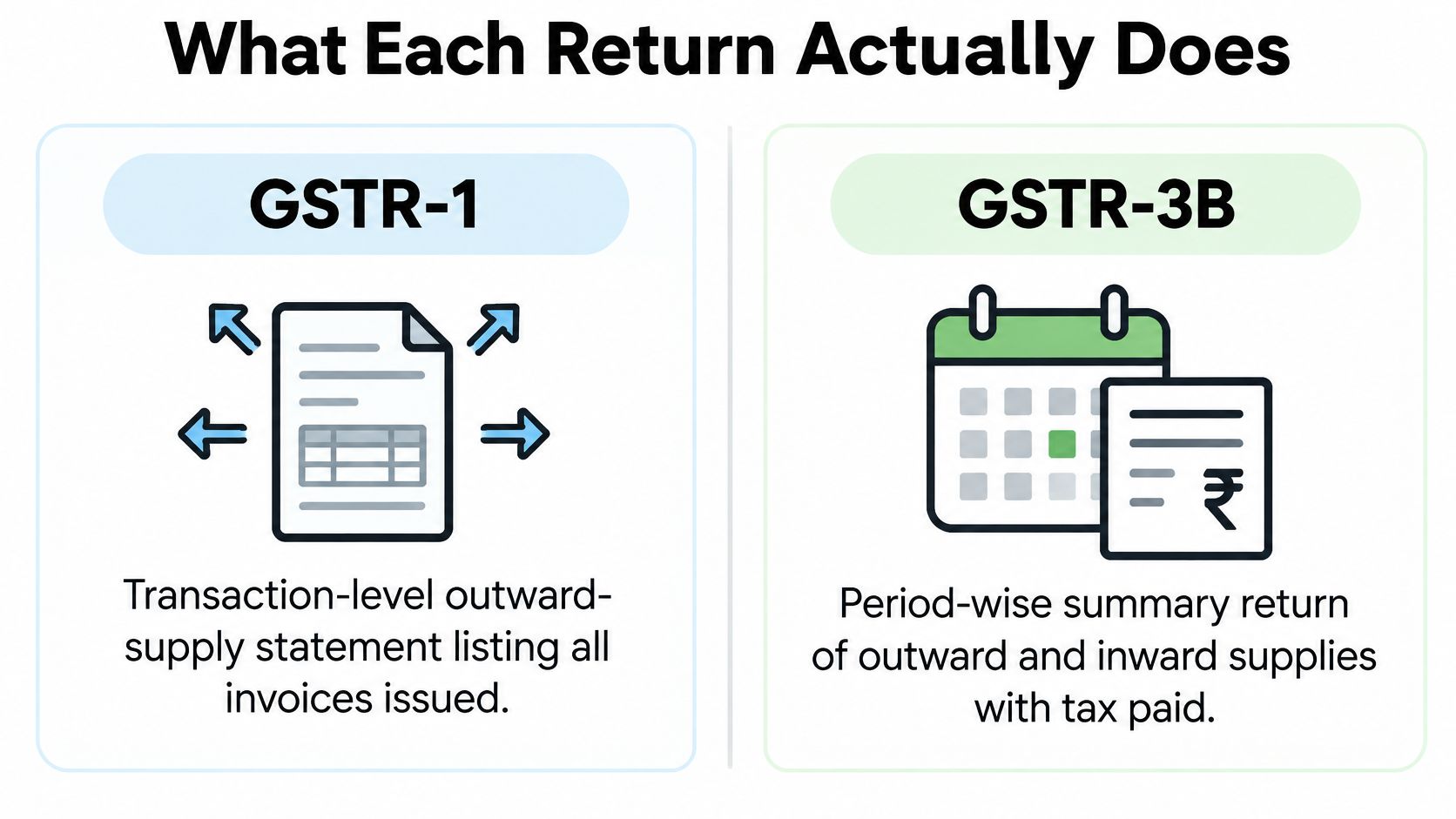
GSTR-1 discloses outward supplies at transaction level. It records invoice and supply information for goods and services, including information that helps populate recipients' inward-supply data. The Government describes it as a Statement of Outward Supplies, rather than the record through which the taxpayer settles the period's tax position, as explained in the official GSTR-1 overview.
That distinction determines what you should expect from the supporting file. A GSTR-1 review needs an outward-supply register that the reviewer can trace to individual documents. A summary sales ledger alone isn't a substitute for that trail.
GSTR-1 and GSTR-3B at a Glance
| Purpose | GSTR-1 | GSTR-3B |
|---|---|---|
| Primary role | Detailed disclosure of outward supplies | Summary declaration and settlement of the tax position |
| Information reviewed | Invoices, credit/debit notes and supply classifications | Output liability, reverse-charge liability, eligible ITC and payment |
| Recipient-facing control | Supports recipient-side invoice visibility and reconciliation | Doesn't replace the supplier's detailed outward-supply disclosure |
| Main supporting working | Document-level outward-supply reconciliation | Liability computation, ITC working and payment reconciliation |
| Reviewer's central question | Have the outward supplies been reported correctly? | Has the tax position been correctly declared and discharged? |
Use this visual as a quick reference when allocating preparation and review responsibilities.
What the summary return must establish
GSTR-3B brings together the taxpayer's aggregate tax position. Its supporting working should distinguish liability, eligible credit, reversals and the amount payable or discharged through the electronic ledgers.
Don't reduce that review to checking whether the outward-supply figure resembles the GSTR-1 total. The purchase-side credit working and the evidence of discharge require their own scrutiny. An outward-supply reconciliation cannot establish the correctness of an ITC claim.
For the client, keep the explanation plain: reporting what you supplied and settling the resulting tax position are different obligations. Completion of one doesn't establish completion of the other.
For the associate, make the evidence requirement equally plain:
- Disclosure file: Retain the documents and classifications supporting the outward-supply statement.
- Settlement file: Retain the computation and ledger evidence supporting the summary return.
- Reviewer conclusion: State what was checked and what remains unresolved.
The difference between GSTR-1 and GSTR-3B is therefore operational, not merely descriptive. Each requires a different review conclusion.
How the Two Returns Differ on Key Criteria
Choose the return to investigate from the problem in front of you. A recipient's missing invoice and a questionable ITC claim shouldn't enter the same review queue.
The GST Portal's GSTR-3B guidance explains the summary-return function, while the outward-supply distinction established above determines the document-level checks. Together, these roles provide a practical basis for allocating exceptions.
Data detail and statutory function
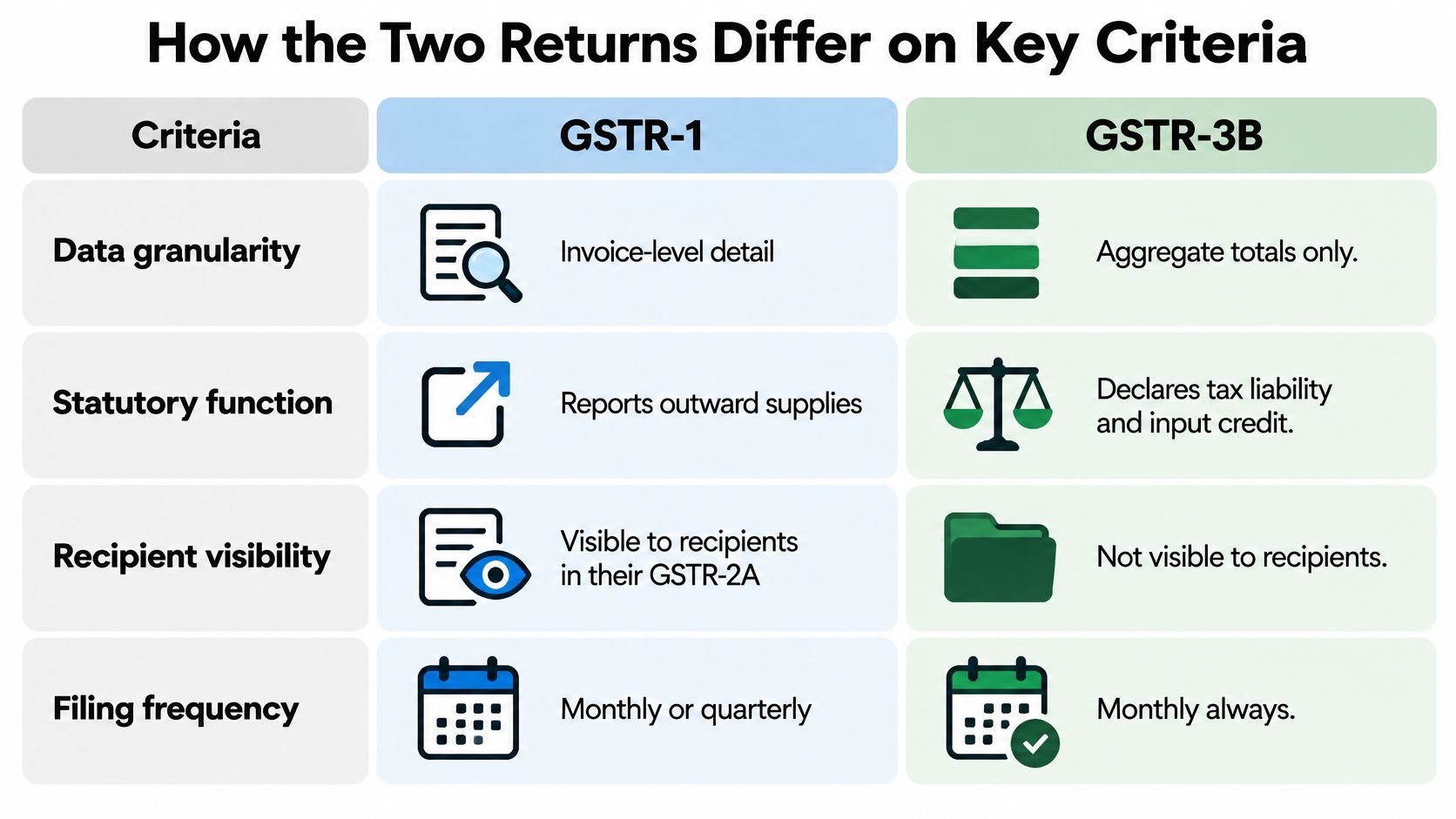
Data granularity. For a wrong recipient GSTIN, invoice value, tax rate or place of supply, begin with the detailed outward-supply record. For an aggregate liability or credit question, begin with the summary working and trace backwards.
Verdict: Investigate document errors at document level. Don't attempt to resolve them by adjusting a summary total.
Statutory function. Use the disclosure-versus-settlement distinction from the comparison table to define the assignment. The preparer responsible for document reporting and the reviewer responsible for tax discharge need connected, but separate, sign-offs.
Verdict: Neither return is a substitute for the other's control.
The following chart provides a visual comparison. Its “monthly always” label for GSTR-3B should not be used for scheduling, because quarterly filing also applies; confirm the taxpayer's actual filing profile.
Recipient impact, timing and exception type
Recipient visibility. If a customer raises an invoice-visibility issue, examine the outward-supply document and its reporting trail. Don't send the customer a payment summary as though it answers their question.
Verdict: Start with the record relevant to the recipient's document, not the supplier's net payment.
Correction window. Identify whether the issue is an omitted document, an amendment to a reported document or an understated liability. Those labels determine the research and evidence required before choosing a correction route.
Verdict: Diagnose first. A generic instruction to adjust the next return is inadequate.
Frequency and due dates. Confirm the filing profile before assigning deadlines. Use the monthly GSTR-1 due-date reference for the relevant calendar task, rather than treating it as a deadline for the entire GST workflow.
Verdict: Maintain separate preparation, review and filing tasks.
Mismatch type. Credit notes, amendments, exempt or nil-rated supplies, reverse charge and reporting-period errors can produce differences requiring classification rather than a simple arithmetic adjustment.
Verdict: Give every exception a reason code and supporting evidence. “Difference noted” isn't a conclusion, and “turnover matches” isn't an explanation.
Filing Sequence and the Auto-Drafting Link
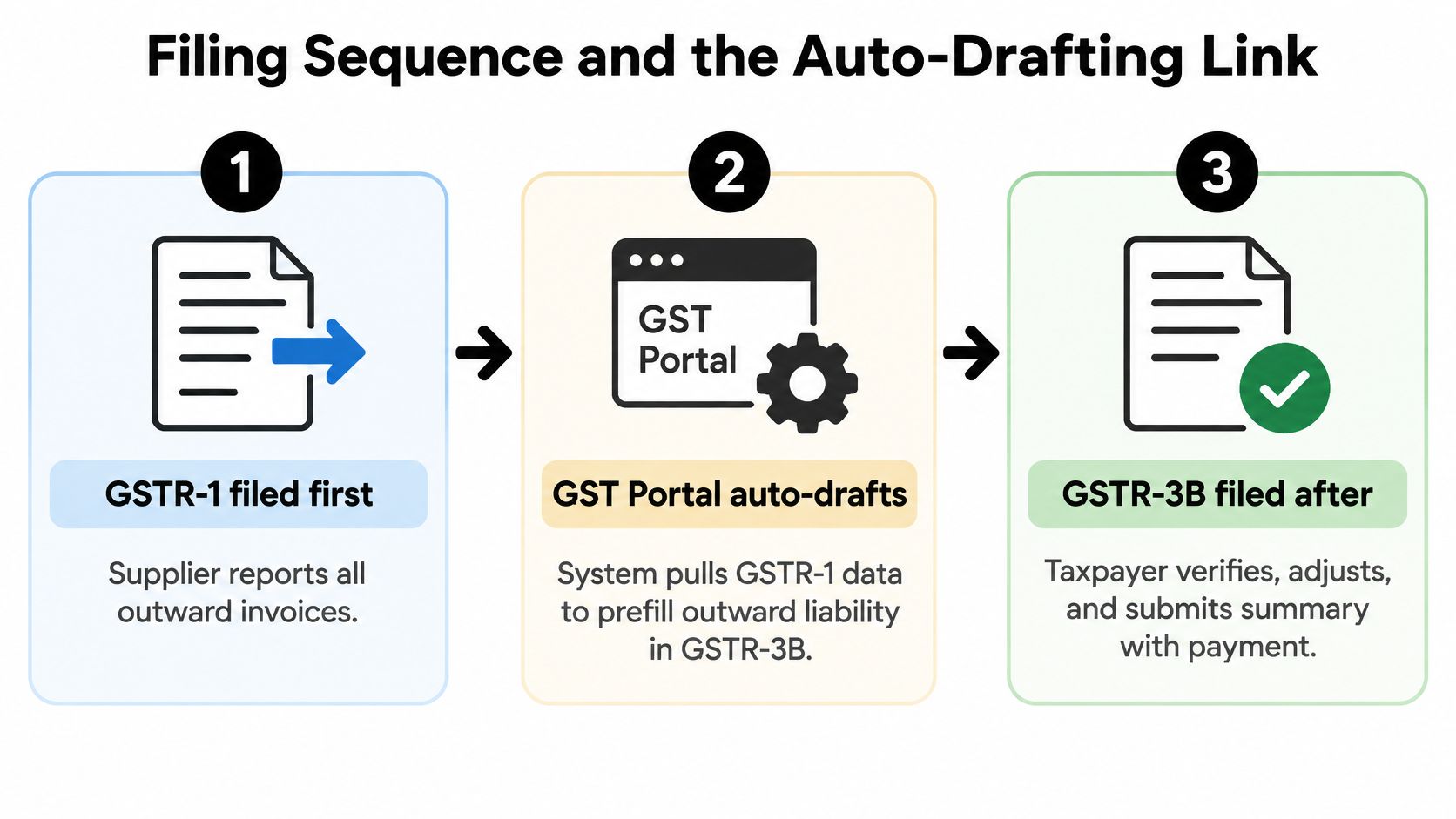
A client hands over the sales register a day before the GSTR-3B deadline and expects the return filed that evening. Push back. The summary return is the last step in the sequence, and the outward-supply statement filed before it decides most of what the portal pre-fills: the GST Portal uses GSTR-1 or GSTR-1A to auto-draft GSTR-3B Tables 3.1(a), 3.1(b), 3.1(c) and 3.1(e), while Table 3.1(d), covering inward supplies liable to reverse charge, is auto-drafted from GSTR-2B, per the official GSTR-3B preparation and submission guidance.
In practice the dependency looks like this. Treat the last stage as a review assignment, never an instruction to accept every populated field.
| GSTR-3B field | Where the draft figure comes from |
|---|---|
| Tables 3.1(a), 3.1(b), 3.1(c) and 3.1(e) | GSTR-1 or GSTR-1A |
| Table 3.1(d): inward supplies liable to reverse charge | GSTR-2B |
That second row is the trap. An associate who reconciles every populated liability field against the sales register alone is checking the wrong evidence for the reverse-charge line. Split the review into two tracks: outward supplies traced to GSTR-1, reverse charge traced to GSTR-2B.
A populated field tells you the system supplied a figure. It says nothing about whether your team validated the classification or completeness behind it. Confirm which outward-supply records support the draft, check whether a correction workflow touches any of them, and freeze the source version you reviewed so a later reviewer can rerun the comparison.
Auto-drafting transfers information. The preparer still owns the conclusion.
Plan the buffer with the monthly GSTR-3B due-date reference and give the reviewer time before the client expects payment approval. The official preparation guidance cited above also covers filing cadence and nil returns, so a quiet month still belongs on the client calendar.
Close-out needs three things on file: the return extracts and workings you approved, a written reason wherever a reviewed figure departs from the draft, and the payment and filing evidence, not just the preparation screen. If an upstream error surfaces late, correct or document it before recommending payment. Changing the summary working without an explanation hides the problem; the reviewer needs an auditable decision, not merely a return that can be submitted.
A Worked Example Through the Two Returns
One B2B invoice will travel through both returns, and it will do two different jobs on the way. Take a supplier that records a sale in its register. The same document feeds the recipient-facing invoice trail in GSTR-1, then disappears into the aggregated tax-discharge figures of GSTR-3B. Watching that one document is the fastest way to internalise the difference.
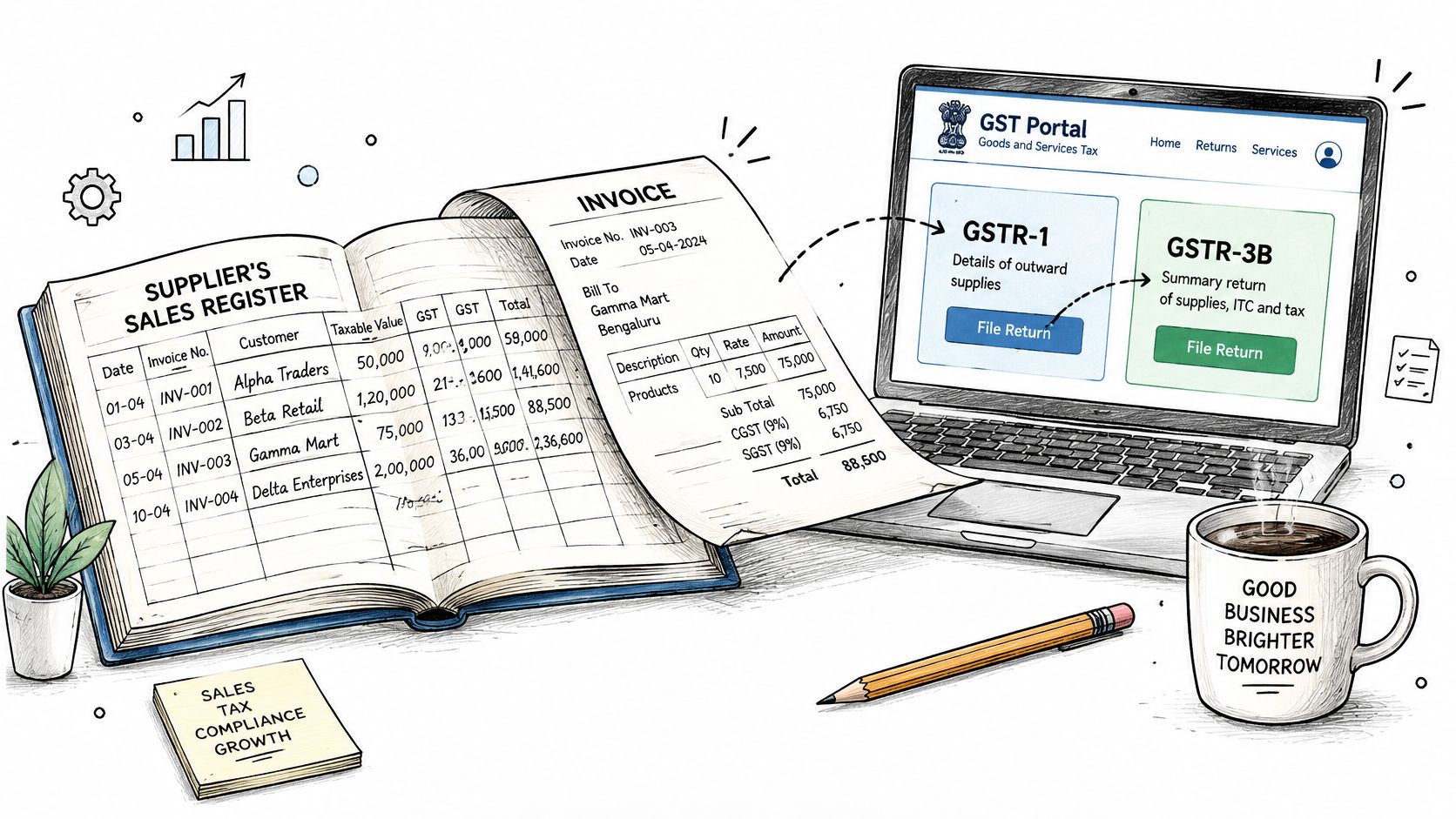
Start at the register. The associate verifies the recipient GSTIN, document date, taxable value, classification and tax heads against the invoice, then locates the matching record in the outward-supply working and keeps its reporting reference. By the time the summary-return review begins, that invoice no longer exists as a line. It exists only as a contribution to an aggregate, so the reconciliation working has to carry the explanation of how the detailed population became the approved liability.
Now run the failure test. Change nothing but the recipient GSTIN. Aggregate liability still matches, every total reconciles, and a reviewer checking only GSTR-3B signs off on a wrong document. The diagnosis lives in the invoice trail, which is exactly why the two returns cannot be reviewed the same way.
For an accompanying visual walkthrough, use the video below alongside the official guidance and the retained client workings.
Extend the scenario: the supplier later issues a credit note against that same invoice. The working paper keeps the original document and the credit note linked instead of collapsing them into a net figure, and the associate establishes three things before either return is touched:
- Which document it relates to. Identify the original invoice and retain the commercial reason for the note.
- Where each effect lands. Record the accounting period, the proposed reporting period and the liability treatment separately.
- Who approved it. Reviewer sign-off is what turns the treatment into a decision.
Issuing a credit note does not by itself create a refund entitlement, and a timing difference is not automatically acceptable because the totals still move. Verify the applicable treatment before assuming the open return can absorb the adjustment.
The weak point is the undocumented hand-off. If the outward-supply preparer knows why the document moved periods but the GSTR-3B reviewer does not, the firm loses the explanation at the exact place it will be asked for later. Write the reason beside the adjustment, not in someone's memory.
Three-Way Reconciliation and the Amendment Cut-Off
A reconciliation that ends in a single "matched" status cannot tell you which of three different failures it was built to catch. Run the three legs as separate reviews, each with its own conclusion:
| Leg of the chain | What to compare | What a break here means |
|---|---|---|
| Sales register and e-invoice data against GSTR-1 | Document population, recipient details, values, classifications and tax heads; investigate missing records in either direction | The recipient-facing invoice trail is incomplete or wrong |
| GSTR-1 against the reviewed outward-liability fields in GSTR-3B | Taxable values and tax heads, with every difference classified as timing, credit note, amendment or classification | What recipients see diverges from what the firm discharged |
| GSTR-3B against ledger discharge and filing evidence | Final liability, credit utilisation, cash discharge and filing proof | The reported liability does not tie to what was actually paid |
Review the ITC support separately. Matching outward supplies says nothing about purchase-side eligibility, and keeping original documents linked to their amendments is what makes the trail reconstructable later.
If departmental correspondence arrives, build the response from the retained reconciliation rather than an unexplained balancing figure. The GSTR-1 and GSTR-3B liability-mismatch intimation guide sets out what that Rule 88C intimation asks the desk to establish.
The amendment window is where unresolved differences turn expensive. A filed GSTR-1 is not an indefinitely editable worksheet: corrections relating to a previous financial year generally cannot be made after 30 November of the following financial year, per the GST Portal's GSTR-1 user guide.
Diagnose before promising anything. An invoice that was never reported, one reported incorrectly, and one correctly disclosed but never reflected in liability are three different problems with three different routes. None of them is "revising the original return."
Hold the exception register to six fields: invoice date and supply year; the original reporting period or proof of omission; the correction period and proposed route; the period in which the related tax was paid; the follow-up needed on the recipient's credit; and the explanation the annual return will need at year end.
One caution on old working papers. Material describing recipient upload or acceptance followed by later supplier reporting and payment through GSTR-3 reflects a different regime; check its applicability before transposing it into a present-day instruction.
"Push it into the next return" is not advice. Confirm the available route, the cut-off, the recipient consequences and the payment treatment, and record the conclusion. If the deadline is close or has passed, escalate the file before committing the client to a correction.
Where Charter AI Fits in This Workflow
Use a software workspace when the review problem is coordination across documents, exceptions and client files. Don't buy one merely to replace a small, controlled spreadsheet.
The platform combines GST reconciliation, source-linked tax research, evidence traceability and assisted drafting. Its reconciliation workflows cover GSTR-2A/2B, e-invoices and e-way bills, with matched, missing and mismatch classifications. Those capabilities can support the control file described above, but they don't remove the partner's responsibility to approve the treatment.
Give the tool a defined assignment
Keep arithmetic and matching rules separate from legal conclusions. Ask the workspace to organise the evidence, identify exceptions and prepare a reviewable draft. Require the associate to verify the source and resolve the exception before closing it.
A useful allocation is:
- Reconciliation: Organise the document populations and surface entries requiring investigation.
- Research: Check the applicable correction deadline and portal guidance against verifiable sources.
- Correspondence: Prepare a structured reply using the approved facts, reconciliation and supporting annexures.
Don't treat generated text as proof. Open the cited material, inspect the relevant passage and confirm that it supports the client's circumstances.
Decide whether the desk needs it
A basic checklist and spreadsheet are enough when the document population is manageable, exceptions are limited and another reviewer can reconstruct every conclusion. Keep that arrangement if it remains controlled.
Use an integrated workspace when associates repeatedly move between reconciliation files, source documents, research and notice drafts, and the firm struggles to preserve the connections. Test it on an existing client file before changing the practice-wide process.
The recommendation is simple: choose the tool for evidence continuity, not attractive output. If the reviewer still can't trace a conclusion to its supporting record, the desk hasn't solved its control problem.
Charter AI offers GST reconciliation, source-linked research and evidence-based notice drafting within a client workspace. Visit Charter AI and test an existing reconciliation file against the disclosure, liability and discharge checks above before adopting it across your GST desk.
Tags
Related guides
- How do I reconcile GSTR-2B against my purchase register step by step?
- Why does my GSTR-2B not match my purchase register: what are the common root causes?
- My invoice number format doesn't match what the supplier filed: will Tally still match it?
- How do I import the GSTR-2B JSON file into Tally Prime?
- How do I reconcile GSTR-2A/2B in Zoho Books?