
Composition Scheme GST Rate 2026: Rates and Eligibility
Composition scheme GST rate for 2026: 1% for traders and manufacturers, 5% for restaurants, 6% for services, plus eligibility limits and trade-offs.
Published 15 min read
The Composition Scheme GST Rate is 1% of turnover for traders and eligible manufacturers, 5% for restaurant services, and 6% for services and mixed supplies. Each rate applies to turnover, not as a separate GST charge on the sale price.
That lookup is where most advice stops, and it's the wrong stopping point. The popular line is simple. If you're small, take the low rate and take the simpler compliance with it. I wouldn't advise a client on that basis. A low rate on turnover can still cost more than regular GST once you account for tax paid on purchases that can't be recovered, the margin the business earns, and whether buyers expect input tax credit.
The rate tells you what the client pays the government. It doesn't tell you what the choice costs the business. Treat the rate as the first line of a calculation, not as the recommendation itself.
Table of Contents
- Composition GST Rates for Each Taxpayer Type
- How to read the table
- Why the period matters
- Who Qualifies and Which Turnover Limit Applies
- The eligibility checklist
- Composition and Regular GST Compared Side by Side
- What the buyer sees
- Why the Headline Rate Can Mislead
- A worked example with stated assumptions
- What a proper decision model needs
- Compliance Duties Under the Composition Scheme
- Duties by period
- When a Client Must Exit and the Next Action
- The exit sequence
- Version confusion is the real risk
Composition GST Rates for Each Taxpayer Type
Find the activity first, then read across to the rate and split. Eligible manufacturers generally pay 1% of turnover in a State or Union Territory, traders and other eligible suppliers in the standard category also pay 1%, restaurant-service providers pay 5%, and eligible service providers and mixed suppliers under the separate option pay 6%, as set out in the CBIC composition FAQ.
| Taxpayer type | Rate (% of turnover) | Split (CGST + SGST/UTGST) | Notes |
|---|---|---|---|
| Traders of goods | 1% | 0.5% + 0.5% | Cannot collect GST from customers or claim input tax credit |
| Eligible manufacturers | 1% | 0.5% + 0.5% | Same conditions as traders; older 2% rate appears in earlier CBIC material |
| Restaurant services | 5% | 2.5% + 2.5% | Separate category with its own rate |
| Services and mixed supplies | 6% | 3% + 3% | Separate option for small service businesses |
How to read the table
Start with what the client supplies, not with the label on the shop board. A business selling goods sits in the 1% row, whether it trades in finished stock or manufactures eligible goods. A restaurant business sits in the 5% row because restaurant services are a distinct category, not a variant of the goods rate.
A service provider or mixed supplier sits in the 6% row under the expanded option for small service businesses. That category matters because it broadened composition treatment beyond the earlier goods-focused framework. Don't force a service business into the traders' row just because its turnover is small.
The split is mechanical once the row is right. Half the total goes as CGST and half as SGST or UTGST for the State or Union Territory of supply. A trader at 1% therefore accounts for 0.5% CGST and 0.5% SGST or UTGST, and a service supplier at 6% accounts for 3% under each head.
Why the period matters
The rate isn't charged invoice by invoice. It's a fixed percentage applied to turnover for the period, so it's best understood as a slice of total sales rather than output tax computed on each supply. That distinction drives how you price, how you bill, and how you reconcile the liability at quarter end.
Older material creates a real trap here. The earlier core structure recorded 2% for manufacturers, 5% for restaurants, and 1% for traders, which shows how presentation and eligibility have developed over time. If a client file, old working paper, or prior-year computation shows 2% for a manufacturer, don't carry it forward without checking the rate in force for the period you're filing.
Practical rule: Activity decides the row, the period decides whether the figure in that row is current, and turnover decides whether the client can use the row at all.
So run the test in that order. Goods point to 1%, restaurant services to 5%, and services or mixed supplies to 6%, subject to the eligibility checks that decide whether composition is open to that client in the first place.
Who Qualifies and Which Turnover Limit Applies
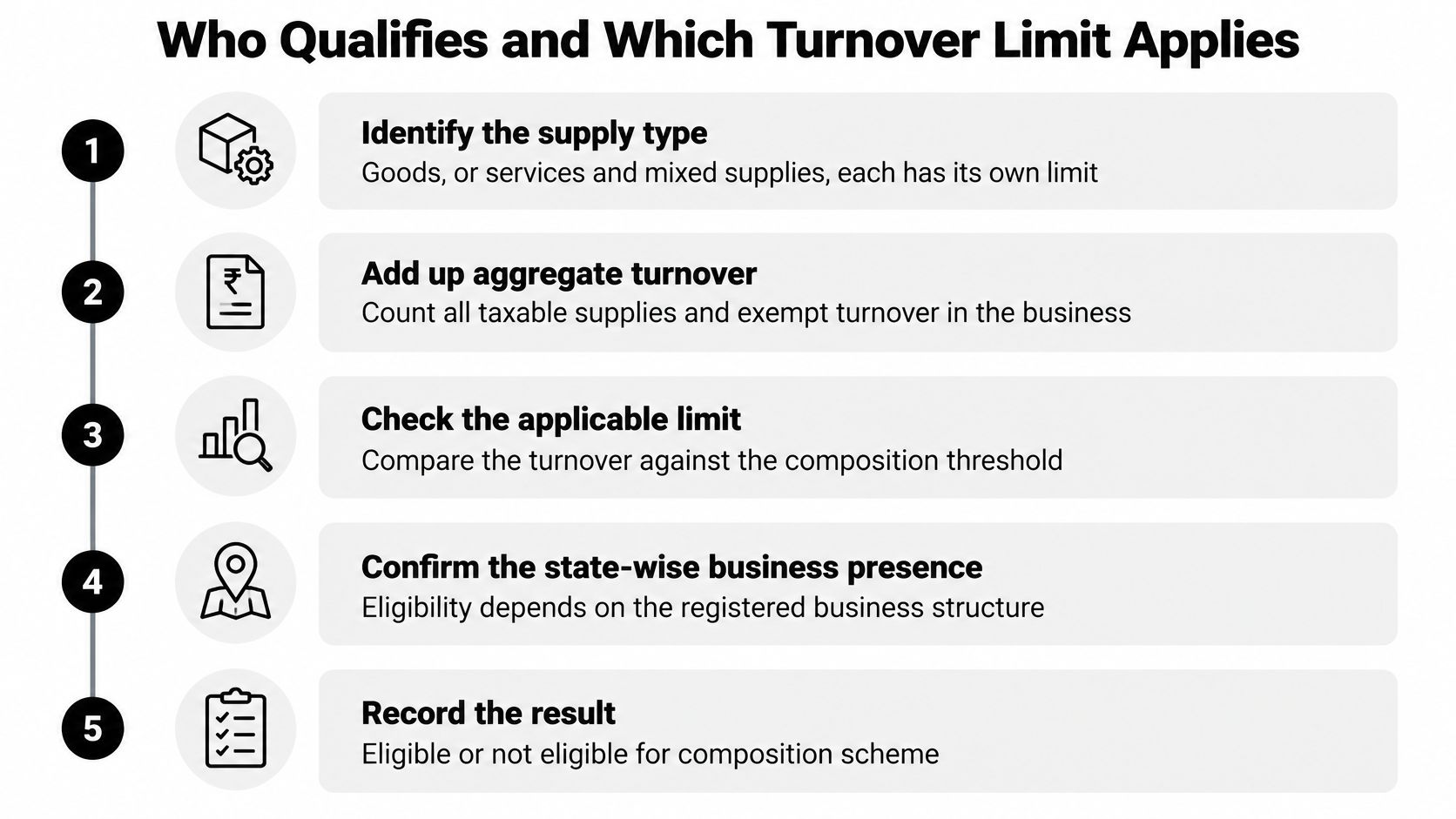
A client's current sales do not decide eligibility. The test uses aggregate turnover in the preceding financial year, and the applicable ceiling depends on the supply category and, for goods suppliers, the State. Under section 10 of the CGST Act, the general ceiling for goods is ₹1.5 crore, reduced to ₹75 lakh in specified States. Services and mixed supplies generally have a ₹50 lakh ceiling.
| Supply category | Turnover limit (preceding year) | Special-category States |
|---|---|---|
| Goods (traders and manufacturers) | ₹1.5 crore | ₹75 lakh in Uttarakhand and North-Eastern States covered by the lower limit |
| Services and mixed supplies | ₹50 lakh | ₹50 lakh |
| Restaurant services | ₹50 lakh | ₹50 lakh |
The eligibility checklist
- Identify the supply type: Classify the client as a supplier of goods, restaurant services, or other services and mixed supplies. The classification determines which turnover ceiling applies.
- Calculate aggregate turnover: Add turnover across all registrations under the same PAN for the preceding financial year. Do not test each shop or GSTIN separately.
- Apply the State limit: For goods suppliers in Uttarakhand and the North-Eastern States covered by the lower ceiling, use ₹75 lakh, rather than ₹1.5 crore.
- Check category exclusions: Confirm that no category exclusion prevents the client from choosing the scheme. Meeting the turnover ceiling alone does not establish eligibility.
Testing current-year sales is a common mistake. A client may appear small today but exceed the applicable ceiling based on last year's turnover. PAN-level aggregation can also change the result when separate registrations each appear to be below the limit.
Consider two traders with ₹1.4 crore of turnover in FY 2025-26. A Gujarat trader is below the ₹1.5 crore goods ceiling and may opt in for FY 2026-27. A Meghalaya trader with the same turnover exceeds the ₹75 lakh ceiling if the lower limit applies there.
Document four items for each client: preceding-year aggregate turnover, PAN, supply category, and State. The rate is only a lookup; eligibility requires the right turnover figure, category, and State.
Composition and Regular GST Compared Side by Side
The comparison that matters to a client isn't administrative. It's what changes on the document the buyer receives and what that buyer can then do with it.
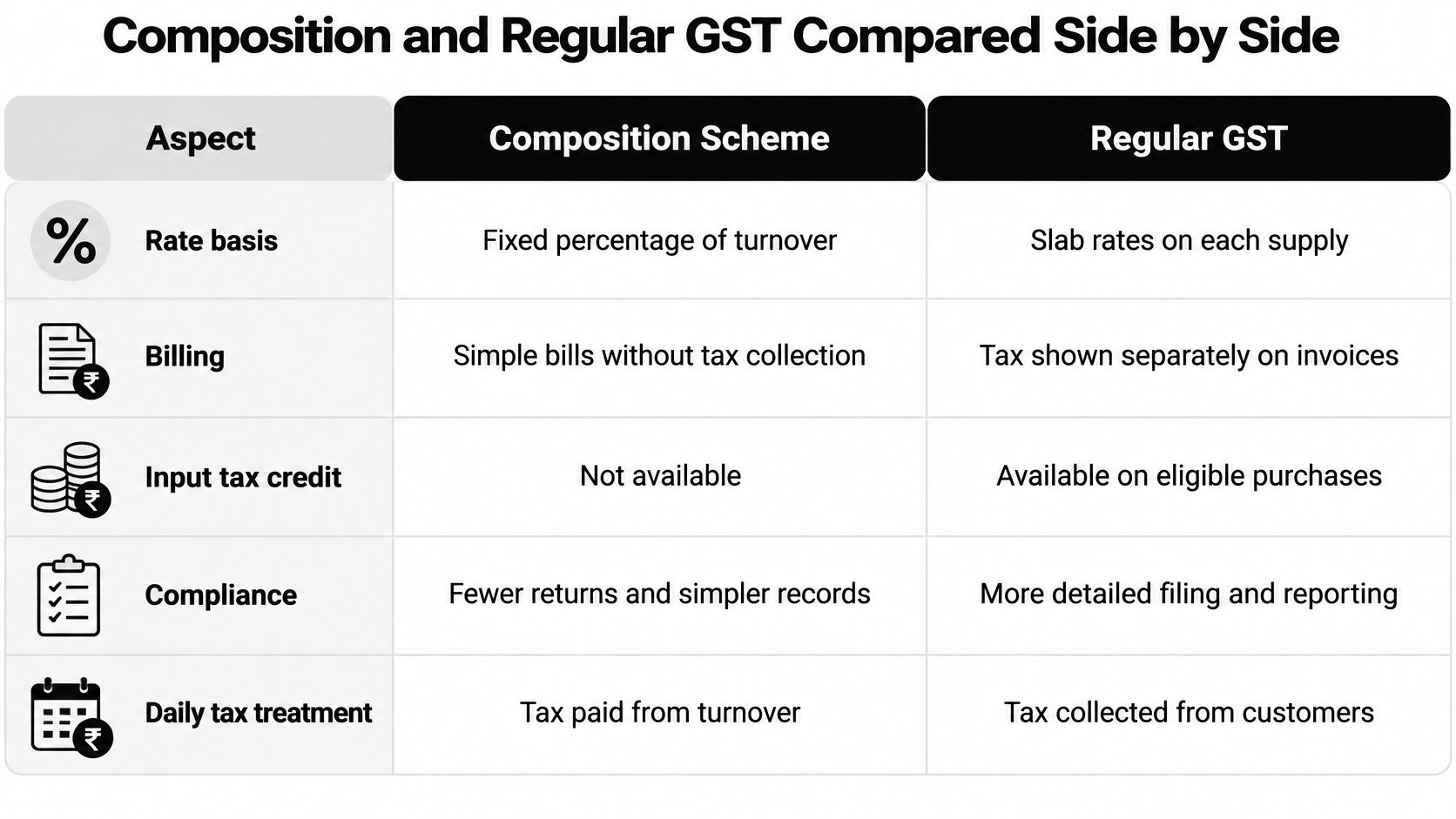
| Feature | Composition scheme | Regular GST |
|---|---|---|
| Rate basis | Fixed percentage of turnover (1%, 5% or 6%) | Slab rates applied to each supply |
| GST collected from customers | No | Yes, shown on the tax invoice |
| Input tax credit | Not available | Available, subject to conditions |
| Document issued | Bill of supply | Tax invoice |
| Inter-State supplies | Not permitted | Permitted |
What the buyer sees
Start with the billing row, because that's where commercial friction appears. A composition taxpayer issues a bill of supply with no GST line, so the buyer has nothing to claim as credit. A regular taxpayer issues a tax invoice showing GST separately, and a registered buyer can take that tax into its own credit ledger, subject to the usual conditions.
That single difference changes how a price comparison works in a business-to-business negotiation. Say two suppliers quote the same shelf price for the same goods. The regular supplier's quote carries recoverable tax for a registered buyer, while the composition supplier's quote doesn't, so the effective cost to that buyer isn't the same even though the printed prices match.
The remaining rows reinforce the same divide. Composition trades a fixed percentage of turnover for the loss of credit on your own purchases and the loss of inter-State selling. Regular registration keeps the credit chain intact in both directions, on what you buy and on what your customers buy from you, at the cost of slab-wise computation on each supply.
Clients often focus on the rate basis row because it looks like the cheapest line in the table. I'd push them to the credit rows instead. A business buying heavily taxed inputs feels the missing credit every month, long after the filing simplicity has stopped feeling like a benefit.
Composition suits a business that sells mainly to consumers, buys little taxable input, and stays comfortably under the limit. Regular registration suits a business whose customers are registered and expect credit.
If a client can't describe its buyer mix, you can't make this call yet. Get the share of sales going to registered buyers first, then decide which column the business belongs in.
Why the Headline Rate Can Mislead
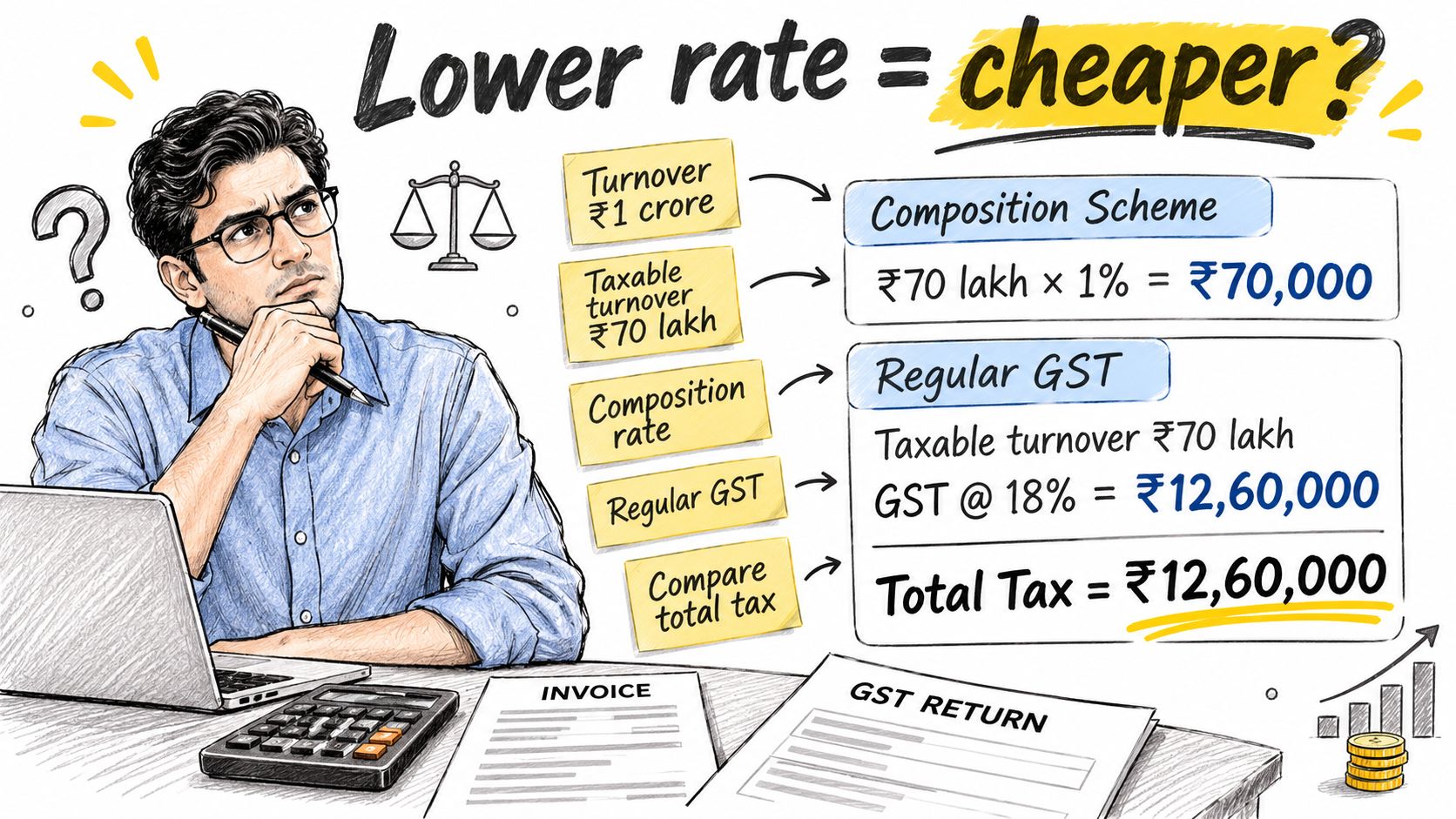
A low composition rate does not necessarily mean a lower tax cost. The CBIC composition rules set out the rate categories and scheme restrictions. To assess the cost, include the input tax that cannot be recovered.
A worked example with stated assumptions
Take a hypothetical trader with ₹1 crore of taxable turnover and ₹70 lakh of purchases carrying GST at 18%. Input tax paid is ₹12.6 lakh. The example holds price, margin, and buyer mix constant to isolate the tax effect, so those assumptions also limit what it can show.
Under composition, tax payable is 1% of ₹1 crore, or ₹1 lakh. The ₹12.6 lakh of input tax is not recoverable, so it remains part of the cost of goods and must be absorbed by the margin or reflected in the selling price. The composition cost therefore includes both the ₹1 lakh tax and the unrecovered input tax.
Under regular GST, output tax at 18% is ₹18 lakh. After ₹12.6 lakh of input tax credit, net tax is ₹5.4 lakh. The business charges GST separately, allowing a registered buyer to claim credit. The cash tax is higher, but the credit chain can reduce the buyer's economic cost.
What a proper decision model needs
- Taxable turnover: The base to which the composition percentage applies.
- Input-tax intensity: How much GST-bearing purchasing becomes unrecoverable cost.
- Customer mix: The share of sales to registered buyers who value credit on the invoice.
- Supply type: Whether supplies are goods, restaurant services, or other eligible services, since that determines the applicable rate category.
Low-margin businesses with heavy purchases face a particular trade-off: unrecovered input tax can take a significant share of profit even when it looks modest against turnover. The comparison should show the post-credit, post-margin cost under each option, not just the composition rate. A separate issue is a difference between reported and payable liability; the Rule 88C liability mismatch intimation process in Form DRC-01B addresses that kind of mismatch.
Compliance Duties Under the Composition Scheme
Composition reduces the volume of compliance. It doesn't remove the discipline, and the duties that remain are the ones clients are most likely to treat casually because the amounts look small.
Duties by period
- Quarterly payment and statement: File CMP-08 for each quarter and pay the composition tax with it, computed by applying the fixed rate to that quarter's turnover. Check the current GST CMP-08 composition due dates rather than relying on a date carried in someone's diary from a prior year.
- Annual return: File GSTR-4 for the financial year, reconciling the four quarters you've already paid against the year's turnover.
- Invoicing: Issue bills of supply with no GST shown as a separate charge, and don't let billing software default to a tax invoice format.
- Input tax credit: Claim none. Purchase invoices support cost, they don't reduce the composition tax payable.
- Records: Keep turnover by quarter and by supply type, so the eligibility test can be repeated cleanly at year end.
Two slips account for most of the trouble. The first is showing GST on the invoice, which invites the buyer to claim a credit the taxpayer can't support and creates a collection the scheme doesn't permit. Train the person at the billing counter, not just the proprietor, because that's where the error is typed.
The second is skipping CMP-08 for a quiet quarter. Low turnover reduces the tax, it doesn't remove the filing. A nil or near-nil quarter still needs to be dealt with, and a run of missed quarters is far harder to tidy up than any single late one.
Records deserve more respect than they usually get under this scheme. Because tax turns on turnover, your turnover record is effectively your tax computation. If sales are logged loosely, split between cash books, payment apps, and a billing system that nobody reconciles, the declared turnover is a guess and the eligibility conclusion built on it is a guess too.
I'd also reconcile bank credits to reported turnover every quarter, not at year end. That one check surfaces missed sales while the explanation is still fresh, and it gives you an audit trail that doesn't depend on the client's memory.
The scheme's simplicity is earned in the quarterly routine or lost there. A client who won't maintain turnover records isn't getting simpler compliance, just less visible non-compliance.
When a Client Must Exit and the Next Action
A client who crosses the applicable turnover limit during the year must leave the composition scheme from the date the limit is exceeded. The exit decision depends on the client's supply type, State and the threshold in force. The 2019 GST Council decision reported by PIB records a ₹1.5 crore goods threshold, a lower ₹75 lakh threshold for Uttarakhand and seven North-Eastern states, a 6% option for service and mixed suppliers, and a ₹50 lakh preceding-year ceiling for the services route. Check the applicable notification and effective date before advising a client.
The exit sequence
- Track turnover monthly: Compare cumulative turnover with the limit that applies to the client's supply type and State.
- Flag early: Use 75% of the applicable limit as a prompt to discuss pricing, billing and the transition to regular registration.
- Document the threshold: Record the notification, effective date and working used to determine the applicable limit.
- Complete the switch: Move to regular registration from the date required by law. For the final composition year, check the GST GSTR-4 annual due dates.
- Review stock credit and invoices: On switching to regular registration, check whether credit is available under section 18(4) of the CGST Act on eligible inputs, semi-finished goods and finished goods held in stock on the switch date. The credit is subject to statutory conditions and time limits. Issue tax invoices from the switch date.
Version confusion is the real risk
Older FAQs and explainers quote different thresholds, including ₹75 lakh, ₹1 crore and ₹1.5 crore. A figure without its effective date and the client's supply classification can lead to the wrong conclusion. Keep the notification relied on, its effective date, the State, the supply classification and the preceding-year turnover working in the client file.
State or business changes also warrant a fresh eligibility check. A move between a special-category State and a general one may affect the applicable ceiling. Adding a services line to a goods business may change which threshold applies. Review turnover and supply mix regularly so these changes are caught before filing.
Filing rule: When turnover approaches the limit, prepare for regular registration, the new invoice series and buyer communication before the threshold is crossed.
An exit also creates deadlines to manage alongside the work itself. Charter provides an unlimited compliance calendar for every client, keeping GST, TDS, ITR and client deadlines visible with reminders 7 days before, 1 day before and on the due date. Its annual plan costs ₹14,999 plus GST per year, shown as ₹1,250 a month and billed yearly.
A useful portfolio check is to compare each client's turnover with the applicable limit and group clients as below 75%, between 75% and 100%, or above the limit. The first group needs routine monitoring; the second needs a discussion about pricing and the transition; the third needs an exit plan. This turns a rate-and-threshold question into a documented decision for each client.
If your firm tracks composition limits, CMP-08 quarters and GSTR-4 filings across clients, Charter AI provides an unlimited compliance calendar, unlimited GSTR-2A/2B reconciliation and source-linked drafting in one workspace for Indian CA practice.