
Automated Bookkeeping Software for Indian CA Firms
Compare automated bookkeeping software for Indian CA firms. Evaluate document ingestion, ledger suggestions, TallyPrime export, GST reconciliation and cost
Published 15 min read
It's Friday evening in a mid-size CA firm, and the room still feels like a war zone. Tally's open, a stack of vouchers is half-typed, client teams are pinging for GST answers, and GSTR-2B mismatches are already waiting for Monday morning attention. That's the point where automated bookkeeping software stops being a nice-to-have and starts looking like the only way to keep the practice from drowning in retyping, rechecking, and apology calls.
The wrong way to buy this software is to ask which product has the slickest OCR. The right way is to ask whether it can ingest, suggest, post, export, and reconcile without breaking your evidence trail or your Tally workflow. In Indian practice, those are not separate features. They're the five jobs that decide whether the system helps you scale or just moves the mess to a different screen.
| Capability | What it should do in Indian CA practice | What usually fails |
|---|---|---|
| Document ingestion | Read bank statements, invoices, and structured GST data | Misses fields, or depends on clean PDFs only |
| Ledger suggestions | Propose the right ledger from known patterns and text cues | Confuses unusual vendors or one-off charges |
| Rule-based posting | Apply arithmetic and statutory checks consistently | Lets bad mappings slip through unchecked |
| TallyPrime export | Preserve GSTIN, invoice numbers, tax split, and voucher type | Re-typing, duplicate entries, broken syncs |
| GST reconciliation | Classify matched, missing, and mismatched items | Dumps exceptions into a spreadsheet and calls it automation |
Table of Contents
- Why Indian CA Firms Are Re-evaluating Automated Bookkeeping Now
- The real workload is not data entry, it's exception control
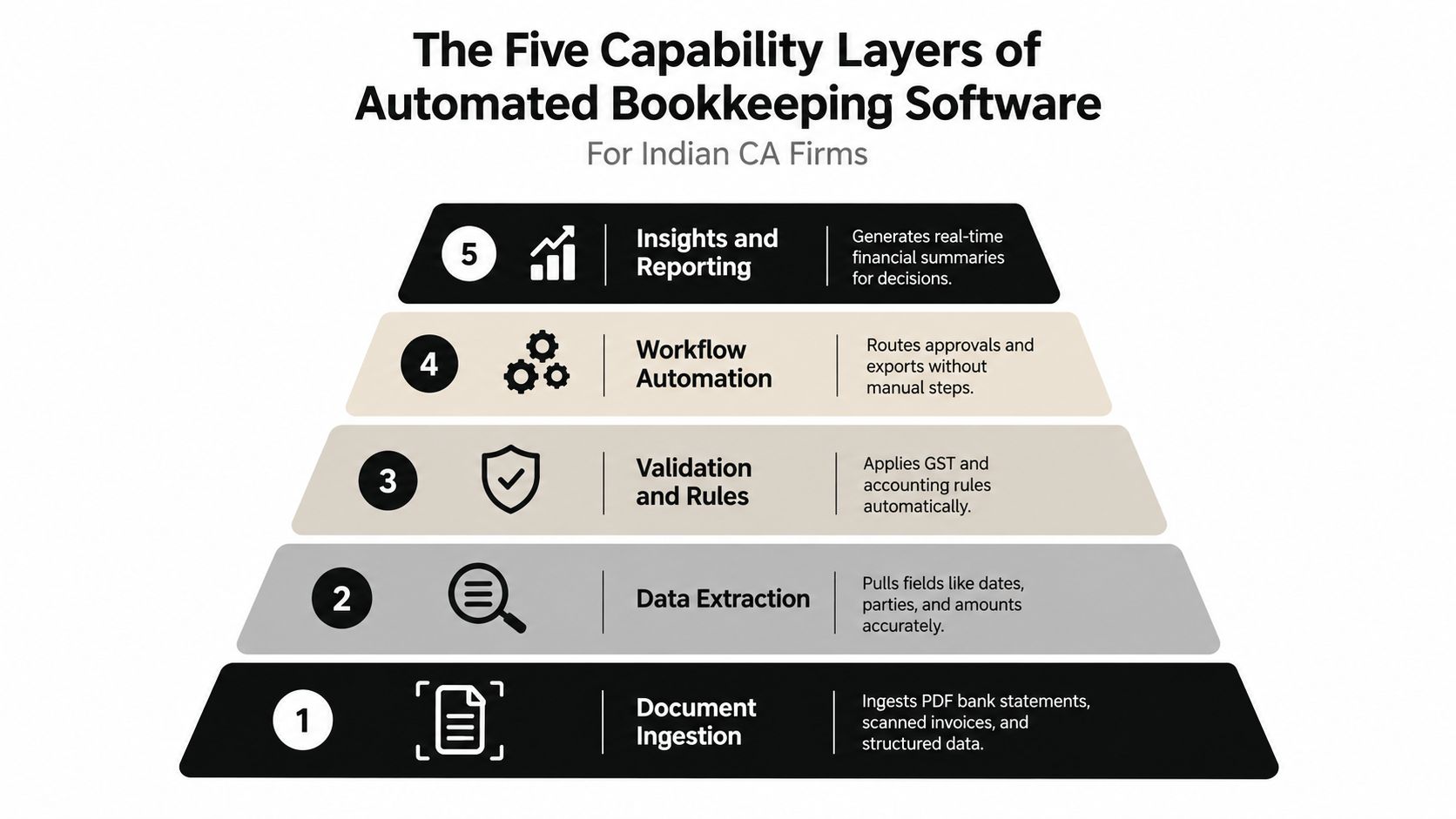
- The Five Capability Layers of Automated Bookkeeping Software
- Layer 1 and Layer 2 are not enough on their own
- Validation, posting, export, and reconciliation are the layers that matter
- Rule-Based Posting vs AI Ledger Suggestions
- Use rules for anything that must be defensible
- TallyPrime Voucher Export Without the Re-typing
- Export has to carry the full accounting context
- The failure modes are what you should interrogate in a demo
- Reconciliation Cadence and What It Reveals About a Tool
- Cadence is a software test, not just an operations habit
- Why Verification Trumps Accuracy in AI Bookkeeping Output
- Accuracy on average is not enough for professional liability
- Cost and Scale Considerations by Firm Size
- Read the pricing model, not just the headline fee
- A 90-Day Rollout Plan for Evaluating and Adopting the Tool
Why Indian CA Firms Are Re-evaluating Automated Bookkeeping Now
The pressure didn't appear overnight, it built up as GST digitised the whole bookkeeping environment. The e-invoicing system was planned for voluntary use from 1 January 2020, then delayed because of technical constraints and the COVID-19 pandemic, before being introduced on 1 October 2020 for taxpayers with aggregate turnover above ₹500 crore, according to the GST e-invoice FAQ and system overview (official FAQ on GST e-invoicing). That shift tied invoice creation directly to government authentication and reporting, so your books are no longer a private ledger, they're part of a larger compliance architecture.
The real workload is not data entry, it's exception control
A modern stack has to do five things well. It must ingest bank statements and invoices, suggest ledgers under consistent rules, post deterministically, export clean vouchers to TallyPrime, and reconcile against GST data and transport records without losing the audit trail. That matters because the GST ecosystem is now operating at enormous scale, with 1.70 crore registered taxpayers, 199.12 crore total returns filed, 833.82 crore e-way bills, and 3,053 crore total invoice uploads reported by GSTN as of 30 September 2026 (GSTN statistics).
Manual review doesn't fail because staff are careless. It fails because the volume and structure of the data make human-only matching slow, inconsistent, and expensive. The right question for partners is no longer whether to adopt automation. It's whether the tool can protect the firm from missed invoices, duplicate postings, and GST mismatches before those issues reach review or filing.
Practical rule: if a tool can't explain why a voucher was created and what it matched against, it's not ready for Indian compliance work.
For Indian CA firms, that means software selection has become a procurement decision, not a trial-and-error purchase. You're not buying a prettier data-entry layer. You're buying a control system that sits between client documents, GST data, and the final books.
The Five Capability Layers of Automated Bookkeeping Software
A vendor demo can look impressive while still being weak where it matters. The only useful way to compare automated bookkeeping software is by capability layer, not by feature checklist. If a tool only does the first layer well, you've bought document capture, not bookkeeping automation.
Layer 1 and Layer 2 are not enough on their own
Document ingestion is the bottom layer. It should read PDF bank statements, scanned invoices, and structured e-invoice data without forcing your team to clean every file first. Data extraction sits above it, pulling out dates, parties, tax amounts, GSTINs, and invoice references accurately enough for downstream accounting work.
That's useful, but it's still not bookkeeping. Many tools stop here and then market the result as automation. They've only digitised the input. They haven't decided what the entry means, what ledger it belongs to, or whether it should even be posted yet.
Validation, posting, export, and reconciliation are the layers that matter
The third layer is validation and rules. Arithmetic checks, GST treatment, duplicate detection, and statutory logic should run without guessing. If the software can't flag a mismatch before posting, it's leaving the hard part to your staff.
The fourth layer is workflow automation. In Indian practice, that means routing exceptions, approvals, and reprocessing without manual chasing. The fifth layer is insights and reporting, which should surface what's matched, what's blocked, and what still needs review. If your vendor can't show all five layers working together, the product is incomplete for CA use.
A useful test is simple. Ask the vendor to trace one vendor invoice from upload to ledger suggestion to voucher export to reconciliation status. If they jump between screens or hand-wave the exception path, the system is too shallow for serious GST work.
Rule-Based Posting vs AI Ledger Suggestions
Firms waste the most money here. They buy a tool that uses AI to suggest ledgers, then assume the same system can safely post everything. That's bad practice. In Indian bookkeeping, the safer model is rules for control, AI for assistance.
Use rules for anything that must be defensible
A bank charge should map to the right ledger under a fixed rule. GST arithmetic should be checked deterministically. Voucher class, tax split, and statutory logic should be consistent every time. That is what rules are for, and they're the part of the system you want to trust most.
AI is better used when the document is messy, the vendor is unfamiliar, or the wording on the invoice isn't standard. It can read text, propose a ledger, and draft a reason for review. But it should not be the final authority when the transaction is novel or high-risk.
| Dimension | Rule-based posting | AI ledger suggestion |
|---|---|---|
| Determinism | Consistent and repeatable | Context-sensitive and variable |
| Audit traceability | Strong, easy to document | Depends on evidence capture |
| Novel transactions | Weak on unfamiliar patterns | Better at proposing a first draft |
| Review effort | Lower for routine items | Higher for edge cases |
| Statutory-check integration | Direct and dependable | Needs validation around it |
A strong stack uses AI to reduce typing, not to replace judgement. That's the right split for Indian firms because the final books may support GST reconciliations, notices, and audit review later. If a ledger suggestion can't be reconstructed months later, it's a liability, not an efficiency gain.
Bottom line: let rules book the predictable items, let AI assist with reading and explanation, and keep humans on the exceptions.
If you're evaluating whether a workflow can survive real client pressure, compare it against how a proper trial balance to balance sheet workflow preserves source logic and reviewability. That's the standard to use, not a demo with polished icons.
TallyPrime Voucher Export Without the Re-typing
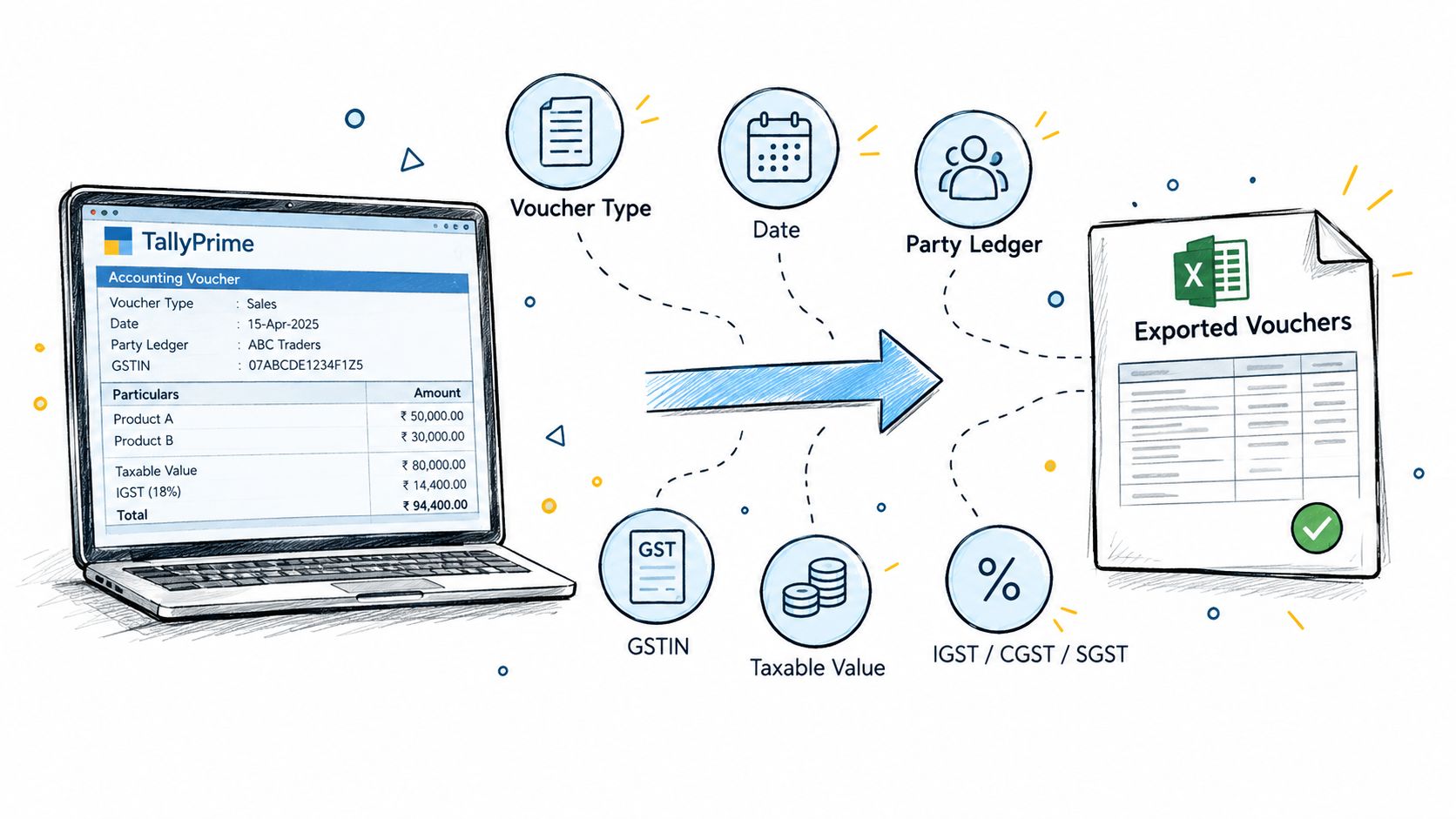
Voucher export deserves its own buying criterion because many tools fail here. A system that reads invoices well but breaks during export is still creating manual work. For a CA practice, that means the software must preserve the actual accounting structure, not just the document image.
Export has to carry the full accounting context
At minimum, the exported voucher should preserve voucher type, date, party ledger, GSTIN, taxable value, IGST/CGST/SGST break-up, invoice reference, and cost centre where relevant. If any of those fields are dropped or flattened, your team ends up fixing the export by hand, which defeats the entire point.
This is also where identifiers matter. The invoice number and GSTIN have to survive the handoff so that TallyPrime doesn't become a second source of truth with different metadata. If the tool is serious, it should preserve the original references and export them in a form your accounting team can use immediately.
The failure modes are what you should interrogate in a demo
Look for duplicate detection, field-level error reporting, and safe reprocessing of failed synchronisations. If the system goes offline or the Tally instance isn't available, it should queue the export rather than create a duplicate later. A good vendor will show you exactly how failed vouchers are retried and how the system prevents double posting.
This is also where pricing claims should be read carefully. Unlimited voucher export is valuable only if the integration remains stable under load and the failed items are recoverable. Don't let a marketing page turn export volume into the only metric. Reliability is the metric that matters in production.
If you're watching a demo, ask the team to export a batch, break the connection, and then reprocess it. That tells you more about the product than any dashboard screenshot.
Reconciliation Cadence and What It Reveals About a Tool
The best reconciliation system doesn't just match items, it changes the rhythm of the firm. In a six-month case study of a Pune-based GST advisory firm, increasing reconciliation from monthly to weekly, along with structured vendor follow-up, lifted the matched-invoice rate from 84% to 95% (study PDF). The exceptions that caused the most friction were GSTIN errors and invoice-value mismatches, which made up more than half of the reconciliation exceptions in that study.
Cadence is a software test, not just an operations habit
A good platform should segment items into matched, missing, GSTIN-error, and value-mismatch buckets. It should also let partners track resolution rates over time, not just display a static exception count. If you can't see whether a supplier's mismatches are being resolved faster this month than last month, you don't have a control system, you have a spreadsheet wrapper.
The cadence question matters because digital adoption is already widespread enough to create mixed workflows. A 2025 MSME digital-index report found that 30% of respondents used accounting tools, which is material but not universal (PayNearby MSME Digital Index Report 2025). That means your software has to work across a reality of partial digitisation, not a clean, idealised stack.
Weekly reconciliation isn't busywork. It's a way to surface errors while the source documents and supplier conversations are still fresh.
For pilots, I'd use two simple metrics. First, the exception-resolution rate by category. Second, the time to resolution from mismatch detection to a defensible client answer. Those two numbers tell you more about the tool's real value than document throughput ever will.
Use the software to enforce a weekly rhythm before you ask it to scale. If the system can't support that cadence without creating more noise, it's not mature enough for a firm that files regularly under GST pressure. For a practical internal benchmark, you can map those checks against your reconciliation workflow in this bank reconciliation tool.
Why Verification Trumps Accuracy in AI Bookkeeping Output
The sales pitch around AI bookkeeping usually goes the wrong way. Vendors talk about OCR accuracy, automatic categorisation, and fewer manual entries, as if that alone settles the question. It doesn't. The issue is whether the output can be verified later, line by line, when a partner, client, or tax officer asks why a voucher was posted.
Accuracy on average is not enough for professional liability
The official e-invoicing overview makes the two-system problem clear. Taxpayers create invoices in their accounting or ERP system, then report invoice data to the Invoice Registration Portal in the prescribed schema, which means the control problem sits between your books and the government system (GST eInvoice system detailed overview). If the software only gives you a suggested entry without a traceable path from source to posting, it leaves the hard part unresolved.
The cautionary side is not theoretical. In an India-focused MSME study, 58% of surveyed firms reported higher operating expenses tied to software purchases, consultancy, and penalties, even though 68% were already using digital GST or accounting tools (same GST e-invoice overview section references the control model; MSME study). That's the warning sign. Digitisation can increase complexity if the system posts entries without explaining mismatches, source conflicts, or tax treatment.
The fix is an automation with controlled exceptions model. Deterministic rules handle arithmetic and statutory checks. AI reads documents and drafts explanations. Every material posting needs an evidence package attached to it.
That package should include the original invoice, the rule applied, the GST treatment, the reviewer's identity, and the edit history. If the vendor can't preserve that, don't buy it for compliance work. Verification is what keeps automation usable when an audit trail is challenged.
Cost and Scale Considerations by Firm Size
Pricing pages are full of distractions. The question isn't whether the subscription is cheap. It's whether the cost model fits your volume, your review process, and your tolerance for integration failure. The wrong pricing structure can make an otherwise decent tool uneconomic within months.
Read the pricing model, not just the headline fee
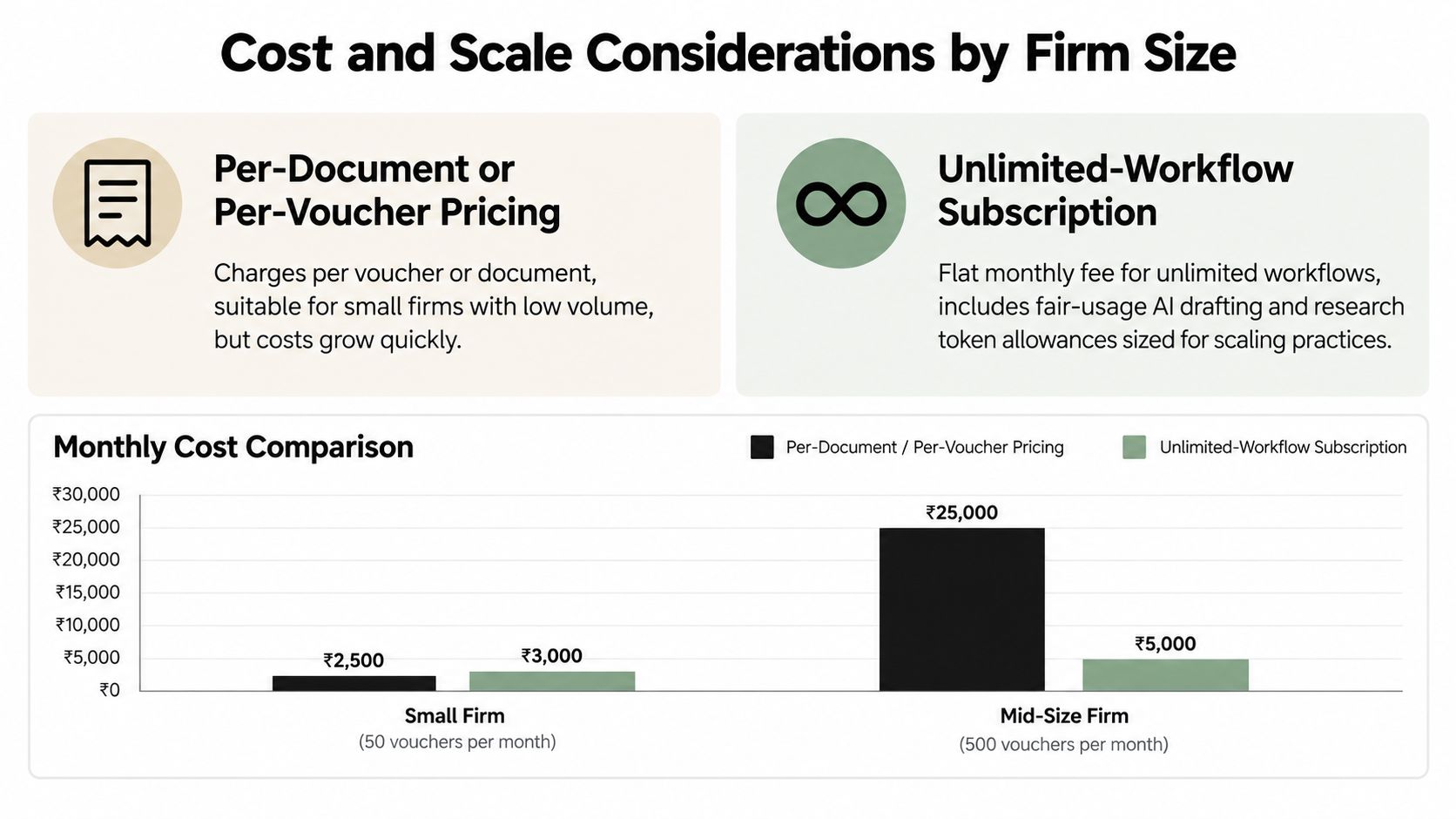
Per-document or per-voucher pricing works when volume is low and stable, but it punishes growth. Unlimited-workflow subscriptions are easier to budget when a firm is scaling, especially if they include fair-usage AI drafting and research token allowances sized for normal workloads. The hidden cost is almost always implementation, not the licence fee.
| Firm size | Better pricing model | What to watch |
|---|---|---|
| Solo CA | Per-document may be acceptable if volume is predictable | Training time, export quality, and exception handling |
| Mid-size firm | Unlimited workflows usually make more sense | Integration resilience and partner review cadence |
| Multi-branch practice | Subscription plus strong controls is the safer fit | Centralised exception queues and traceable approvals |
A small firm can tolerate some manual cleanup if the workflow is simple. A mid-size practice cannot. By the time vouchers, approvals, and reconciliations cross multiple clients and staff, the cost of rework becomes a primary budget line.
You should also separate software cost from implementation cost. Staff training, exception-queue design, and partner review routines all take time. If the vendor can't help you build those controls, the price on the proposal is incomplete. For a pricing benchmark, review the structure on this plan page and compare it against your actual monthly voucher flow, not your optimistic forecast.
A 90-Day Rollout Plan for Evaluating and Adopting the Tool
Start with two pilot clients that have high invoice volume and messy Tally histories. Document the current matched-invoice rate, the exception categories, and who handles each follow-up. Run parallel posting for four to six weeks, then measure how many items the system can classify cleanly without partner intervention.
In weeks seven to ten, tighten the rules and decide which vouchers get sample review versus auto-approval. Define the evidence package required for AI-generated postings, then train the team to use the same checklist every time. By weeks eleven and twelve, extend the workflow to five clients and lock in SLAs around exception-resolution rate and reconciliation cadence.
Charter AI gives Indian CA firms an AI-enabled workspace for bookkeeping, GST reconciliation, Tally export, and compliance workflows in one client-centric system. If you want a stack that treats verification, exception handling, and traceable voucher export as first-class controls, visit Charter AI and see how it fits your practice.
Written with Outrank tool
Tags
Related guides
- How do I reconcile GSTR-2B against my purchase register step by step?
- Why does my GSTR-2B not match my purchase register: what are the common root causes?
- My invoice number format doesn't match what the supplier filed: will Tally still match it?
- How do I import the GSTR-2B JSON file into Tally Prime?
- How do I reconcile GSTR-2A/2B in Zoho Books?