# What Is Input Tax Credit in GST? Rules and Examples
What is input tax credit in GST? Learn eligibility, blocked credits, time limits, GSTR-2B matching and tax-head rules, with worked examples for CA firms.
Published 9 Nov 2026. 16 min read.
Input tax credit is the GST a registered business has paid on eligible business purchases, which it can set off against the GST it collects on sales. On a purchase of ₹1,00,000 carrying ₹18,000 of GST, that ₹18,000 can bring a ₹30,000 bill of GST on sales down to ₹12,000 of cash GST payable, but only if the claim survives eligibility, timing and tax-head rules.
You are probably staring at a healthy figure in the electronic credit ledger a day before GSTR-3B, wondering why the cash challan is still not zero. A large credit balance is a claim in progress, not a promise that this month's tax will be paid entirely from that balance. The credit has to clear business use, a valid document, supplier reporting, a payment clock and the order in which tax heads may be set off. Miss one of those, and the ledger number stays on screen while cash still leaves the bank.
## Table of Contents
- [What Input Tax Credit Means in GST](#what-input-tax-credit-means-in-gst)
- [Who Qualifies and Which Credits Are Blocked](#who-qualifies-and-which-credits-are-blocked)
- [What Section 17(5) keeps out](#what-section-175-keeps-out)
- [Capital goods and the double claim](#capital-goods-and-the-double-claim)
- [Time Limits and Payment Rules That Cost Credit](#time-limits-and-payment-rules-that-cost-credit)
- [The 180-day payment reversal](#the-180-day-payment-reversal)
- [Matching GSTR-2B With Your Purchase Register](#matching-gstr-2b-with-your-purchase-register)
- [Four ways the books and 2B part company](#four-ways-the-books-and-2b-part-company)
- [Why Credit Balance Does Not Always Mean No Cash Tax](#why-credit-balance-does-not-always-mean-no-cash-tax)
- [What credit is not allowed to pay](#what-credit-is-not-allowed-to-pay)
- [The Journey and Pre-Claim Check](#the-journey-and-pre-claim-check)
- [What to run before GSTR-3B](#what-to-run-before-gstr-3b)
## What Input Tax Credit Means in GST
**Input tax credit** is the GST charged on eligible inward supplies that a registered person may use to reduce the GST payable on outward supplies. [Section 16(1) of the CGST Act, 2017](https://charterai.in/law/cgst-act-2017) creates that entitlement for supplies used in the course or furtherance of business, and the [CBIC circular on credit conditions](https://cbic-gst.gov.in/pdf/circular-231.pdf) treats it as a reduction of tax, not an automatic cash benefit.
Without this set-off, the same value would be taxed again at every stage of the supply chain. A manufacturer would pay GST on raw material, a wholesaler would pay GST on a price that already included that earlier tax, and the retailer would do the same. Credit is meant to stop that **cascading**, so the net tax in the chain falls on value added rather than on the full price at every handoff.
Say a trader buys inputs worth **₹1,00,000** and the supplier charges **₹18,000** of GST. Those inputs go into sales on which customers are charged **₹30,000** of GST. If the ₹18,000 is eligible, cash GST payable is **₹12,000**. The ₹18,000 was tax paid upfront on inputs. It comes back as a set-off, not as a cheque from the department and not as a line that reduces profit in the profit and loss account.
| Item | Amount | Effect on GST payable |
| --- | --- | --- |
| Taxable purchase of inputs | ₹1,00,000 | Taxable value on which purchase GST was charged |
| GST charged on purchase | ₹18,000 | Input tax credit if eligible |
| GST collected on sales | ₹30,000 | Output tax liability |
| Cash GST payable after credit | ₹12,000 | Output GST minus eligible credit |
That cash figure appears only after the paperwork holds. The recipient needs a valid tax invoice or other prescribed document, must have received the goods or services, must see that the tax has been paid to the Government, and must furnish the required return. Credit also fails where depreciation has already been claimed on the GST component of capital goods.
> **Practical rule:** ITC reduces GST payable. It is not a cash refund, and it is not an expense deduction you can take as well as the credit.
Composition taxpayers under Section 10 pay tax at a flat rate and cannot claim this credit. The entitlement belongs to regular registered persons. Your first check on any purchase is simple. Does the invoice carry GST, and does that GST belong to business use?
## Who Qualifies and Which Credits Are Blocked
A purchase reaches the **electronic credit ledger** only when four conditions in Section 16(2) are all true. You hold a valid tax invoice or debit note. You have received the goods or services, including under a bill-to-ship-to arrangement where the law treats receipt as complete. The supplier has paid the tax to the Government. You have filed the return in which the claim is made. Drop any one of those and the credit does not belong in the ledger yet, even if the invoice looks perfect.
Section 16(1) of the CGST Act then applies the **business-use test**. The [updated CGST Act text](https://cbic-gst.gov.in/pdf/CGST-Act-Updated-01082021.pdf) ties entitlement to supplies used or intended to be used in the course or furtherance of business. A firm buying a delivery van to carry its own goods generally has a business nexus. A director buying a car for private weekends does not. Eligible input GST reduces net cash GST payable. Ineligible or blocked credit stays inside cost.
### What Section 17(5) keeps out
Section 17(5) blocks named categories even when the invoice is valid and the supplier has paid the tax. A hotel can claim credit on kitchen equipment and on building materials used for its taxable business. It cannot claim credit on staff food, because food and beverages sit in the blocked list unless a statutory exception applies. The same invoice file can hold both an eligible line and a blocked line. Split them before anyone posts the full GST to the ledger.
| Category | Status | Exception or note |
| --- | --- | --- |
| Motor vehicles and conveyances for passengers | Blocked | Exceptions for passenger transport for hire, driving training, goods carriage or further supply of such vehicles |
| Food, beverages and outdoor catering | Blocked | Exception where provided to employees under a legal obligation |
| Beauty treatment, health services and cosmetic surgery | Blocked | Exception where used for further supply of the same services |
| Club, health or fitness centre membership | Blocked | Exception where further supplied as a taxable service |
| Rent-a-cab, life insurance and health insurance | Blocked | Exception where health insurance is mandatory for employees under law |
| Travel benefits extended to employees | Blocked | Check the specific exceptions in the statute before claiming |
| Works contract and construction of immovable property | Blocked | Exception for plant and machinery, subject to conditions |
| Goods or services for personal consumption | Blocked | Business use must be proven |
| Goods lost, stolen, destroyed, written off or given free | Blocked | Applies even where a valid invoice exists |
Read the exception column before you reject a line. Passenger vehicles are blocked for ordinary office use, yet the same vehicle can be eligible when the business is passenger transport, driving training, or further supply of such vehicles. Health insurance is blocked as a staff perk, yet it can pass when the law itself forces the employer to provide it.
### Capital goods and the double claim
You also cannot take the credit twice, once as an expense and again as ITC. On capital goods the control is sharper. Where depreciation is claimed on the GST component of capitalised cost under the Income-tax Act, ITC on that tax component is not allowed. The depreciation policy and the GST claim are one decision. If the tax is capitalised and depreciated, that slice of GST is gone as credit.
Where a business makes both taxable and exempt supplies, Section 17(2) requires reversal of the credit attributable to the exempt supplies. Only the taxable share stays claimable. Common inputs, such as rent or electricity for a mixed shop, need an apportionment rather than a full claim.
Before a purchase is posted, record four things on the voucher itself.
- **Business nexus:** what the purchase does in the business, in one line.
- **GSTIN:** the supplier's number as printed, matched to the invoice.
- **Tax component:** IGST, CGST, SGST or cess, kept separate.
- **Blocked-credit risk:** clear, blocked, or blocked unless a named exception is met.
## Time Limits and Payment Rules That Cost Credit
A valid invoice can still stop producing a usable credit if you miss a statutory deadline or leave the supplier unpaid too long. These are separate tests: one sets the last date for claiming ITC, while the other can require a reversal after credit has already been claimed.
Under **section 16(4)**, a registered person generally cannot claim credit for an invoice or debit note after **30 November** following the end of the relevant financial year, or the date of furnishing the relevant annual return, whichever is earlier. The [CBIC circular on the 2024 time-limit changes](https://cbic-gst.gov.in/pdf/circular-237-31-2024-GST.pdf) states the rule in those terms. For an invoice from financial year 2024–25, the ordinary deadline is **30 November 2025**, unless the annual return is furnished earlier. An earlier return date takes precedence.
### The 180-day payment reversal
If you claim ITC but do not pay the supplier the invoice value plus tax within **180 days** of the invoice date, you must add the credit back to output-tax liability, with interest as prescribed. The CGST Act text sets out the 180-day payment condition and provides for reclaiming the credit in the GSTR-3B for the month in which the supplier is paid. Use the [monthly GSTR-3B due-date calendar](https://charterai.in/due-dates/gst-gstr3b-monthly) to track the return's filing date. Payment later does not erase the reversal already made, so track unpaid invoices before they cross the 180-day mark.
Debit notes have a separate timing rule. From **1 January 2021**, section 16(4) uses the debit note's issue date, rather than the underlying invoice date, to determine the relevant financial year. A debit note issued in April 2025 for a sale made in March 2024 therefore falls within the 2025–26 time window.
The Finance (No. 2) Act, 2024 inserted **sections 16(5) and 16(6)**, providing retrospective relief for specified earlier-period cases. The relief is limited to those cases, so confirm that the transaction qualifies before relying on it.
| Rule | Deadline or trigger | What happens |
| --- | --- | --- |
| General time limit under Section 16(4) | 30 November after financial year end, or annual return date if earlier | Credit for that invoice or debit note is lost |
| 180-day payment rule | Invoice value plus tax not paid to supplier within 180 days of invoice date | Credit is reversed with interest and reclaimable after payment |
| Debit note timing from 1 January 2021 | Financial year set by the debit note's issue date | Determines which deadline applies |
| Relief under Sections 16(5) and 16(6), added in 2024 | Specified earlier-period cases only | Limited retrospective relief; check eligibility |
Keep three dates against each supplier invoice: the invoice date, the payment date, and the applicable section 16(4) deadline. Sort the purchase register by the outer deadline as November approaches, and separately flag invoices that remain unpaid as they near 180 days.
## Matching GSTR-2B With Your Purchase Register
A purchase register can show an invoice that GSTR-2B does not, and GSTR-2B can show a credit the business cannot claim. The statement is a starting point for reconciliation, not a complete eligibility decision. The [GST portal's GSTR-2B FAQ](https://tutorial.gst.gov.in/userguide/returns/FAQ_gstr2b.htm) says taxpayers should reconcile it with their books and assess eligibility separately. GSTR-2B is a static statement generated from supplier filings in GSTR-1, GSTR-1A and GSTR-5, and ISD filings in GSTR-6. Import of services and some reverse-charge transactions may not appear in it.
When a purchase-register entry and the statement differ, classify the line before deciding whether to claim, hold or follow up.
### Four ways the books and 2B part company
**Missing from 2B.** The invoice is in your register, but the supplier has not reported it in GSTR-1. Keep the invoice, proof that the goods or services were received, and proof of payment. If you can establish those facts, you have grounds to contest a denial based only on the supplier's reporting lapse. That does not make every missing entry automatically eligible. If you receive a [Rule 88D DRC-01C intimation about an ITC mismatch](https://charterai.in/notice/gst-itc-mismatch-intimation-rule-88d-drc-01c), respond with the relevant records rather than a ledger screenshot.
**Present but blocked.** An entry can appear in 2B and still be ineligible. For example, an employee insurance premium may be blocked under Section 17(5) if no law requires the employer to provide it. Record the provision considered and why the credit does not meet an exception. A 2B entry is not, by itself, permission to claim.
**Eligible subject to conditions.** Some credits depend on a condition that remains open. If the claim depends on payment within 180 days, retain the bank record as evidence. Until payment is established, track the entry as conditional rather than treating it as fully cleared.
**Eligible through another compliance route.** Some transactions are not reflected in 2B, including import of services and certain reverse-charge transactions. For reverse-charge purchases, check whether the transaction appears in 2B rather than assuming it will be absent. Keep the self-invoice, where required, and the cash-ledger payment record for tax paid under reverse charge.
For each difference, tie a dated evidence file to the purchase-register row. Include the invoice, the relevant 2B extract or a note that no entry appears, the eligibility classification and any supplier follow-up. A “matched” or “unmatched” label alone will not explain the decision if the entry is questioned later.
## Why Credit Balance Does Not Always Mean No Cash Tax
A positive balance in the electronic credit ledger does not mean this return needs no cash. **ITC utilisation follows tax-head sequencing**, not the total of all heads added together. The [GST portal's utilisation principles](https://tutorial.gst.gov.in/userguide/returns/Utilization_Principles.htm) set the order. IGST credit is used first against IGST and may then be used against CGST or SGST/UTGST. CGST credit cannot be used against SGST/UTGST. SGST/UTGST credit cannot be used against CGST. Cess credit has no inter-head adjustment.
That is why a business can hold ₹50,000 of SGST credit and still pay **₹20,000 in cash** against ₹20,000 of CGST on its sales. The SGST pot cannot cross over. The portal will not "use the bigger balance" to clear the smaller head. Maximising the credit you claim does not maximise cash saved unless the mix of credit matches the mix of output liability.
| Credit head | Offsets first | Can then offset |
| --- | --- | --- |
| IGST | IGST | CGST or SGST/UTGST |
| CGST | CGST | IGST only |
| SGST/UTGST | SGST/UTGST | IGST only |
| Cess | Cess | No other head |
### What credit is not allowed to pay
Some liabilities never touch the credit ledger, however large it is. ITC cannot pay **reverse-charge liabilities, interest, penalties, fees or other non-tax amounts**. Those go out in cash. A month with a late fee, an interest line from an earlier short payment, and a reverse-charge purchase will show three cash items even when input credit covers every rupee of forward-charge output tax. Unusable cess credit creates the same illusion. The total looks comfortable, and the cess liability still needs a challan.
Before you file, line up each credit head against the output liability of that head, then add the cash-only items. The shortfall is the amount to keep in the electronic cash ledger, not a figure you discover after the return is submitted. A firm that sells mostly inside the state but buys mostly from other states will often be long on IGST and short on one local head. Plan the challan for that short head instead of waiting for the portal to refuse the set-off.
## The Journey and Pre-Claim Check
Treat every rupee of credit as a chain of six stages. It is usable only when the whole chain is complete, and it breaks at the first missing link.
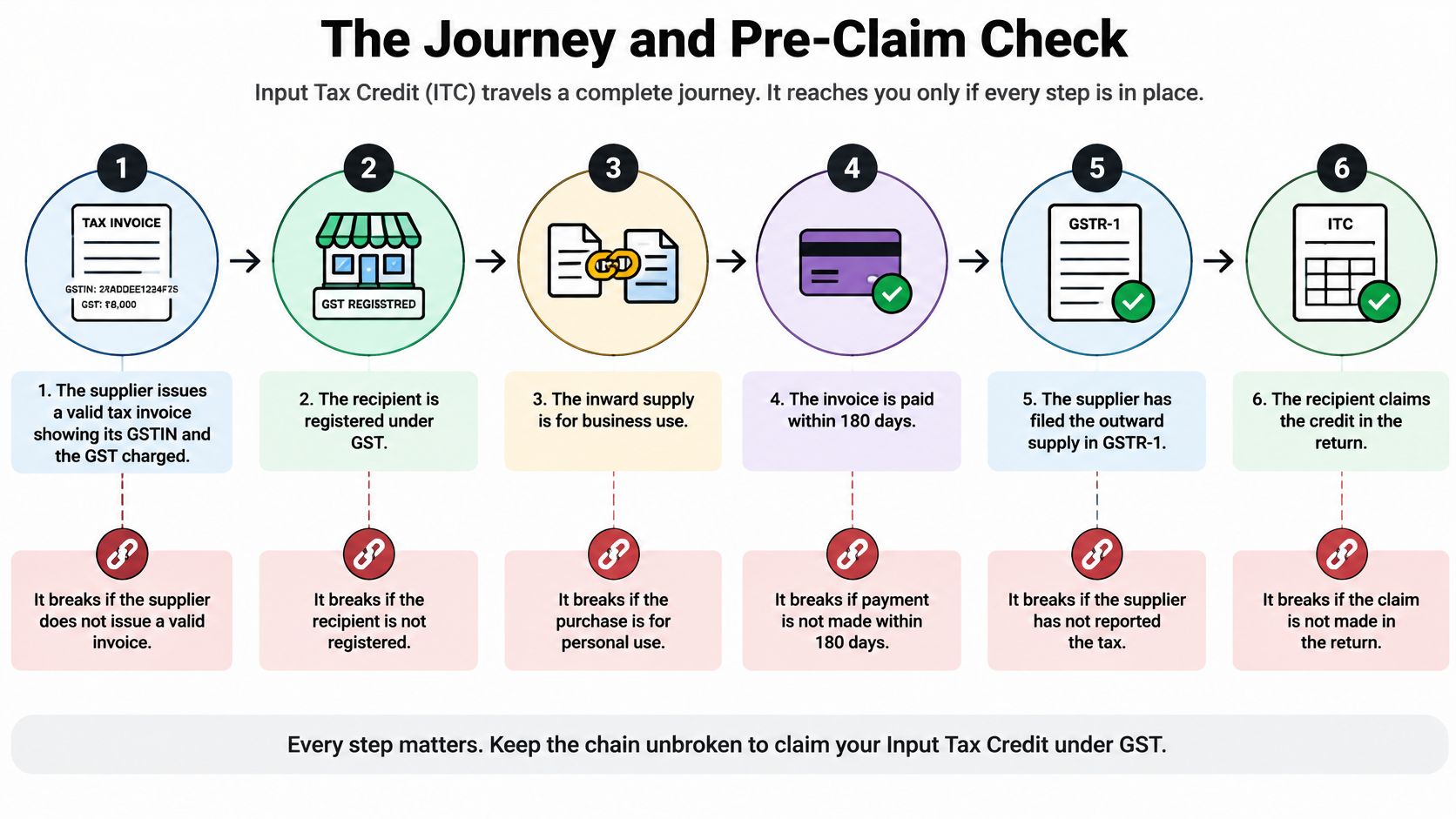
1. **The supplier issues a valid tax invoice** showing its GSTIN and the GST charged. The chain breaks if the invoice is missing, is in someone else's name, or shows the wrong tax.
2. **The supplier reports the sale in GSTR-1** for the tax period. The chain breaks when that return is not filed, which is why the line never reaches you.
3. **The purchase appears in your GSTR-2B.** A missing entry is classified the way any other books-versus-statement gap is classified, not ignored and not claimed blindly.
4. **You confirm receipt, business use and that the supplier's tax is paid.** Personal use, non-receipt, or a supplier who never deposited the tax stops the claim here.
5. **Eligible tax is credited to the electronic credit ledger.** A Section 17(5) category never reaches this stage, however clean the earlier papers were.
6. **You offset the credit against output GST in GSTR-3B** and pay any balance in cash. A tax-head mismatch leaves cash payable even though the ledger total looks enough.
Say a trader buys packing material on an invoice dated 5 June with GST of ₹9,000. The supplier files GSTR-1 for June. The credit shows in the GSTR-2B generated for July and is set off in the July GSTR-3B. If the June supplier return is late, July's 2B stays blank and the ₹9,000 waits. The invoice date does not move the credit forward by itself.
A short walk-through of the same chain, from invoice to return, is here.
### What to run before GSTR-3B
On filing day, take each open purchase through qualification, the November outer date, the 180-day payment position, the mismatch bucket, and the head-wise balance. Then compute the cash shortfall and fund it before you submit. Invoice, receipt, payment proof and the 2B extract stay in the same file as the register row. Charter AI estimates that a rules-based match of GSTR-2B to the purchase register saves about 4 hours on each reconciliation, roughly ₹4,000 of a CA's time at ₹1,000 an hour, because only the broken links need a human decision.
A credit that has finished this journey is the only credit that lowers the challan. Everything else is a balance that still has a condition attached.
---
If your firm is still reconciling input tax credit line by line before every GSTR-3B, Charter AI keeps GSTR-2B matching, notice replies on ineligible credit, and the client compliance calendar in one workspace built for Indian CA practices. You can trace each figure back to the return and the invoice instead of rebuilding the file when a mismatch notice arrives. See how that fits your GST desk at [Charter AI](https://www.charterai.in).
## Tags
- [Input tax credit](https://charterai.in/blog/tag/input%20tax%20credit)
- [ITC under GST](https://charterai.in/blog/tag/ITC%20under%20GST)
- [GSTR-2B reconciliation](https://charterai.in/blog/tag/GSTR-2B%20reconciliation)
- [Blocked ITC](https://charterai.in/blog/tag/blocked%20ITC)
- [GST credit ledger](https://charterai.in/blog/tag/GST%20credit%20ledger)
Canonical: https://charterai.in/blog/what-is-input-tax-credit-in-gst