
Tax Audit Software Compared: How to Choose the Right Tool
Compare tax audit software on working papers, checklists, automated depreciation and limit tests, reports and audit trails for Indian CA firms.
Published 16 min read
If the matching engine cleared every invoice and the form filled itself, could a partner still defend that figure eighteen months later, from the source document through the rule, the adjustment and the clause?
Speed of matching is not the same thing as a conclusion a human can reproduce. Most tax audit software is sold on how fast it fills returns and flags differences. The harder test is whether a reviewer who was not in the room can open the file, see why a mismatch was accepted or rejected, and stand behind that choice when a notice arrives.
Table of Contents
- Why Indian CA Firms Need Tax Audit Software
- What the daily file actually needs
- Five Capabilities Every Tax Audit Tool Should Cover
- The five, and what to click in a demo
- Working Paper Management and Section Checklists Compared
- Which workflow fits the firm
- How to test attachment
- Testing Depreciation, Limits and Reconciliations Automatically
- What a fixed rule can actually prove
- Why portal data is not a control
- An exception-first log
- Report Generation and Compliance Traceability in Practice
- One amount, five stops
- What the evidence pack must contain
- Matching Tool Choice to Firm Size and Practice Mix
- Where automation should stop
- Choosing Your Tax Audit Software and Next Steps
- A test you can run this week
Why Indian CA Firms Need Tax Audit Software
Filing automation does not close a tax audit. It only changes the medium in which the same professional risk travels.
India's tax-audit workflow is now an electronic filing under Section 44AB. The prescribed route is Form 3CA or Form 3CB, paired with Form 3CD, the detailed statement of particulars. Form 3CD was last substituted by the Income-tax (Seventh Amendment) Rules, 2014, with effect from 25 July 2014, and it is filed online through the Income Tax Department's e-filing portal. That shift moved preparation away from paper and loose spreadsheets toward structured capture, validation, document generation and electronic submission.
A useful tool has to keep two objects apart. The audit report is the format, Form 3CA or 3CB. The particulars sit clause by clause inside Form 3CD. Software that prints a neat report without storing the clause-level evidence has only finished the last step. It has not done the audit.
What the daily file actually needs
Three jobs follow from that structure.
- Capture with a home: Each particular needs a source, not a typed total that nobody can reopen.
- Validate before upload: Missing clauses, inconsistent books and tax computations should fail inside the firm, not on the portal.
- Generate from stored work: The report should be a print of reviewed data, not a fresh document assembled on the due date.
Before any of that, a team still has to decide whether the audit applies. Our tax audit applicability check answers six questions and is a sensible first filter, so a full working-paper set is not built for a client who is outside the threshold.
A portal acknowledgement proves that a file was received. It does not prove that the particulars inside it can be defended.
Scepticism belongs on any claim that “automation” equals audit quality. The regulatory design asks for clause-based disclosure, preserved evidence and consistency across books, tax computation and reported particulars. A tool that cannot show that chain is a form filler.
Five Capabilities Every Tax Audit Tool Should Cover
Volume makes those design choices operational, not theoretical. As of 15 February 2022, the Income Tax Department reported more than 29.8 lakh major Tax Audit Reports on its e-filing portal for financial year 2021–22, including 2,65,153 Form 3CA-3CD filings and 24,48,950 Form 3CB-3CD filings. On the extended due date itself, more than 4.14 lakh major reports and forms were filed. 14% of those statutory forms landed on the final day, and 30% during the last five days, from 11 to 15 February 2022, according to the department's press release.
That clustering is why batch processing, deadline tracking and an audit trail are foundational. A demo that looks fine on one client will fail when a third of the firm's reports arrive in five days.
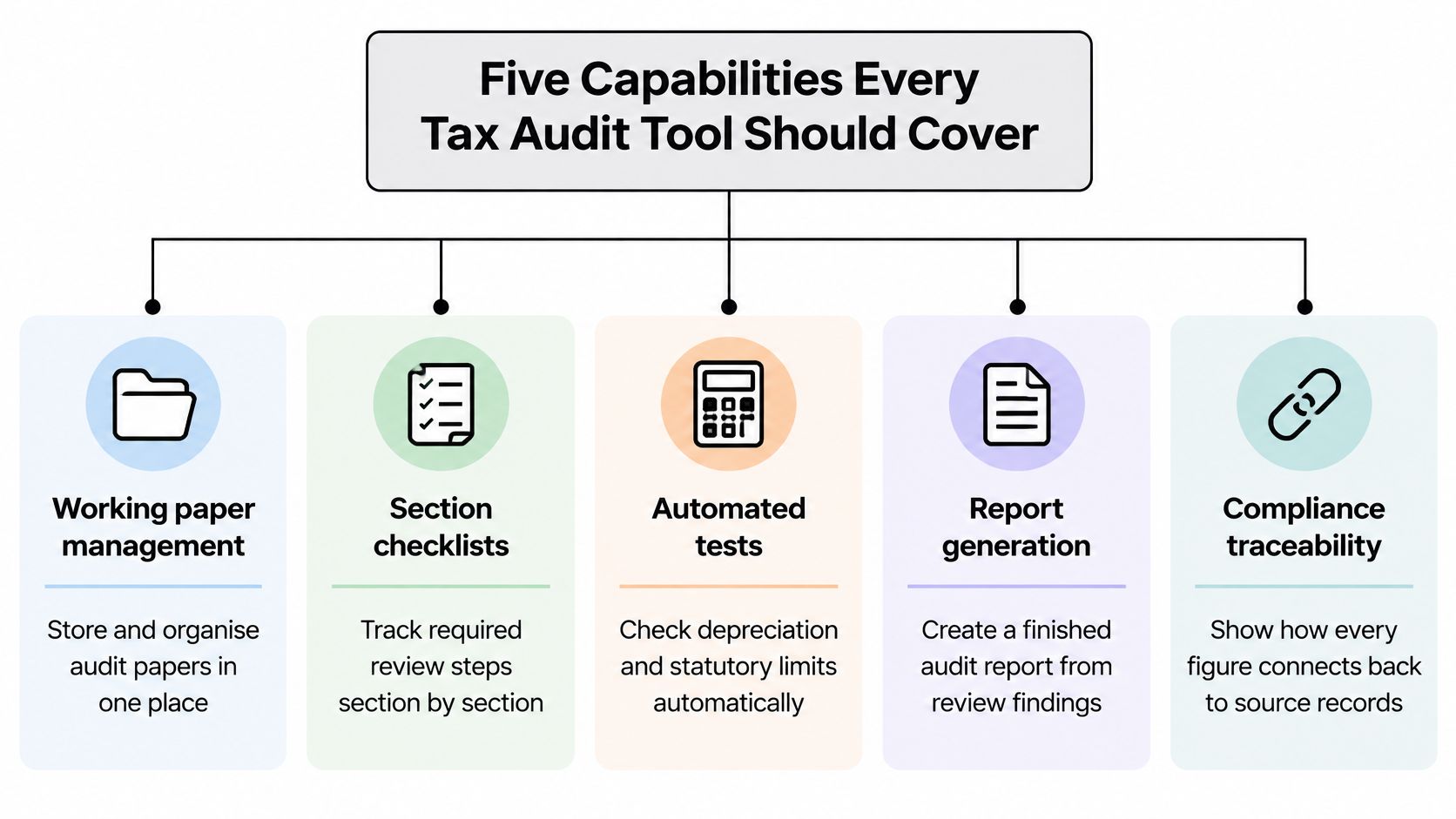
Treat the five capabilities below as one test, not five brochures. Each one fails if the next one cannot read its output.
The five, and what to click in a demo
Working paper management stores and organises the papers, with the source file still attached to the figure. Ask to reopen last year's verified client master and see whether this year's file inherits it or asks someone to retype it.
Section checklists track review steps clause by clause against Form 3CD. A checklist that says “done” without a sign-off name and a date is a sticker.
Automated tests check depreciation, cash limits and other statutory thresholds. In a serious product the limit, the rate and the date last reviewed are visible. Hidden formulae are not a test. They are a black box.
Report generation builds the finished report from those findings. If a reviewer changes one particular, the clause text and the annexure should move with it.
Compliance traceability shows how every figure connects back to source records, the rule applied and the person who accepted an exception.
Run the demo on a file that already has a known error. A tool that only looks good on clean data has not been tested.
The insight is simple. These five are one chain. Working papers without a checklist miss clauses. Checklists without tests miss arithmetic. Tests without a report leave the partner rewriting. A report without traceability cannot be reopened when the assessment starts.
Working Paper Management and Section Checklists Compared
Working papers and section checklists answer different questions, and firms that buy only one of them usually discover the gap in March.
A working paper ties a figure to its source. The purchase register line, the invoice and the ledger entry sit on the same page as the amount that will later appear in a clause. A section checklist confirms that each Form 3CD clause has been considered and signed off. Overlap exists where a clause is itself a schedule, such as depreciation or related-party disclosure. They diverge where the checklist can be ticked from memory while the paper still has no document behind it.
| Criterion | Working paper management | Section checklists |
|---|---|---|
| Evidence attachment | Source file sits on the figure | Often only a tick, unless the tool forces an attachment |
| Review trail | Shows who changed the amount | Shows who signed the clause |
| Multi-year clients | Prior-year papers and masters carry forward | Prior-year ticks are a weak guide to this year's facts |
| Reuse of verified data | Strong, if masters are versioned | Weak, unless the checklist reads the same master |
| Best fit | Firms with heavy bookkeeping and document volume | Firms that miss clauses more often than they miss documents |
Which workflow fits the firm
A small team with a handful of mid-sized clients can live on checklists if every client file is already tidy. A practice that ingests bank statements, sales and purchase registers and invoices every month needs working papers first. Otherwise the checklist is signing off numbers that were never tied to a voucher.
We automate that intake. Bookkeeping runs from bank statements, registers and invoices, approved vouchers post to TallyPrime, and GSTR-2A/2B is reconciled against the books. Firm automation covers those same flows plus client documents and a compliance calendar, without a per-document cap. The working paper should be able to point at that voucher and at the bank reconciliation that cleared it.
How to test attachment
During a trial, change one source PDF and see whether the working paper still cites the old file. Then mark a Form 3CD clause complete with no attachment and see whether the tool allows it. If both actions succeed without notice, the product organises tasks. It does not preserve evidence.
Testing Depreciation, Limits and Reconciliations Automatically
Rule-based tests and exception review are not the same control, and a match is not proof.
What a fixed rule can actually prove
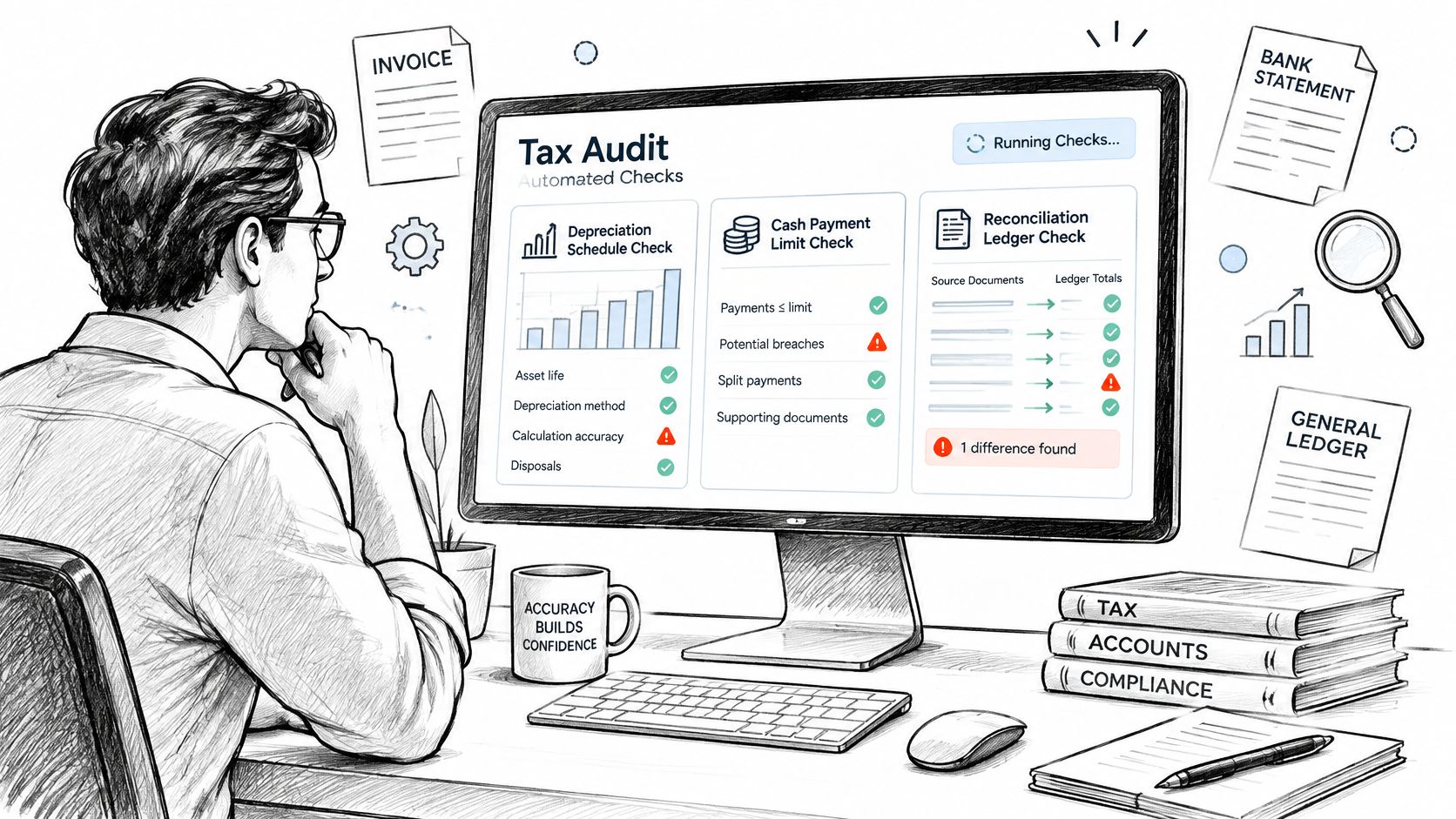
Fixed rules suit work where the statute states a limit, a rate or a date. Depreciation block working, the 180-day test, cash-payment thresholds, TDS, Section 43B timing, PF and ESI, related-party flags, ratios, GSTIN and PAN checks, and voucher-balance checks all belong here. Arithmetic and these checks should not be left to a language model. In our build, due dates, GSTIN and PAN checks, voucher balances, GST 2A/2B matching, tax audit checks and every Excel export run on fixed rules. Each limit, rate and due date shows its source and the date it was last reviewed.
A depreciation schedule is the cleanest demo of that idea. The block, the half-year rule and the clause 18 table should recompute from the fixed-asset register, and a reviewer should see the rate, not a pasted total.
Judgement stays with the reviewer wherever classification is arguable. Is this payment really hit by Section 43B, or is the year of allowability a legal call? The tool can compute the timing difference. It should not pretend to decide the characterisation.
Why portal data is not a control
The Comptroller and Auditor General reported that the originally envisaged system-verified input-tax-credit flow through invoice matching had not been implemented, and that technical glitches and return complexity left the system vulnerable to ITC fraud, as set out in the CAG's 2019 press note. A downloaded return is therefore an input, not a certificate of correctness.
India's e-invoicing design shows what a stronger source looks like. Invoice data is authenticated by GSTN and transferred in real time from the Invoice Registration Portal to the GST portal and the e-way-bill portal, which NIC describes as a way to cut duplicate entry and reconciliation mismatches. Software should ingest the IRN, validate the GSTIN, normalise invoice number and date, compare tax rate and taxable value, and classify exceptions.
An exception-first log
- Exact matches: Clear them automatically and keep the pair.
- Tolerance differences: Route them to a named reviewer.
- Hard exceptions: Missing, duplicate, cancelled or value-mismatched rows stay open until someone records a decision.
Unlimited GSTR-2A/2B reconciliation should work through only the entries that need attention, and the log should keep source file, supplier GSTIN, invoice identifier, tax components, rule, reviewer decision and final adjustment. Match rate by count and by taxable value, ageing of unresolved rows, and the share of ITC backed by a primary invoice are the metrics that matter.
The short film below walks through how an automated check looks on screen, which is useful only if you then open the exception log and try to disagree with one row.
Report Generation and Compliance Traceability in Practice
Better matching can raise the pile of exceptions without lowering professional risk. That is the part most product pages skip.
A CAG GST audit found 10,124 sampled deviations. Among 8,106 cases with departmental responses, 2,519 involved compliance deviations with a revenue implication of ₹21,695.11 crore. A separate audit found 553 high-value inconsistencies on input tax credit or tax liability, of which 394 cases, worth ₹1,636.02 crore, were classified as compliance issues, as summarised in the CAG's GST press brief. A flag without a defence is just a longer list.
One amount, five stops
Take a single reported figure, say a mismatch the department later questions.
- Source document. The original invoice or e-way record is stored, not summarised away.
- Ledger entry. The same amount hits the books, with party and tax components intact.
- Rule. The reconciliation rule that paired or rejected it is named, including any tolerance.
- Reviewer adjustment. A person records why the pair was accepted, split or written off.
- Clause and reply. The final particular, and later the notice reply, cite that chain.
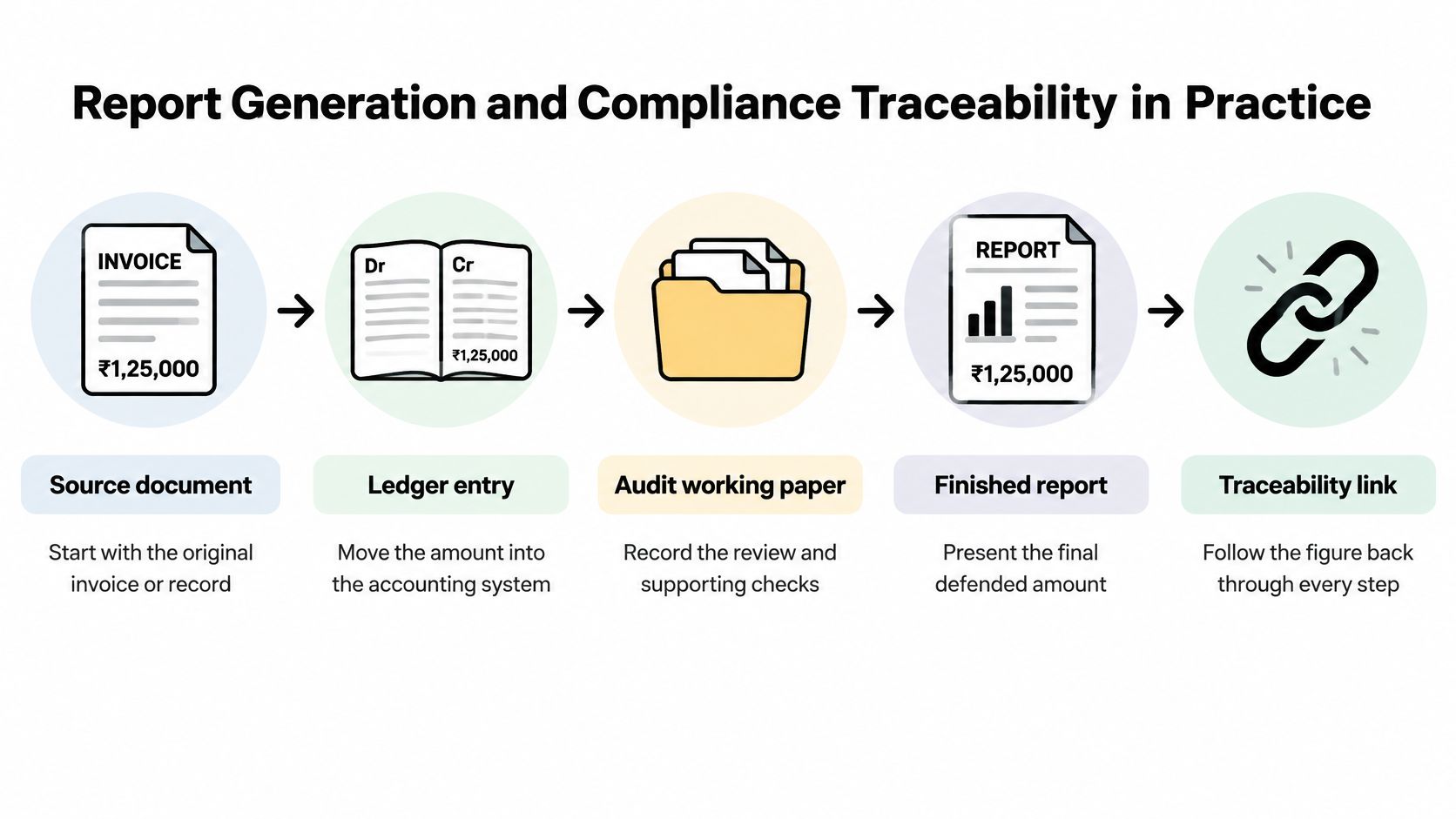
Arithmetic validation is what the rule can prove: the totals agree, the GSTIN checksum holds, the date falls in the period. Legal interpretation is what the CA still owns: whether the credit is admissible, which circular applies, and how to frame the reply. A good tool labels those two layers so a junior does not treat a green tick as a legal opinion.
What the evidence pack must contain
The same pack should support an ASMT-10 reply, a departmental audit, an appeal and a partner review. Our drafting writes the remark text for each tax audit clause and sends a typed request to the feature that holds the working. Dates and figures come from rules, not from a guess, and every draft cites a source the user can open.
A sample ASMT-10 reply in that workspace carries section 61, form ASMT-10, the tax period April to September 2026, a deadline of 30 October 2026 and an amount of ₹13,20,000. Those are sample facts for layout, not a client outcome. The test you should run on any product is narrower. Months later, can someone who did not prepare the file recompute every amount and open every citation without calling the original article clerk?
If the only person who can explain the mismatch has left the firm, the software did not create an audit trail. It created a dependency.
Matching Tool Choice to Firm Size and Practice Mix
Feature counts are a poor way to choose. Firm size, client mix and how many states you face should drive the shortlist.
A small practice with a few mid-sized clients needs reliable papers, a clause checklist and depreciation and cash-limit tests that show their rules. Litigation load is low, so a heavy notice workspace is optional. What matters is that one person can reopen the file in September and still see the source.
A firm running many audits, with bookkeeping volume every week, needs batch intake, unlimited reconciliation and export into the ledger the client already uses. Here the time sink is not the Form 3CD remark. It is the purchase register. We estimate about 4 hours saved on each GST reconciliation of GSTR-2B against the purchase register, roughly ₹4,000 of a CA's time at ₹1,000 an hour. That estimate is a capacity point, not a guarantee, and it only matters if the exception log is good enough to review.
Where automation should stop
Digitisation is not the same as consistent treatment across states. In Deloitte's GST@9 survey, 69% of respondents called compliance digitisation GST's biggest success, yet businesses still reported ITC disputes, refund delays and a pro-revenue approach in audits, and the survey called for coordinated audits of multi-state entities, as covered in Deloitte's survey release. Official audit work has also noted that some GST functions were not automated, including issue of ASMT-13 and identification of non-filers for returns other than GSTR-3B.
Software can model the applicable state, the period, the registration type, the notice stage and the deadline. It can keep a compliance calendar and a chronology of notices. It cannot make two assessing officers read a circular the same way.
- Clerical inconsistency: Dates, GSTINs, clause completion and reused masters. A tool should remove most of this.
- Interpretive inconsistency: Whether a view is sustainable in that state, for that year. A partner still owns this, and the file should say so in plain words.
Buy for the exposure you have, not for the module list you might use. A multi-state litigation practice and a three-person compliance desk are not choosing the same product, even when the brochures look alike.
Choosing Your Tax Audit Software and Next Steps
Shortlist on the chain you can reopen, then on price predictability. Ignore slogans about “end-to-end automation” until the five checks below pass on a real client file.
- Working papers keep the source attached. Change the PDF and confirm the citation moves, or refuses to.
- Checklists map to each Form 3CD clause, with a named sign-off, not a single “audit complete” flag.
- Depreciation and limit tests show the rule, the rate and the date that rule was last reviewed.
- The report can be reproduced. A second person rebuilds one figure without the original preparer.
- Pricing for bookkeeping, reconciliation and export is predictable. Per-document meters punish the busiest month, which is exactly when the firm is weakest.
Charter AI is one option that bundles bookkeeping, GST reconciliation, Tally export and compliance management. Bookkeeping, GST reconciliation and Tally export are unlimited on every plan, so the due-date spike does not change the bill. The trade-off is real. If your current stack already posts vouchers cleanly and your pain is only legal drafting, you may not need the bookkeeping layer. If your pain is retyping and unmatched 2B rows, a form-only tool will leave that work outside the audit file.
A test you can run this week
Nine free tools need no sign-up and no AI: a section finder, a notice-reply deadline calculator, an MSME 45-day payment checker, bank reconciliation, a depreciation schedule, tax audit applicability, a cash payment limit checker, trial balance to balance sheet, and an income tax calculator. Run applicability, depreciation and the cash-payment check on one live client before you sit through a vendor demo. If those three cannot show their workings, the rest of the suite will not become transparent later.
Bring the exception log, not the sales deck, to the partner meeting. The right tax audit software is the one a reviewer can still explain when the person who clicked “match” is no longer on the engagement.
Charter AI gives Indian CA firms one workspace for clause-level tax audit working, rules-based checks, GSTR reconciliation and source-linked drafts, so a figure can still be defended months later. If you want to see that chain on your own client file, start with the free checks and then open a full workspace. Visit Charter AI and run a live file through the tools before you commit the firm's next audit season to another form filler.