
Sample Notice for Board Meeting: Template and Steps
Sample notice for board meeting under the Companies Act, 2013, with template, 7-day notice rule, agenda, quorum and dispatch proof for Indian companies.
Published 15 min read

It's Friday, and the chair expects the Board to meet on Monday. You open the notice file and find no venue, no attached agenda and no record of which directors received it. The problem isn't the wording of the invitation. You can't yet show that the directors were properly called or given the papers they need.
A useful sample notice for board meeting should help you assemble a dated evidence file, not just a polished letter. That file connects the authorised notice, the agenda pack, each director's delivery details and the records you'll retain.
Table of Contents
- A Sample Board Meeting Notice You Can Adapt
- Illustrative notice
- Required fields in a board meeting notice
- Statutory Meeting Frequency That Sets Your Dates
- Statutory meeting-frequency requirements
- How to Draft the Notice in Seven Steps
- Draft in a controlled order
- Keep ownership visible
- Building the Agenda and Explanatory Notes
- Write notes that support a decision
- Quorum and Electronic Participation Rules
- Quorum for board meetings by board size
- Make hybrid attendance workable
- Notice Period, Delivery and Proof of Dispatch
- Notice timing and proof by delivery channel
- Shorter notice needs a separate decision
- Issue the Notice Only After a Dated Delivery Check
A Sample Board Meeting Notice You Can Adapt
The following is an illustrative template, not an issued notice. Replace every bracketed field with verified company information. The dates and meeting reference demonstrate how the completed document should read.
Illustrative notice
Kaveri Textiles Private Limited
CIN: [Insert CIN from registration certificate]
Registered office: [Insert complete registered office address, Ahmedabad, Gujarat, PIN code]
Notice reference: BM/2026-27/04
Dispatch date: 2 October 2026
Delivery: Email and hand delivery to each director's address registered with the company
To: [Director's full name]
Registered postal address: [Insert address from company records]
Registered email address: [Insert email from company records]
Notice is hereby given that a meeting of the Board of Directors of Kaveri Textiles Private Limited will be held on Monday, 12 October 2026, at 11:00 a.m. IST, at [insert complete meeting address], Ahmedabad, Gujarat, to transact the following business:
- To consider and confirm the minutes of the previous Board meeting.
- To consider and approve the unaudited quarterly financial results.
- To review working-capital requirements and the supporting finance proposal.
- To discuss the operational matters described in the enclosed agenda.
Electronic participation: Video-conferencing facilities will be available through [approved platform]. Joining instructions, access credentials, the technical contact and backup arrangements are enclosed in the joining note. Please confirm your intended participation mode to [company secretary's contact].
The agenda, explanatory notes and supporting papers listed in the attachment index are enclosed.
For and on behalf of the Board
[Signature]
[Name]
Company Secretary / Authorised Director
[Contact details]
Required fields in a board meeting notice
| Field | What to write | Example |
|---|---|---|
| Company name and CIN | Full registered name and CIN from the registration certificate | Kaveri Textiles Private Limited, CIN as registered |
| Serial number | Sequential reference used consistently in meeting records | BM/2026-27/04 |
| Day, date and time | Weekday, full date and start time in IST | Monday, 12 October 2026, 11:00 a.m. IST |
| Venue or electronic details | Complete meeting address and electronic joining information | Registered office, Ahmedabad, complete address inserted; VC access in joining note |
| Business items | Numbered matters for decision or discussion | Approve unaudited quarterly results |
| Attachments | Agenda, explanatory notes, draft minutes and papers, listed by name | Annexure A: draft minutes of the previous meeting |
| Issuing signatory | Name, designation and signature | Company Secretary, for and on behalf of the Board |
| Dispatch date and mode | Actual date and channels used | 2 October 2026, email and hand delivery |
| Registered address | Each director's postal and email details from company records | Address verified against the director's particulars |
Don't leave Ahmedabad as the entire venue description. Insert the building, floor, street and PIN code before issue. Check the Articles of Association too: the sample is a starting point, not confirmation that your company's additional requirements have been met.
Statutory Meeting Frequency That Sets Your Dates
The general scheduling requirements under Section 173(1) of the Companies Act, 2013 are a first Board meeting within 30 days of incorporation, at least four meetings in every calendar year, and no more than 120 days between consecutive meetings.
Statutory meeting-frequency requirements
| Requirement | Rule | What it means for your notice |
|---|---|---|
| First Board meeting | Within 30 days of incorporation | An illustrative company incorporated on 1 April should generally convene by 1 May |
| Minimum meetings | At least four in every calendar year | Map the year's proposed meeting dates before January |
| Maximum gap | No more than 120 days between consecutive meetings | Count from the previous meeting date recorded in the minutes, not the date the minutes were signed |
Use these as the general statutory baseline, then confirm the provisions applicable to your company's category. When checking the legal framework, keep the Companies Act, 2013 reference alongside the company's Articles and incorporation records.
The first-meeting deadline belongs in the incorporation checklist. Don't wait for banking arrangements, office fit-out or routine administrative work to finish before considering the Board calendar.
For an established company, separate the annual meeting count from the permitted interval. A calendar can contain enough proposed meetings yet still leave an excessive gap between consecutive meetings. Equally, postponing a meeting beyond an internal target doesn't automatically mean the statutory interval has been breached.
Planning rule: Measure the gap from when the Board actually met. Signing the minutes later doesn't restart the clock.
Build notice preparation backwards from the proposed meeting date. Leave room for the finance team to finalise papers, the signatory to approve the notice and the company secretary to resolve delivery problems.
A reserved date isn't evidence that a meeting occurred. Update the calendar after postponements and record the next notice-preparation date when the previous meeting's records are completed. That keeps the company from treating the outer statutory limit as the day to start organising.
How to Draft the Notice in Seven Steps
Treat the notice as a controlled compliance document. The Companies Act provisions on Board meetings establish the written-notice framework; your drafting process should make the resulting document identifiable, authorised and traceable.
The visual below provides a drafting aid. Keep the circulation record with the completed notice, rather than treating sending as the end of the task.
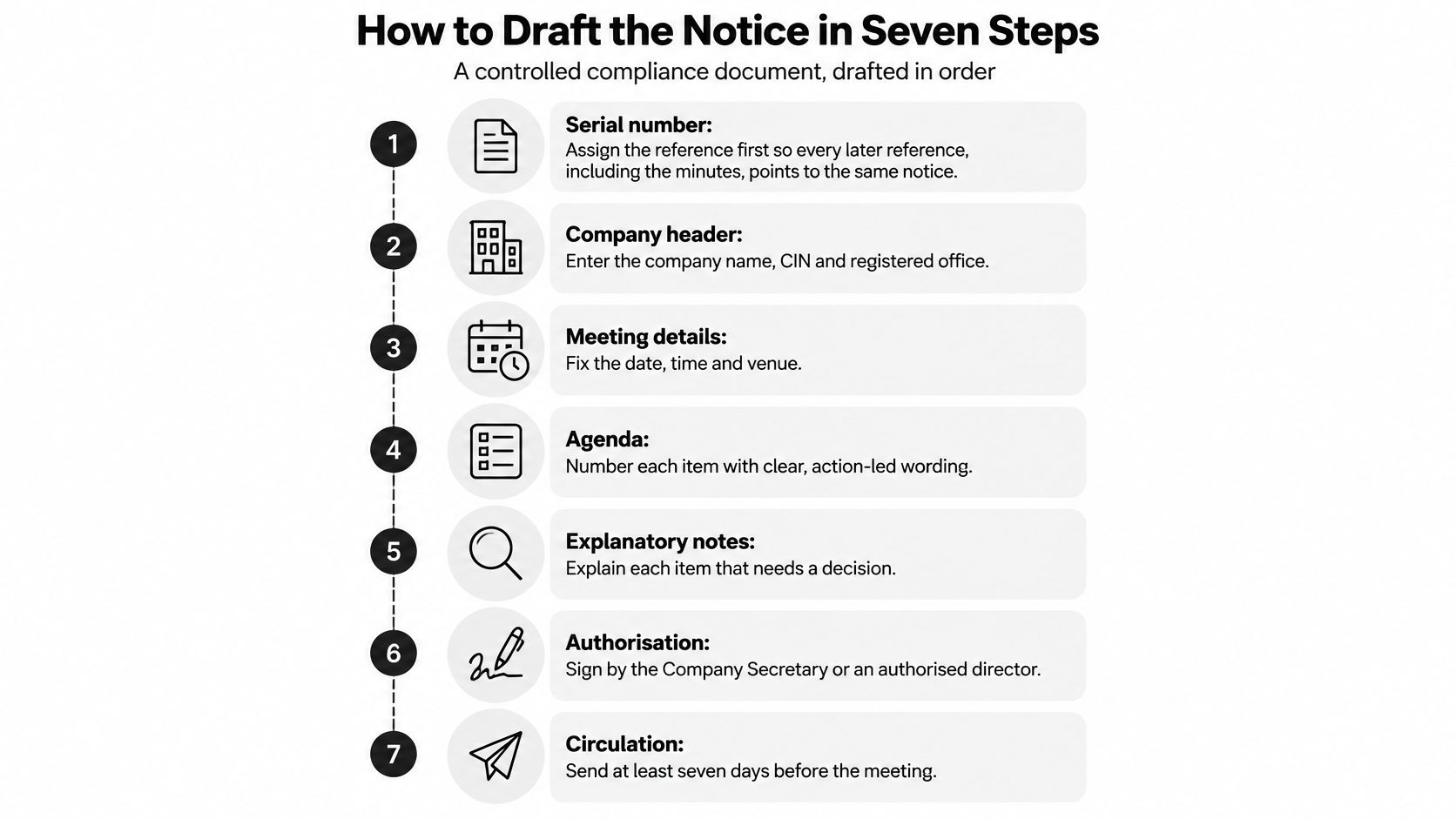
Draft in a controlled order
Assign the serial number first. Use the same reference on the notice, agenda cover, delivery log and minutes. Don't create a fresh reference when an assistant saves the signed PDF.
Fix the meeting details. Confirm the day, date, time and complete venue with the chair and relevant organisers. A tentative room booking isn't enough. Check that the physical address in the notice matches the actual booking, whether or not the meeting is at the registered office.
Define the business. Ask each agenda-item owner what the Board must decide, note or discuss. Avoid drafting the business list after the notice has already gone out. That approach leaves the issued notice disconnected from the papers directors receive.
Assemble the agenda and explanatory notes. Obtain the supporting material before finalising the notice. An approval item without its proposal or relevant background isn't ready merely because someone has written a resolution heading.
Specify participation arrangements. Confirm whether attendance is physical, electronic or hybrid. Test access using the permissions a director will have, not an administrator's account. A working meeting link is of little use if the accompanying board-paper folder denies access.
Authorise and circulate the written notice. Have the company secretary or authorised director approve the final issue copy. Verify the recipient list against company records, then use the selected delivery channel. Don't rely on an old email chain as your current director list.
Capture dispatch and delivery evidence. Save the issued document, attachments and channel records together. A screenshot showing an email subject doesn't establish which papers were attached.
Keep ownership visible
Give each substantive item a named internal owner, such as the finance head for results or the operations head for a capital proposal. The owner checks the paper's content; the company secretary controls how that paper enters the issued pack.
A signed notice and a complete agenda pack should describe the same meeting. If they don't, stop circulation and reconcile them.
Building the Agenda and Explanatory Notes
Directors should be able to tell what they must read and what decision they're being asked to make. A heading such as Financials leaves both questions unanswered.
Use an action-led item instead. In an illustrative pack, that could read: To consider and approve the unaudited quarterly financial results for the quarter ended 30 September 2026.
A clear agenda makes the required action visible before a director opens the supporting paper.
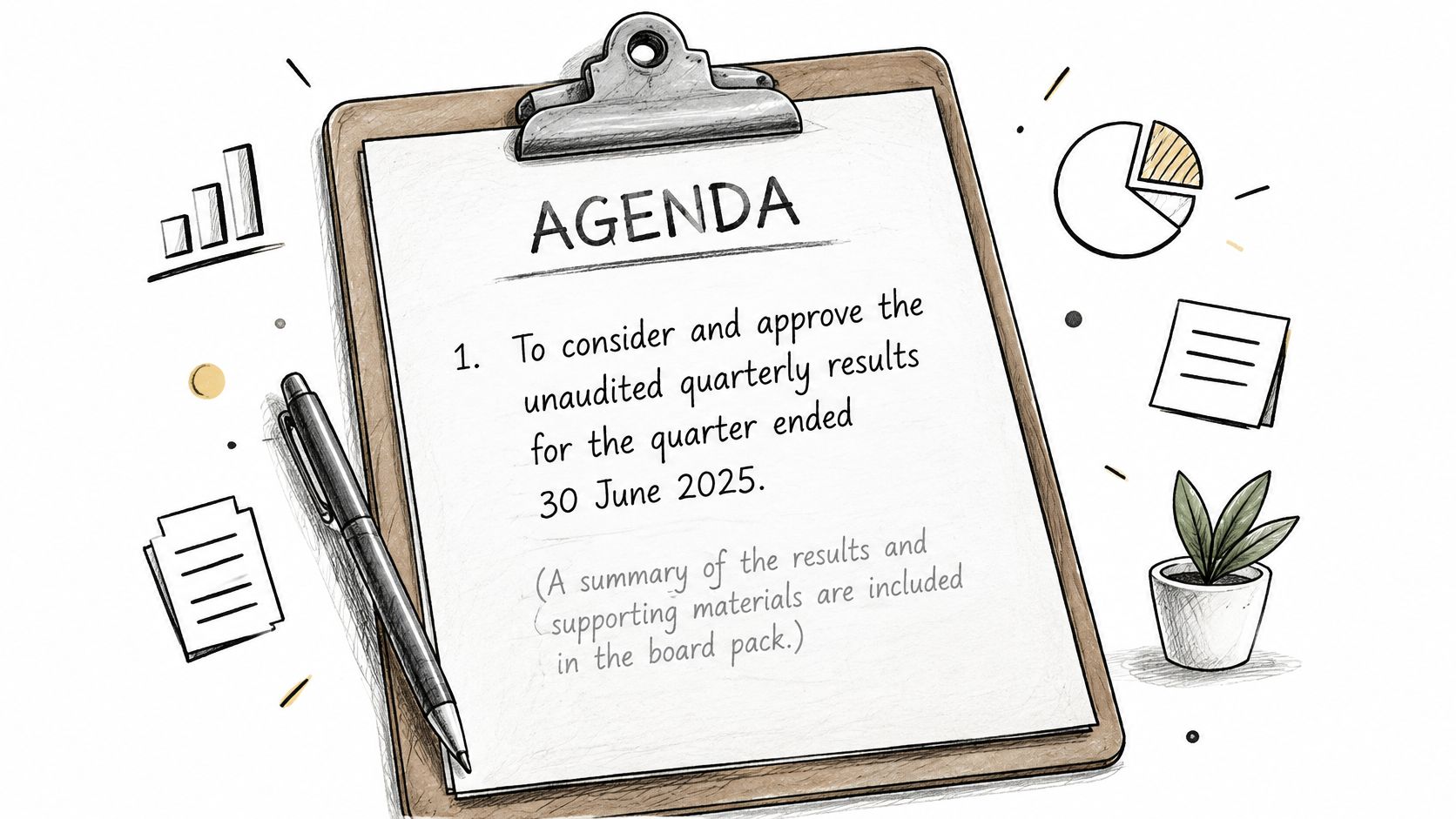
Write notes that support a decision
Put routine business, such as confirmation of previous minutes, before substantive approvals and discussion items. Mark items clearly as for approval, for noting or for discussion. Directors shouldn't have to infer the requested action from a long attachment.
For an approval paper, explain the proposal, material facts, implications and any director interest. Include the proposed resolution where useful, but don't let legal wording replace the commercial explanation.
Consider a proposed contract with a business in which a director has an interest. The note should identify the relationship, describe the proposed transaction and explain the relevant approval and participation questions for review. Burying that relationship inside a contract attachment makes the Board's preparation harder.
Keep the attachment index specific:
- Draft minutes: Identify the previous meeting and the document being presented for confirmation.
- Decision papers: Match each paper to its agenda item and name its owner.
- Financial schedules: Label the reporting period and distinguish management workings from the approval document.
- Draft resolutions: Connect each proposed resolution to the supporting explanation.
- Joining note: Keep technical instructions separate from substantive Board papers.
The accompanying video can be used as a supplementary reference when reviewing the meeting-document workflow.
Once the pack is issued, a replacement document needs a new version identifier and a fresh dispatch note explaining what changed. Don't overwrite a file behind an existing shared link without notice. Directors may otherwise arrive with different versions while the company's folder appears complete.
Quorum and Electronic Participation Rules
Confirm quorum against the company's actual Board strength and applicable provisions before promising that the meeting can proceed. The following is an illustrative planning calculation, not a substitute for checking the governing rule, exclusions and company-specific circumstances.
Quorum for board meetings by board size
For illustration, applying a working formula of one-third of total strength or two directors, whichever is higher, with fractions rounded upwards, produces:
| Total directors | Minimum quorum |
|---|---|
| 3 | 2 |
| 5 | 2 |
| 6 | 2 |
| 7 | 3 |
| 9 | 3 |
| 10 | 4 |
| 12 | 4 |
Don't confuse confirmation of attendance with confirmation of quorum. Ask the company secretary to check the current Board composition, relevant interests and whether a director's participation can count for the business being considered.
Make hybrid attendance workable
The revised Secretarial Standard-1, effective 1 April 2024, addresses electronic participation, notice, agenda, attendance, minutes and record preservation, as explained in the Secretarial Standard-1 guide. Where electronic participation is offered, directors need access information and a request to confirm their participation mode in advance.
A hybrid joining note should contain:
- Platform and access: Name the approved video-conferencing service and explain how directors obtain credentials.
- Technical contact: Identify who can resolve connection or document-access problems.
- Identity verification: Explain the joining check without circulating unnecessary personal information.
- Recording arrangements: State the approved recording policy and who controls the facility.
- Backup procedure: Explain whom directors should contact if they disconnect.
- Confidentiality controls: Restrict circulation of sensitive company and client papers to authorised recipients.
A convenient public link creates a different risk from an authenticated workspace. Choose access controls that protect the papers without making directors dependent on last-minute permission changes.
Ask directors to confirm both their attendance mode and access to the pack. Preserve the issued attachment index and delivery records so the company can establish which version each director received. Electronic participation needs an auditable connection between the notice, papers, attendance record and minutes, not merely a video link in an email.
Notice Period, Delivery and Proof of Dispatch
A courier slip dated the morning of the meeting is worth more than a clean notice dated too late. The file should show that every director was called in time, at the address the company had on record, with the same papers the Board later used.
Under Section 173(3) and (4) of the Companies Act, 2013, the general requirement is at least seven days' written notice to every director at the address registered with the company, delivered by hand, post or electronic means; an officer responsible for giving notice who fails to do so may face a ₹25,000 penalty.
Notice timing and proof by delivery channel
| Channel | Timing to plan for | Proof to keep |
|---|---|---|
| Hand delivery | Serve before the seven-day period expires; record the handover time | Signed acknowledgement with date, recipient name and pack list |
| Registered post, speed post or courier | Dispatch earlier than electronic notice so transit delay does not shorten the period | Postal receipt, tracking record, delivery confirmation and returned-cover remarks |
| Email to registered address | Send before the deadline expires and keep the full attachment set | Sent-mail copy with attachments, delivery/read receipts where available, and log entry |
| Shorter notice for urgent business | Use only after checking the urgency procedure and director safeguards | Urgency record, attendance evidence and applicable ratification records |
Do not schedule postal dispatch at the same point as electronic dispatch. Test the date calculation against the chosen channel before issue, and keep the failed-delivery record when an address bounces or a cover is returned. Deleting the attempt deletes the trail.
Shorter notice needs a separate decision
The same statutory provision permits shorter notice for urgent business, subject to independent-director safeguards where applicable. Where the company has an independent director, at least one should attend; if none attends, decisions become final only after circulation to all directors and ratification by at least one independent director.
A late paper is not automatically urgent business. Record why the matter cannot wait for the next scheduled meeting, who approved the shorter period, and which directors received the papers in time to participate.
Keep a recipient-level proof log containing the dispatch date, channel, registered address used, issued notice version, attachment list and available receipts. Record acknowledgements and exceptions separately, because a folder labelled “Board notice sent” will not explain one missing director, one old address or one attachment that failed to upload.
Issue the Notice Only After a Dated Delivery Check
Release the notice only when the company secretary can approve the issue file and the circulation arrangements. Then complete the delivery record as evidence arrives. Don't mark delivery as confirmed merely because dispatch has been authorised.
Use this final gate:
- Reference controlled: Serial number, issue version and authorised signatory are confirmed.
- Timing checked: The proposed dispatch date suits the chosen channel and applicable notice requirements.
- Pack complete: Agenda, explanatory notes and named attachments match the issue index.
- Attendance assessed: Quorum has been checked against current Board strength and the proposed business.
- Electronic access tested: Joining instructions and document permissions work for intended recipients.
- Evidence assigned: A named person will log dispatch, monitor failures and retain receipts.
A notice that looks correct on paper still needs a dispatch record the company can produce.
The Articles may require more than the statutory baseline, and urgent-business procedures deserve legal review. Ask counsel to confirm uncertain wording or exceptions before dispatch, rather than trying to repair the record after the meeting.
For the next meeting, create the notice folder when the date is proposed. Keep the authorised issue copy separate from working drafts, and close the delivery check with a dated sign-off.
Charter AI offers a client-centric workspace for Indian CA firms, combining source-linked research, drafting, document management and compliance tracking. Visit Charter AI to explore how those tools can support the research and organised client records behind your compliance work, while keeping Board-notice approval with the company secretary and counsel.