# Reverse Charge Mechanism in GST for CA Firms
Learn the reverse charge mechanism in GST: notified supplies, who pays, cash before ITC, and return treatment for CA firms.
Published 6 Nov 2026. 16 min read.
Reverse charge applies only where an applicable notification shifts GST liability to the recipient, chiefly under section 9(3) of the CGST Act. An unregistered vendor alone doesn't create reverse charge liability.
The popular advice to charge RCM on every bill without a GSTIN is a poor starting point for a live file. It confuses a supplier's registration status with the legal test for the transaction, and can lead your team to pay tax unnecessarily while missing notified supplies.
For a CA firm, the **reverse charge mechanism in GST** is best treated as a vendor-onboarding and effective-date control. Before posting an inward bill, the junior needs to establish what was supplied, who supplied it, who received it, and which notification applied to the transaction.
## Table of Contents
- [What Makes Reverse Charge Apply](#what-makes-reverse-charge-apply)
- [Start with the statutory route](#start-with-the-statutory-route)
- [Convert the law into a classification decision](#convert-the-law-into-a-classification-decision)
- [Notified Supplies and the Person Who Pays](#notified-supplies-and-the-person-who-pays)
- [Work through the GTA bill first](#work-through-the-gta-bill-first)
- [Read each remaining row narrowly](#read-each-remaining-row-narrowly)
- [From Time of Supply to Cash and ITC](#from-time-of-supply-to-cash-and-itc)
- [Keep transition relief separate from ordinary compliance](#keep-transition-relief-separate-from-ordinary-compliance)
- [Journal Entries and GSTR-3B Treatment](#journal-entries-and-gstr-3b-treatment)
- [Post the vendor balance separately from the tax](#post-the-vendor-balance-separately-from-the-tax)
- [Map the balances to the return](#map-the-balances-to-the-return)
- [Three Files a CA Practice Actually Sees](#three-files-a-ca-practice-actually-sees)
- [The factory freight file](#the-factory-freight-file)
- [The director's sitting-fee file](#the-directors-sitting-fee-file)
- [The commercial-rent file](#the-commercial-rent-file)
- [The recurring scrap supplier needs monitoring too](#the-recurring-scrap-supplier-needs-monitoring-too)
- [Classify the Next Inward Bill Before You Book It](#classify-the-next-inward-bill-before-you-book-it)
- [Run the reviewer's checks](#run-the-reviewers-checks)
## What Makes Reverse Charge Apply
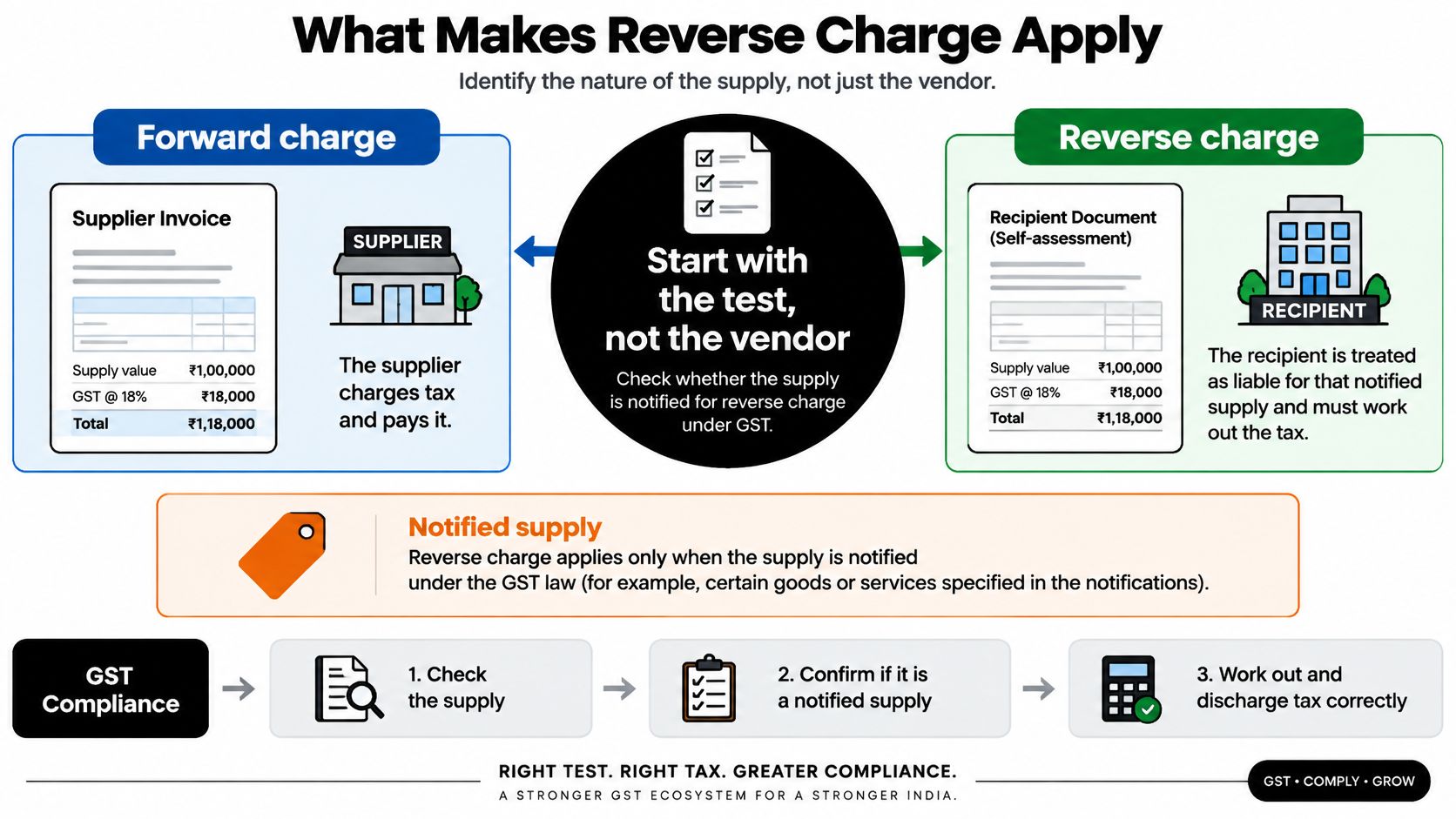
**An absent GSTIN isn't the test.** Under forward charge, the supplier charges GST and pays it to the Government. The recipient checks the invoice and assesses whether the input tax credit is eligible.
Under reverse charge, the recipient becomes the person liable for tax on the notified supply. That means the buyer must determine taxability, place of supply, rate, time of supply, documentation, payment and return reporting rather than accepting the vendor's tax treatment.
The distinction is easier to understand when the transaction, rather than the vendor master, sits at the centre of the review.
### Start with the statutory route
The CBIC explanatory flier on reverse charge describes the framework introduced with GST on **1 July 2017**, including notification-based liability under **section 9(3)** of the CGST Act, **section 5(3)** of the IGST Act and the corresponding UTGST provisions.
The Government exercises that notification power on the GST Council's recommendations. It isn't a general permission for the accounts team to classify any inconvenient or incomplete invoice as RCM.
The [CGST Act](https://cbic-gst.gov.in/pdf/CGST-Act-Updated-30092020.pdf) distinguishes **section 9(3)**, which concerns notified categories of supplies, from **section 9(4)**, whose operation for supplies from unregistered suppliers is subject to the applicable statutory conditions and notifications.
**Section 9(3) against section 9(4)**
| Question | Section 9(3) | Section 9(4) |
|---|---|---|
| What switches it on | A notification naming goods or services, on GST Council recommendation | Taxable supplies from an unregistered supplier to a registered person, only as a current notification provides |
| Is every unregistered purchase covered | No | No; don't apply it as a blanket rule |
| Who is treated as liable | The recipient, for that notified supply | The registered recipient, where the provision applies |
| Intra-State or inter-State | CGST plus SGST or UTGST, or IGST under the parallel notification | The supply's jurisdiction and the notification in force determine the tax |
| What the file must prove | Supply, supplier class, recipient status, notification version | That the provision was notified for that supply on that date |
### Convert the law into a classification decision
Say a junior receives an office-purchase bill without a GSTIN. The correct response isn't to tick the RCM box. The junior should identify the goods or services and test whether a notification covers that supply and the relevant parties.
A registered supplier can also supply something covered by reverse charge. Conversely, an unregistered supplier can make a purchase that doesn't fall within any applicable reverse-charge entry.
> **Practical rule:** Treat supplier registration as an input to the decision, not the decision itself.
Create separate fields for **nature of supply**, **supplier class**, **recipient status** and **applicable notification version**. Record the tax jurisdiction alongside them. A vendor-level default can suggest a review, but it shouldn't replace transaction-level classification.
Finally, don't confuse the invoice date with the complete timing analysis. It helps locate the relevant legal version, but the applicable effective-date and time-of-supply rules still need examination.
## Notified Supplies and the Person Who Pays
**Common notified RCM supplies and who pays**
| Supply | Supplier class | Who pays the tax | Usual legal hook |
|---|---|---|---|
| Goods transport by road through a GTA | GTA that hasn't opted for applicable forward-charge treatment | Specified recipient such as a factory, society, co-operative or registered person | Central-tax service notification and parallel integrated-tax notification |
| Legal services | Individual advocate or advocate firm | Business entity located in the taxable territory, subject to applicable exemptions | Service RCM notification |
| Services by a director | Director supplying services in that capacity | Company or body corporate receiving the service | Service RCM notification |
| Sponsorship services | Supplier covered by the applicable notification version | Body corporate or partnership firm covered by that version | Service RCM notification, as amended |
| Security services other than to a composition person, as notified | Person other than a body corporate | Registered recipient covered by the entry | Amended service RCM notification |
| Renting of residential dwelling | Supplier covered by the entry | Registered person, subject to applicable exclusions | Amended service RCM notification |
| Renting of commercial immovable property | Unregistered person | Registered recipient within the applicable entry | Effective notification, amendments and transition circulars |
| Specified waste and scrap | Unregistered supplier | Registered recipient covered by the entry | Goods notification and government FAQ applicable to the transaction |
This is a **screening table, not a substitute for the notification text**. Each row identifies a question to investigate before booking tax, and the exceptions matter as much as the main description.
The [integrated-tax reverse-charge notification](https://cbic-gst.gov.in/hindi/pdf/integrated-tax-rate/Notification10-IGST.pdf), **Notification No. 10/2017-Integrated Tax (Rate)**, places liability for specified inter-State services on the recipient; its GTA entry includes recipient categories such as factories, societies, co-operative societies and registered persons. The corresponding central-tax service framework is **Notification No. 13/2017-Central Tax (Rate)**, issued in **June 2017**, with later amendments requiring transaction-date review.
### Work through the GTA bill first
For freight, begin with the underlying transport document and the supplier's status. Don't assume that every road transporter is a GTA or that every freight bill belongs under reverse charge.
Check whether the GTA has adopted forward-charge treatment under the applicable rules. Keep evidence supporting that treatment rather than relying only on an accounts executive's email saying that the transporter handles GST.
Then identify the recipient responsible under the notification. A factory's status can be relevant, but the reviewer should still establish who is liable to pay for the freight and whether the notified conditions are met.
**Tax jurisdiction needs its own check.** An intra-State supply calls for the applicable central and State or Union-territory components. Specified inter-State services require integrated-tax treatment, rather than a split selected from the supplier's address alone.
### Read each remaining row narrowly
For legal services, don't extend the advocate entry to every consultant merely because the ledger says professional fees. For director payments, distinguish services supplied as a director from employment remuneration and services supplied in another capacity.
Security-service classification requires the supplier's legal constitution, not just the service description. Residential rent requires examination of the recipient and exclusions; commercial rent needs a supplier-registration and effective-date check.
Sponsorship is another reason not to reuse an old chart without reviewing amendments. Specified scrap requires precise goods classification rather than a broad ledger named scrap purchases.
Use the [statutory reverse-charge provision](https://charterai.in/law/cgst-act-2017/9) as the starting point for the legal trail, then save the operative notification entry with the working paper. The reviewer should be able to reconstruct the conclusion without asking the preparer which website they consulted.
## From Time of Supply to Cash and ITC
Once applicability is established, build the return in the order the liability arises. **Classification, cash payment and credit recognition are separate decisions.**
Use this visual as a sequence reminder, not as a replacement for the detailed timing provisions.
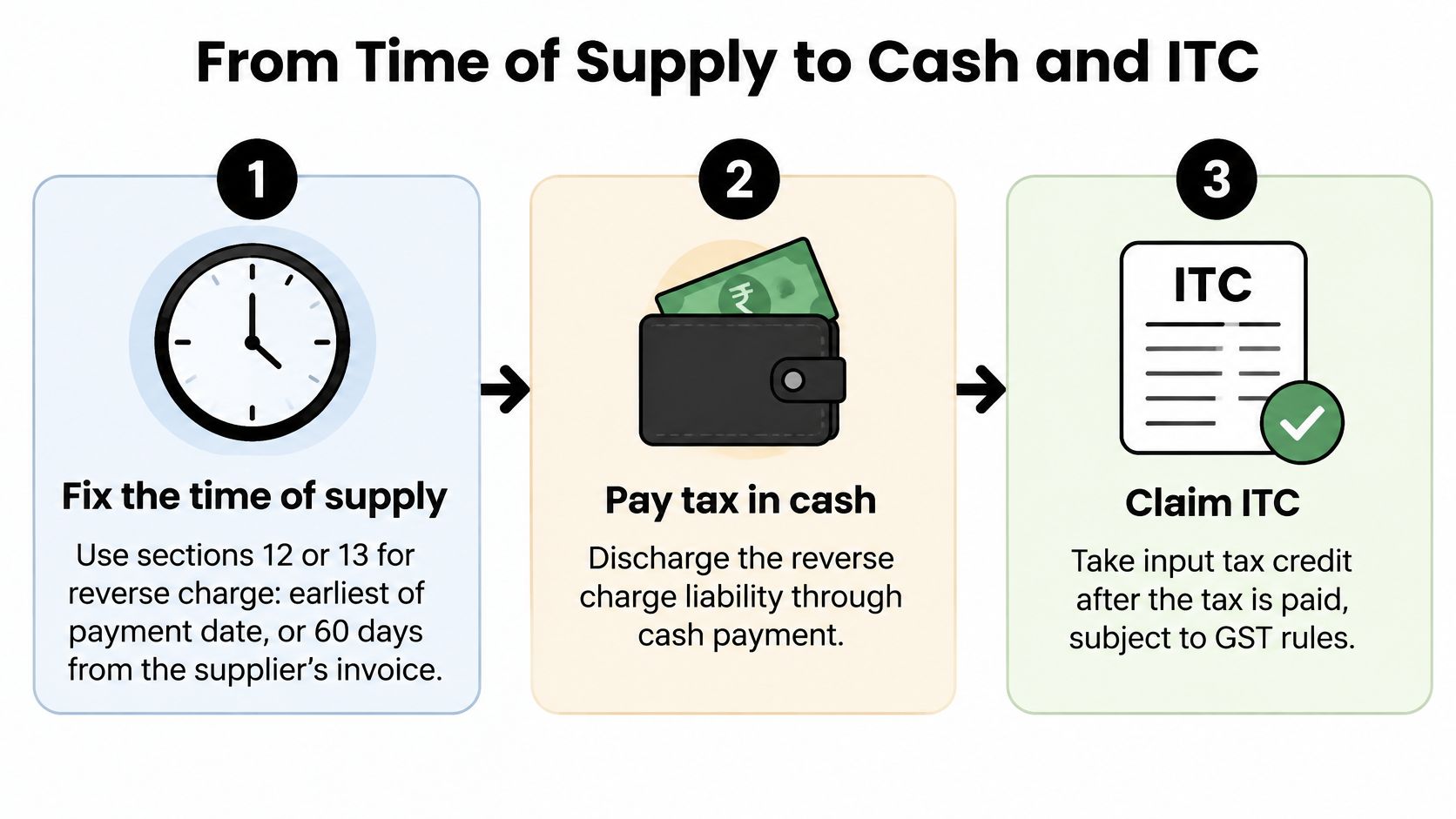
1. **Fix the time of supply and legal version.** Examine the applicable goods or services rule using the payment, invoice, receipt and book-entry evidence relevant to that rule. Don't use a single invoice-age shortcut for every inward supply, and separately test whether a transition notification or circular changes the treatment.
A specific example is [Circular No. 245/02/2025-GST](https://gstcouncil.gov.in/sites/default/files/2025-01/cir-245022025-cgst.pdf), which regularised RCM on commercial-property renting by an unregistered person to a registered composition taxpayer for **10 October 2024 to 15 January 2025** on an **“as is, where is” basis**. That narrow treatment mustn't be extended automatically to a regular taxpayer or a transaction outside the stated window.
2. **Confirm place of supply.** Determine whether the liability belongs under central and State or Union-territory tax, or integrated tax. Keep the reasoning where the supplier's location, recipient's registration and property or service location could cause confusion.
3. **Prepare the required documents.** Where an unregistered supplier makes a supply attracting RCM, prepare the applicable self-invoice and payment voucher. Retain the supplier's underlying bill, agreement, consignment note or other evidence as well; self-invoicing doesn't replace proof that the supply occurred.
4. **Discharge the liability in cash.** Use the electronic cash ledger, not available input tax credit, to settle RCM. A bank challan establishes that money entered the cash ledger, while the ledger debit establishes its use against the liability.
5. **Recognise only eligible ITC.** After payment, assess business use, documentary conditions, blocked credits and the recipient's entitlement. Review the [conditions for input tax credit](https://charterai.in/law/cgst-act-2017/16) before moving a provisional receivable into the credit claimed in the return.
### Keep transition relief separate from ordinary compliance
Regularisation isn't the same as a general exemption, and it doesn't necessarily create a refund entitlement. Record exactly which taxpayer category, supply and period the relief covers.
For omitted or underpaid RCM, prepare a correction working instead of adding the amount to the next purchase entry. Determine the appropriate payment and reporting route, calculate applicable interest, and keep unpaid tax out of the eligible-credit claim.
> A defensible working paper records the relevant dates, legal version, liability period, cash-ledger debit and ITC conclusion as separate fields.
For a visual walkthrough alongside that working paper, use the following explainer.
## Journal Entries and GSTR-3B Treatment
Assume, purely for this worked example, an **intra-State notified service costing ₹1,00,000**, with an assumed applicable GST rate of **18%** and full ITC eligibility. The illustrative tax is **₹9,000 CGST and ₹9,000 SGST**; these figures demonstrate posting mechanics, not the rate applicable to every RCM service.
### Post the vendor balance separately from the tax
**RCM journals for a hypothetical ₹1,00,000 intra-State supply at 18%**
| Event | Debit | Credit |
|---|---|---|
| Book the inward supply and RCM | Expense or asset ₹1,00,000; CGST RCM receivable ₹9,000; SGST RCM receivable ₹9,000 | Supplier ₹1,00,000; CGST RCM payable ₹9,000; SGST RCM payable ₹9,000 |
| Pay tax through the cash ledger | CGST RCM payable ₹9,000; SGST RCM payable ₹9,000 | Electronic cash ledger ₹18,000, funded from bank |
| Recognise eligible ITC after cash payment | CGST ITC ₹9,000; SGST ITC ₹9,000 | CGST RCM receivable ₹9,000; SGST RCM receivable ₹9,000 |
| Inter-State alternative on the same hypothetical base | IGST RCM receivable ₹18,000 | IGST RCM payable ₹18,000, later paid in cash |
The supplier credit is essential. Omitting it produces an unbalanced journal and hides the commercial amount payable to the vendor.
In TallyPrime, maintain identifiable RCM payable and provisional-credit ledgers so the reviewer can distinguish assessed liability from credit claimed. Ledger names can follow the firm's chart of accounts, but they shouldn't merge RCM with ordinary supplier-charged input tax.
Funding the cash ledger and discharging tax are also distinct events. If the books track the electronic cash ledger as a separate balance, record the bank transfer into that ledger before recording the debit against the RCM liability.
If ITC is blocked or otherwise unavailable, don't leave the amount indefinitely in a recoverable account. Charge or capitalise the non-recoverable tax according to the underlying expense or asset treatment.
### Map the balances to the return
- **Liability reporting.** Put the assessed amount in the inward-supplies-liable-to-reverse-charge row of GSTR-3B.
- **Credit reporting.** Include eligible paid tax in the appropriate ITC field, with any required ineligible-credit treatment.
- **Outward supplies.** The recipient doesn't report the inward purchase as its own outward supply in GSTR-1.
- **Period control.** Use the firm's [monthly GSTR-3B compliance schedule](https://charterai.in/due-dates/gst-gstr3b-monthly) to track completion, but establish the correct liability period independently.
The closing reconciliation should connect the purchase register, RCM assessment, payable ledger, cash-ledger utilisation and ITC claim. **A receivable created by a journal isn't proof of credit eligibility**, and a challan alone isn't proof that the liability was discharged.
## Three Files a CA Practice Actually Sees
### The factory freight file
Suppose Kaveri Textiles, a hypothetical registered factory, receives a consignment note for an intra-State movement and the junior codes the charge as freight inward. The reviewer checks the GTA's status, forward-charge position and the factory's place in the notified recipient category before approving the liability and eligible credit treatment. The evidence supporting that dated conclusion is the consignment note together with the supplier's tax-treatment declaration and the operative notification extract.
This file shows why a vendor master needs more than a GSTIN. Add a field for the GTA's treatment, identify who verified it, and retain the supporting document rather than carrying forward an unexplained tick from an earlier period.
### The director's sitting-fee file
Suppose a company pays its non-executive director a sitting fee and the bookkeeper treats it like an ordinary professional bill. The reviewer establishes the capacity in which the director supplied the service, checks the notified recipient position, and separates tax payment from the assessment of eligible credit. The dated board record, fee advice and saved notification entry support the conclusion.
Don't issue a self-invoice merely because the payee is a director. First establish registration status and the applicable documentary requirement, then connect the fee record to the payment and return working.
### The commercial-rent file
Suppose Patel Agro, a hypothetical registered regular taxpayer, rents commercial premises from an unregistered landlord after the composition-specific regularisation period. The reviewer checks the operative commercial-rent entry and the tenant's scheme status rather than importing the treatment used for a composition client. The lease, landlord-status evidence, tenant-registration record and applicable legal extract prove the date-based conclusion.
> The strongest file doesn't merely say RCM applicable. It shows why this supplier, this recipient and this transaction fall within the rule.
### The recurring scrap supplier needs monitoring too
The [CBIC sectoral FAQs](https://cbic-gst.gov.in/sectoral-faq.html) explain the distinction relevant to specified waste and scrap: the registered recipient's RCM obligation can arise on covered purchases from an unregistered supplier even while the supplier remains below its applicable registration threshold.
That makes supplier onboarding an ongoing control. If a recurring scrap supplier becomes registered, reassess the transaction and any applicable TDS requirement instead of automatically continuing the previous RCM setting.
For each file, retain an **evidence pack** containing the underlying supply document, registration verification, dated notification or circular, tax-payment evidence and return mapping. Where a notice questions the treatment, that pack lets the team explain the legal and factual position together.
## Classify the Next Inward Bill Before You Book It
Give the preparer a purchase-register workflow that ends in a supported decision, not just a yes-or-no RCM column. The reviewer should be able to see what was checked, what remains unresolved and which document supports the posting.
Charter AI brings purchase-register reconciliation and source-linked legal research into a client workspace; its GSTR-2A/2B matching runs on **rules, not AI**, so the same returns always produce the same matching result. That consistency helps identify entries needing attention, but the practitioner still needs to approve the notification-based RCM conclusion.
### Run the reviewer's checks
1. **Read the actual supply.** Open the invoice and supporting agreement or consignment note. A ledger label such as transport, rent or professional fees is a starting description, not a legal classification.
2. **Verify both parties and the effective rule.** Confirm supplier class, registration evidence, recipient status and composition status. Save the applicable notification version and record why its conditions are satisfied.
3. **Set the correct tax jurisdiction.** Establish place of supply before selecting the tax components. Don't let a vendor's State code automatically determine the answer.
4. **Complete the documentary trail.** Prepare the self-invoice and payment voucher where required, and retain the supplier's original evidence. Link the documents to the same purchase-register reference so the reviewer can follow the transaction.
5. **Separate payment from credit.** Match the assessed liability to cash-ledger utilisation, test any late-payment interest exposure and approve ITC only after checking its conditions. Keep unresolved credit in a review category rather than claiming it by default.
6. **Tie the file to the return.** Reconcile the payable and credit balances to the relevant GSTR-3B fields, then archive the legal extract with the working paper. Record who reviewed exceptions and how they were resolved.
A static category spreadsheet is useful for screening, but it can't establish which amended rule applied to a particular transaction. **Approve the bill only when the classification, effective date, documentation and return treatment agree.**
---
We offer source-linked tax research, bookkeeping and rules-based GST reconciliation so your team can review inward bills alongside the supporting legal and client records. Visit [Charter AI](https://www.charterai.in) to bring your purchase register into a client workspace and build an RCM review trail from classification through payment and return preparation.
## Tags
- [Reverse charge mechanism in GST](https://charterai.in/blog/tag/reverse%20charge%20mechanism%20in%20gst)
- [GST RCM](https://charterai.in/blog/tag/GST%20RCM)
- [Section 9(3)](https://charterai.in/blog/tag/section%209(3))
- [Notified supplies](https://charterai.in/blog/tag/notified%20supplies)
- [CA GST practice](https://charterai.in/blog/tag/CA%20GST%20practice)
Canonical: https://charterai.in/blog/reverse-charge-mechanism-in-gst