# Remuneration to Partners: The 40(b) Ceiling
Remuneration to partners in India: the Section 40(b) ceiling, book-profit add-back, deed tests, ledger entries and Section 194T TDS at 10%.
Published 29 Oct 2026. 16 min read.
You're closing a partnership firm's accounts. One partner has drawn a fixed monthly amount for running the office, both partners expect to split the remaining profit, and the remuneration voucher is ready in TallyPrime. Then a late adjustment changes the profit, someone asks whether the deed supports the credit, and the payment date turns out not to be the date that matters for TDS.
**Remuneration to partners needs separate checks for entitlement, deduction and withholding.** Getting the arithmetic right won't repair a defective deed, and waiting for a bank payment can leave an earlier ledger credit unchecked.
## Table of Contents
- [What Counts as Remuneration to Partners](#what-counts-as-remuneration-to-partners)
- [The deduction needs every test to pass](#the-deduction-needs-every-test-to-pass)
- [Accounting profit isn't the calculation base](#accounting-profit-isnt-the-calculation-base)
- [How Partners Are Taxed on Their Remuneration](#how-partners-are-taxed-on-their-remuneration)
- [Separate computations, with a statutory adjustment](#separate-computations-with-a-statutory-adjustment)
- [TDS is a credit, not the income computation](#tds-is-a-credit-not-the-income-computation)
- [The Section 40(b) Ceiling and Book-Profit Base](#the-section-40b-ceiling-and-book-profit-base)
- [Build the base before calculating the ceiling](#build-the-base-before-calculating-the-ceiling)
- [Apply the aggregate ceiling](#apply-the-aggregate-ceiling)
- [Label the assessment year](#label-the-assessment-year)
- [Deed Clauses and Partner Ledger Entries](#deed-clauses-and-partner-ledger-entries)
- [Write a method the accounts team can apply](#write-a-method-the-accounts-team-can-apply)
- [Post the entitlement, then reconcile the tax treatment](#post-the-entitlement-then-reconcile-the-tax-treatment)
- [Section 194T Credits That Trigger TDS](#section-194t-credits-that-trigger-tds)
- [Control the event, not just the payment run](#control-the-event-not-just-the-payment-run)
- [Reconcile across every partner account](#reconcile-across-every-partner-account)
- [Worked Figures for Profit and Loss Years](#worked-figures-for-profit-and-loss-years)
- [A profitable close](#a-profitable-close)
- [Late adjustments change the entitlement](#late-adjustments-change-the-entitlement)
- [A loss doesn't remove the decision](#a-loss-doesnt-remove-the-decision)
- [Close the Year with a Remuneration File](#close-the-year-with-a-remuneration-file)
- [Use a review gate before filing](#use-a-review-gate-before-filing)
## What Counts as Remuneration to Partners
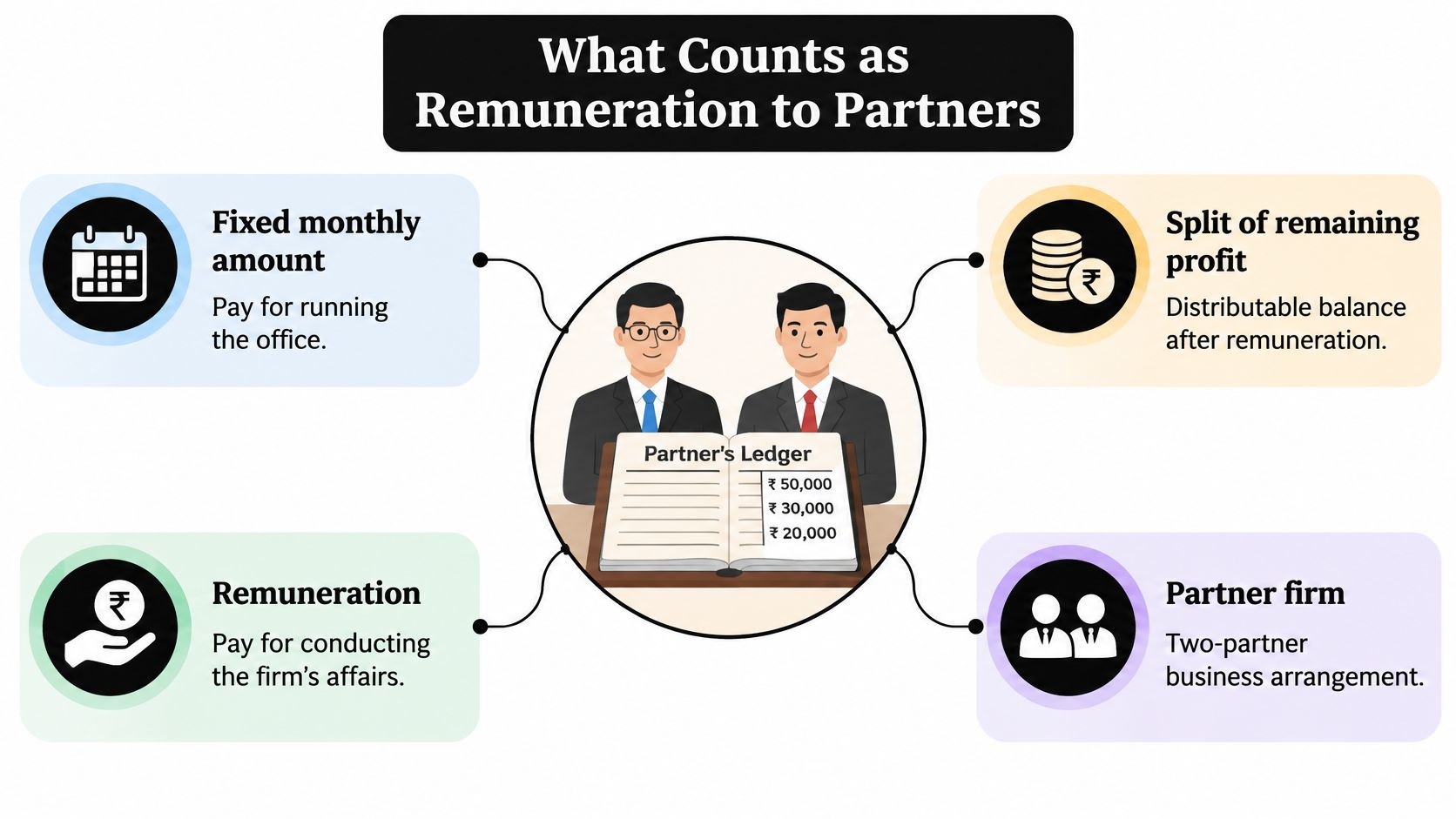
Take a firm with two partners. One manages staff, signs engagements and runs the office, receiving a fixed monthly amount for that work. Both partners later divide the distributable profit.
The monthly amount may be **remuneration for conducting the firm's affairs**. The later division is a **profit share**. A withdrawal, however, isn't automatically either: drawings may represent money taken against an existing balance.
The distinction is easier to see when the payment and the profit distribution are kept separate.
### The deduction needs every test to pass
Under [section 40(b) of the Income-tax Act](https://www.incometaxindia.gov.in/w/section-40-2), deductible remuneration must be paid to an individual working partner, authorised by and consistent with the deed for the relevant period, and within the statutory aggregate ceiling.
> **The deduction checklist**
>
> - **Working partner:** The individual actively conducts the firm's affairs.
> - **Effective deed authority:** The deed authorises the payment and covers the period to which it relates.
> - **Aggregate limit:** The combined remuneration paid or payable stays within the book-profit formula.
A sleeping partner doesn't become a working partner merely because the deed names them as eligible for payment. Keep evidence of the actual role, such as responsibility for operations, client work or supervision.
Likewise, a later deed amendment doesn't retrospectively authorise remuneration for an earlier period. Approval minutes can document a decision, but they can't replace missing deed authority.
### Accounting profit isn't the calculation base
**Book profit** is the profit computed under the business-income provisions, increased by remuneration already deducted in arriving at that profit. The add-back prevents the remuneration expense itself from shrinking the base used to calculate its deductible limit.
That makes the printed profit and loss account a starting document, not the completed remuneration working. First establish eligibility and authority, then calculate the rupee ceiling.
## How Partners Are Taxed on Their Remuneration
**Partner remuneration isn't employment salary merely because the ledger calls it salary.** The relevant starting point is [section 28(v), covering partner remuneration as business income](https://charterai.in/law/income-tax-act-1961/28), rather than the salary-income computation used for employees.
There's an important qualification: **a disallowance under section 40(b) does not automatically mean the same amount remains fully taxable to the partner**. The proviso to section 28(v) requires the partner's income to be adjusted to the extent the remuneration has not been allowed under section 40(b).
### Separate computations, with a statutory adjustment
The firm calculates its allowable business deduction. The partner calculates taxable business income from the firm, taking account of the statutory adjustment for remuneration disallowed to the firm.
So the proposition that a remuneration disallowance necessarily creates double taxation is misleading. Equally, the partner shouldn't omit a receipt because someone expects the firm to disallow it. The return needs the completed computation, not an assumption.
Use a reconciliation with clearly labelled fields:
- **Gross remuneration:** What the firm paid or credited under the deed.
- **Firm-level allowance:** What the firm ultimately claimed as deductible remuneration.
- **Disallowance analysis:** The amount and reason for any section 40(b) restriction.
- **Partner-level adjustment:** The corresponding treatment under section 28(v).
### TDS is a credit, not the income computation
Withholding and taxable income answer different questions. The partner should reconcile the gross credit and tax deducted with the firm's ledger, the TDS certificate and the tax-credit records.
Don't report only the net bank receipt as remuneration. Equally, don't assume that the gross amount appearing in a withholding record settles the final taxable amount without examining the applicable adjustment.
A non-working partner's remuneration also needs careful treatment. The firm's eligibility failure and the partner's income computation must be analysed together, rather than treating the deed label as decisive.
> **Return-preparation rule:** Reconcile the firm's deduction with the partner's business-income computation before either return is finalised.
## The Section 40(b) Ceiling and Book-Profit Base
Start with a tax-adjusted profit working, not a percentage applied to the bottom line in TallyPrime. The [section 40 statutory text](https://charterai.in/law/income-tax-act-1961/40) should sit alongside the computation so the preparer and reviewer use the same legislative version.
The practical task is to identify the correct base before applying any slab.
### Build the base before calculating the ceiling
1. **Start with the accounts:** Take the profit shown in the financial statements and identify where partner remuneration has been charged.
2. **Make business-income adjustments:** Reconcile accounting treatment with the relevant tax treatment. Keep each adjustment visible rather than using an unexplained balancing figure.
3. **Add back remuneration already deducted:** Include remuneration components by substance, not merely by ledger name. A bonus or commission paid for a partner's services shouldn't disappear from the review because it uses a separate expense head.
4. **Keep other items distinct:** Don't add back partner interest merely because it is a payment to a partner, and don't treat residual profit distribution as remuneration expense.
The result should be a traceable **book-profit working**, with a clear bridge from the accounts. A reviewer should be able to reproduce it without asking which version of the trial balance the preparer used.
### Apply the aggregate ceiling
The [Income Tax Department's LLP guidance](https://www.incometaxindia.gov.in/web/guest/llp) states that the current formula allows the higher of **₹3,00,000 or 90%** on the first **₹6,00,000** of book profit, with **60%** on the balance; in a loss situation, the ceiling is **₹3,00,000**. Its worked example gives a ceiling of **₹13,80,000** on book profit of **₹20,00,000**, comprising **₹5,40,000** on the first band and **₹8,40,000** on the balance.
**Deductible remuneration ceiling under the current Section 40(b) formula**
| Book-profit band | Rate or floor | Base | Deductible ceiling |
|---|---|---|---|
| First ₹6,00,000 of book profit | Higher of ₹3,00,000 or 90% | Up to ₹6,00,000 | 90% of the relevant book profit or ₹3,00,000, whichever is higher |
| Balance above ₹6,00,000 | 60% | Remaining book profit | 60% of the balance |
| Example: book profit ₹20,00,000 | 90% then 60% | ₹6,00,000 plus ₹14,00,000 | ₹5,40,000 plus ₹8,40,000, totalling ₹13,80,000 |
| Loss year | Ceiling of ₹3,00,000 | Negative base | ₹3,00,000 |
| Remuneration above the aggregate ceiling | Not allowable under section 40(b) | Excess over the applicable ceiling | Disallowed in the firm's business income |
This is a **firm-wide ceiling**, not a fresh allowance for each working partner. The deed determines how the authorised remuneration is divided between them.
Keep three outputs on the working paper: **deed entitlement**, **amount recognised in the accounts**, and **tax-deductible amount**. They may agree, but they aren't interchangeable.
### Label the assessment year
The [Income Tax Department's historical amendment text](https://www.incometaxindia.gov.in/w/section-16-114) records a substituted structure effective **1 April 1993**, including a first **₹75,000** band with a **₹50,000 or 90%** test and **60%** on the next **₹75,000**. Those are historical figures, not a current-year shortcut.
An old spreadsheet can calculate perfectly and still apply the wrong law. Put the assessment year and legislative version above the formula, then retain the reviewed version with the final accounts.
## Deed Clauses and Partner Ledger Entries
A useful deed clause makes the entitlement calculable. It identifies the eligible working partners, explains the amount or method, states how the total is allocated, and records when the clause takes effect.
Check those matters against the actual deed before preparing the voucher.

### Write a method the accounts team can apply
A fixed sum, an objectively calculable formula or a clearly drafted lower-of mechanism gives the preparer something to calculate. A bare reference to an amount being mutually agreed leaves avoidable uncertainty about what the deed authorises.
Don't confuse a recommendation for good drafting with a statutory requirement to use particular wording. The objective is a clause that establishes authority and permits a reliable calculation.
Before the year-end credit, give the preparer:
- **The operative clause:** Include the effective date and any amendments.
- **The allocation method:** Specify how the authorised total belongs to each eligible partner.
- **The provisional calculation:** Use the latest accounts and identify outstanding adjustments.
- **The approval record:** Document who reviewed the amount and the basis used.
### Post the entitlement, then reconcile the tax treatment
The gross entry normally debits partner remuneration expense and credits the relevant partner's current account. Record the withholding liability separately so the partner ledger shows the correct net payable.
Keep capital, current, remuneration and interest accounts distinguishable in TallyPrime, but use a common partner identifier. Separate ledgers help classification only if the reviewer can still assemble the full partner-wise position.
**Don't automatically reverse a genuine entitlement merely because part is non-deductible.** If the deed creates an unconditional fixed obligation, a tax restriction alone doesn't cancel that obligation. Retain the accounting liability and make the appropriate tax adjustment unless there is a valid basis to change the entitlement.
Where the deed instead limits entitlement to the statutory ceiling, a provisional excess may require a genuine correction. Document that correction and its effect on withholding, rather than both reversing the expense and adding it back again.
For a visual companion to the deed-and-ledger review:
Retain the signed deed extract, working-partner role note, provisional and final calculations, approval and journal voucher together. Don't bury remuneration corrections in drawings or profit appropriation.
## Section 194T Credits That Trigger TDS
**Cash isn't the only trigger.** A firm can create a withholding obligation by crediting a partner's account before anyone instructs the bank to pay.
Under the [Income Tax Department's section 194T text](https://www.incometaxindia.gov.in/w/section-194t-1), the firm deducts **10%** on covered remuneration, commission, bonus and interest at the earlier of credit or payment, including credit to a capital account, where the aggregate for the partner exceeds **₹20,000 in the financial year**.
### Control the event, not just the payment run
The following matrix applies that rule to the ledger. For advances, first establish their character: a genuine loan or capital drawing isn't automatically remuneration merely because the recipient is a partner.
**Partner-ledger control for Section 194T**
| Event | Counts toward ₹20,000 | When TDS is tested | Correction if missed |
|---|---|---|---|
| Remuneration credited to current account | Yes | Earlier of credit or payment | Deduct 10% on the covered credited sum and fix the net payable |
| Commission or bonus credited | Yes, in the same aggregate | Earlier of credit or payment | Same 10% deduction and partner-wise reconciliation |
| Interest credited to capital | Yes, aggregated with remuneration | Earlier of credit or payment | Include it in the partner-wise review despite the separate ledger |
| Credit to capital instead of current | Yes, where it is a covered sum | Capital credit date, unless paid earlier | Trace the voucher date, not the later cash date |
| Advance to a partner | Yes, if it is an advance of a covered sum | Earlier of the relevant credit or payment | Don't wait for year-end adjustment |
| Year-end provision actually credited | Yes, where credited to the partner's account | Credit date, unless paid earlier | Deduct with that credit; distinguish an unposted internal memo |
| Aggregate of ₹20,000 or below in the year | Threshold not crossed | No deduction while the aggregate remains within the threshold | Keep aggregating later credits |
| Aggregate above ₹20,000 | Threshold crossed | 10% on the covered sums credited or paid | Deposit and reconcile partner-wise |
### Reconcile across every partner account
At each quarterly review, assemble opening unpaid balances, fresh covered credits, payments, tax deducted and closing net payable. Opening balances need their own history so the team doesn't deduct again on an amount already subjected to withholding.
In TallyPrime, review vouchers by partner across current, capital and relevant expense ledgers. A remuneration-only report won't capture interest parked in capital or bonus credited separately.
Use a [TDS return compliance schedule](https://charterai.in/due-dates/tds-return-26q) to connect ledger review, deposit and statement preparation. If a deduction was missed, calculate the shortfall, assess the applicable interest and correction requirements, deposit the amount due, and update the partner reconciliation.
> A non-deductible remuneration expense can still be a covered credit for withholding. The deduction ceiling isn't a TDS exemption.
Date the credit voucher accurately and preserve its approval trail. The later bank date doesn't replace an earlier taxable credit event.
## Worked Figures for Profit and Loss Years
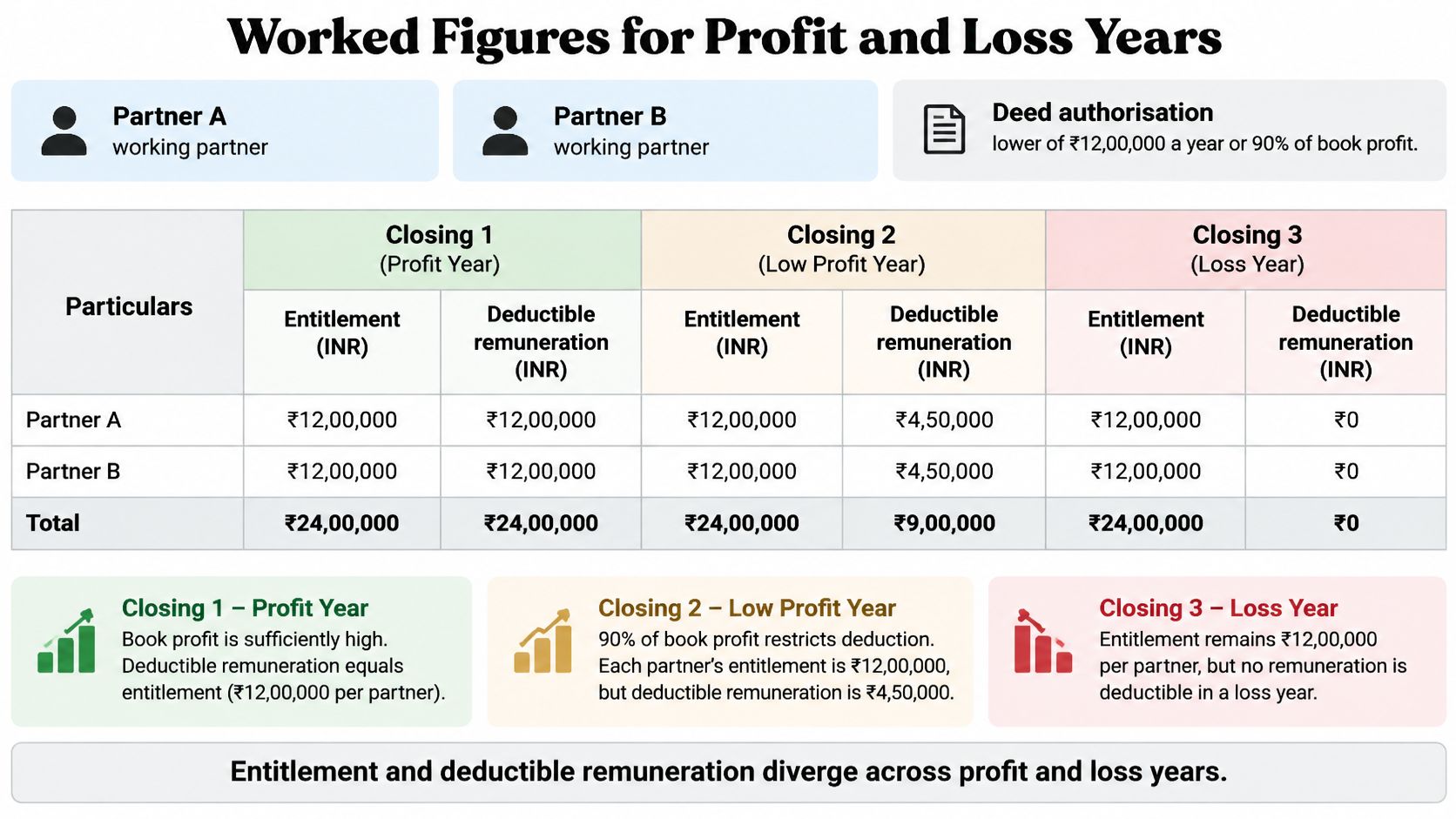
Consider a hypothetical firm with **Partner A and Partner B**, both working partners. Its deed, effective throughout the relevant period, authorises the lower of a fixed annual amount and the statutory remuneration ceiling, divided equally.
The [Income Tax Department's firm guidance](https://www.incometaxindia.gov.in/firm) supports the underlying calculation: **₹3,00,000 or 90%** on the first **₹6,00,000**, whichever is higher, plus **60%** on the balance, with a stated **₹3,00,000** ceiling in a loss year. The figures below are hypothetical applications of that formula, using a fixed annual reference amount of **₹12,00,000**.
The key distinction is between a **fixed reference amount** and an **unconditional fixed entitlement**.
### A profitable close
Suppose final book profit is **₹20,00,000**. Applying the stated formula produces a ceiling of **₹13,80,000**, so the hypothetical fixed reference amount of **₹12,00,000** is the lower amount.
The firm therefore credits **₹6,00,000** gross to each partner. Withholding is recorded separately under the applicable partner-wise credit-date control, rather than treating the gross entitlement as the net amount available for withdrawal.
### Late adjustments change the entitlement
Now suppose late debit notes reduce final book profit to **₹4,00,000**. The formula produces **₹3,60,000**, being higher than the fixed floor.
Under this hypothetical lower-of deed, the entitlement falls accordingly. If the accounts team provisionally credited **₹12,00,000**, the excess provisional credit is **₹8,40,000** and needs correction on a documented basis.
That differs from a deed promising an unconditional fixed amount. In that case, the firm cannot cancel a valid liability to make its accounts match the tax deduction.
**Three closings for one firm with a fixed ₹12,00,000 deed clause**
*Hypothetical clause: the fixed amount is expressly restricted to the lower statutory ceiling.*
| Scenario | Book profit | Ceiling | Credited | Deductible | Action |
|---|---|---|---|---|---|
| Profit year | ₹20,00,000 | ₹13,80,000 | ₹12,00,000 | ₹12,00,000 | Credit ₹6,00,000 gross to each partner and apply withholding |
| Late debit notes | ₹4,00,000 | ₹3,60,000 | ₹12,00,000 provisionally, corrected to ₹3,60,000 | ₹3,60,000 | Correct the ₹8,40,000 provisional excess and reconcile TDS |
| Loss year | Loss | ₹3,00,000 | ₹3,00,000 | ₹3,00,000 | Check withholding on each partner's covered credits |
### A loss doesn't remove the decision
In the loss scenario, the statutory ceiling remains available, but it doesn't create entitlement by itself. The deed and the actual obligation still determine what the firm recognises.
Nor does an available deduction mean payment is automatically sensible. Partners should review cash needs, their individual tax positions and withholding consequences before committing to the credit.
Model the possible closing outcomes before approval. Once the accounts are final, replace the provisional working and retain the reason for every changed credit.
## Close the Year with a Remuneration File
A remuneration file should let another CA move from the deed to the accounts, then to the firm's return, the partner's computation and the withholding records without reconstructing the decisions.
The strongest final check is a **three-way match between deed authority, the deductible ceiling and the credit event**. A correct slab calculation proves only one part of that match.
### Use a review gate before filing
- **Confirm authority:** Retain the operative deed and amendments, verify the period covered, and document each recipient's working role.
- **Recompute the base:** Tie the final book-profit calculation to the approved accounts and show the remuneration add-back.
- **Resolve provisional amounts:** Correct genuine provisional errors, but don't reverse an enforceable entitlement solely to avoid a disallowance.
- **Match the partner computations:** Record the firm's allowance and the partner-level statutory adjustment consistently.
- **Complete withholding reconciliation:** Assemble covered amounts across partner accounts and check the earlier credit or payment event.
- **Preserve the audit trail:** File voucher dates, approvals, deduction workings and withholding records together.
- **Identify the law used:** Put the assessment year and legislative version on the signed-off working paper.
Assign a preparer and reviewer to the same final version. Mark unresolved deed wording, disputed entitlement or missed withholding as open items, not informal notes that disappear after the return is uploaded.
> **Final approval standard:** Don't approve the remuneration posting and return treatment until the deed, computation and credit-date records agree.
---
Charter AI brings source-linked tax research, bookkeeping workflows and client documents into a shared workspace, so the partner can review the deed and legal position while the team handles repetitive reconciliation work. Our unlimited compliance calendar keeps TDS, ITR and client deadlines alongside the related work. Visit [Charter AI](https://www.charterai.in) to organise your remuneration workings, supporting documents and compliance review in the same client workspace.
## Tags
- [Remuneration to partners](https://charterai.in/blog/tag/remuneration%20to%20partners)
- [Section 40 b](https://charterai.in/blog/tag/section%2040(b))
- [Book profit](https://charterai.in/blog/tag/book%20profit)
- [Section 194T](https://charterai.in/blog/tag/section%20194T)
- [Partnership deed](https://charterai.in/blog/tag/partnership%20deed)
Canonical: https://charterai.in/blog/remuneration-to-partners