# Rate of Depreciation as Per Companies Act 2013
Rate of depreciation as per Companies Act 2013 explained: Schedule II useful lives, legacy Schedule XIV rates, worked examples and book vs tax differences.
Published 16 Nov 2026. 17 min read.
The popular advice to pick a depreciation percentage from an online chart and apply it to every asset is the wrong starting point. For the **rate of depreciation as per Companies Act 2013**, the working question is the asset's useful life, not which familiar percentage appeared in last year's spreadsheet. A calculation can be arithmetically correct and still be wrong because the accountant selected the wrong asset class, reporting framework or depreciable base.
A sound working paper starts with classification, establishes the amount to depreciate, and then converts the useful life into a charge using the selected method. Legacy company-law percentages and income-tax rates belong in separate calculations, not in the same lookup column.
## Table of Contents
- [Schedule II Useful Lives for Common Assets](#schedule-ii-useful-lives-for-common-assets)
- [Match the asset before selecting its life](#match-the-asset-before-selecting-its-life)
- [Turn the selected life into a charge](#turn-the-selected-life-into-a-charge)
- [How to Calculate Depreciation Under Schedule II](#how-to-calculate-depreciation-under-schedule-ii)
- [Build the calculation from approved inputs](#build-the-calculation-from-approved-inputs)
- [Check the formula, not just the total](#check-the-formula-not-just-the-total)
- [When a Different Useful Life or Residual Value Applies](#when-a-different-useful-life-or-residual-value-applies)
- [Distinguish evidence from a preferred result](#distinguish-evidence-from-a-preferred-result)
- [Recalculate from the right point](#recalculate-from-the-right-point)
- [Mid-Year Purchases, Disposals and Impairment](#mid-year-purchases-disposals-and-impairment)
- [Keep the period calculation reproducible](#keep-the-period-calculation-reproducible)
- [Separate impairment from routine allocation](#separate-impairment-from-routine-allocation)
- [Legacy Schedule XIV Rates for Earlier Years](#legacy-schedule-xiv-rates-for-earlier-years)
- [Keep historical rates tied to their authority](#keep-historical-rates-tied-to-their-authority)
- [Preserve the history without preserving an obsolete basis](#preserve-the-history-without-preserving-an-obsolete-basis)
- [Why Book and Income Tax Depreciation Differ](#why-book-and-income-tax-depreciation-differ)
- [Compare the inputs rather than forcing agreement](#compare-the-inputs-rather-than-forcing-agreement)
- [Reconcile the difference before assessing deferred tax](#reconcile-the-difference-before-assessing-deferred-tax)
- [Opening Carrying Amount After the Schedule II Switch](#opening-carrying-amount-after-the-schedule-ii-switch)
- [Reconstruct the opening position](#reconstruct-the-opening-position)
- [Test the opening balance and denominator separately](#test-the-opening-balance-and-denominator-separately)
- [Related Standards and Disclosures to Check](#related-standards-and-disclosures-to-check)
- [Keep a focused cross-reference file](#keep-a-focused-cross-reference-file)
- [Make the review trail usable](#make-the-review-trail-usable)
## Schedule II Useful Lives for Common Assets
Schedule II's useful-life table is the practical starting point: it gives each listed asset category a life in years, which can then be converted into an annual depreciation charge. The percentage is a result of the calculation, not a universal rate to apply across the asset register.
Classification determines which life applies. A register entry such as “building”, “equipment” or “computer” may be too broad. Check the asset's construction, function and use against the relevant Schedule II description before selecting a life.
### Match the asset before selecting its life
| Asset class | Schedule II useful life |
|---|---:|
| Building, factory (RCC frame) | 30 years |
| Building, other than factory (RCC frame) | 60 years |
| Plant and machinery, general | 15 years |
| Plant and machinery, continuous process | 25 years |
| Electrical installations and equipment | 10 years |
| Furniture and fittings | 10 years |
| Office equipment | 5 years |
| Motor cars | 8 years |
| Computers, servers and networks | 6 years |
| Computers, end-user devices | 3 years |
These are the useful lives specified for the listed categories in Schedule II to the Companies Act, 2013. Apply the entry that fits the asset's actual classification, not the closest wording in the register.
A classification should be clear from the records. For machinery, retain the equipment description and operating purpose. For buildings, document the construction type and use. An invoice description helps identify what was purchased, but may not establish the correct depreciation category on its own.
> **Practical rule:** Record enough detail for another accountant to understand why the selected Schedule II entry applies.
### Turn the selected life into a charge
For straight-line depreciation, divide cost less residual value by the selected useful life. The result is the annual charge when the asset is in use for the full year. Dividing cost alone by the life ignores residual value and changes the depreciable amount.
A different useful life may be appropriate when the company can support it with technical evidence and provides the required disclosure. That judgement should reflect the asset's expected use, not a preferred profit outcome.
## How to Calculate Depreciation Under Schedule II
A reliable calculation separates the inputs from the formula. Keep cost, residual value, useful life, method and relevant dates in distinct asset-register fields rather than embedding assumptions inside spreadsheet formulas.
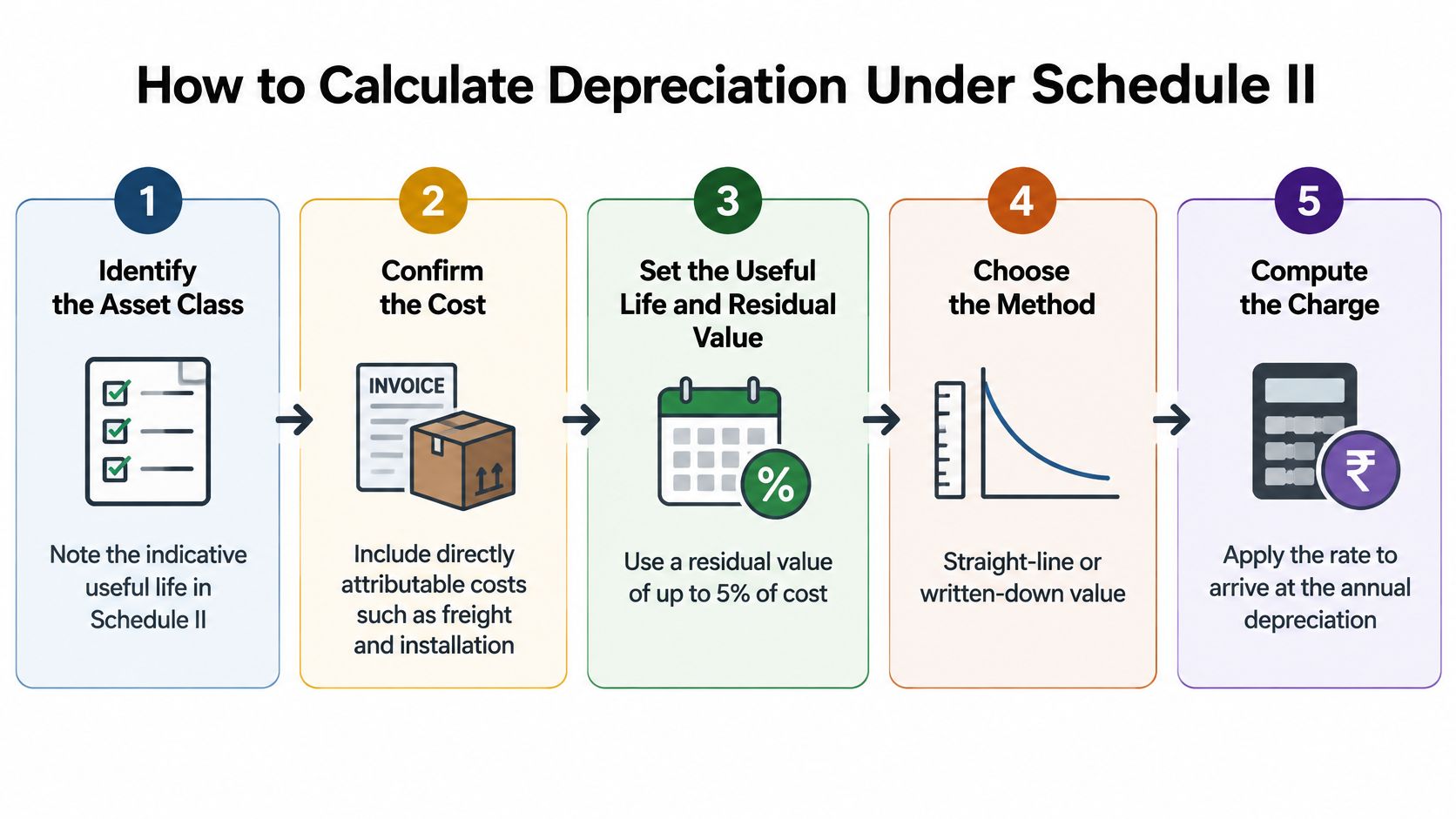
The calculation workflow is illustrated below.
### Build the calculation from approved inputs
1. **Identify the asset class.** Match the asset to the applicable Schedule II description and document the selected life. Resolve uncertain classifications before running the schedule.
2. **Confirm the depreciable base.** Reconcile the capitalised amount to the purchase documentation and ledger. Review freight, installation and similar expenditure under the applicable accounting requirements rather than treating the invoice total as automatically conclusive.
3. **Estimate residual value.** Establish the expected amount remaining at the end of the asset's useful life and check it against the applicable requirements. Don't select a residual value merely because the spreadsheet already contains one.
4. **Calculate the depreciable amount.** Deduct residual value from cost or the other appropriate depreciable base. Keep the deduction visible so a reviewer can distinguish an input error from a formula error.
5. **Choose the method.** Use straight-line, written-down value or another appropriate method that reflects the consumption of economic benefits. A convenient tax percentage isn't, by itself, a reason to select a book method.
6. **Compute and reconcile the charge.** Apply the chosen method, then reconcile opening carrying amount, depreciation and closing carrying amount. Deal separately with part-period adjustments and other movements.
### Check the formula, not just the total
Under the **straight-line method**, the core calculation is:
**Annual depreciation = (depreciable base − residual value) ÷ useful life**
Expressed as a percentage of original cost, the corresponding straight-line rate is:
**Annual straight-line rate = annual depreciation ÷ original cost**
That distinction matters. The reciprocal of useful life isn't necessarily the correct percentage of original cost when the calculation includes a residual amount.
Under a **written-down value method**, the percentage applies to the reducing carrying amount. A rate derived to reach a selected residual value over a selected life is conceptually different from a tax rate prescribed for a block of assets.
The [depreciation schedule tool](https://charterai.in/tools/depreciation) can support preparation of the working schedule, but the accountant still needs to approve the classification and assumptions.
Before posting, check that the straight-line charge is consistent across comparable full periods and that the closing amount approaches the selected residual value. Retain calculation precision internally and control rounding at presentation level, rather than allowing repeated rounding to create an unexplained balance.
## When a Different Useful Life or Residual Value Applies
**A different useful life needs evidence before it needs a formula.** Management should be able to explain why the asset's expected service differs from the class indication and how that assessment affects depreciation.
Useful evidence addresses the asset itself. A technical note might consider operating intensity, maintenance arrangements, exposure to corrosive conditions, expected obsolescence or restrictions on continued use. A general statement that management considers the asset serviceable doesn't explain a particular remaining life.
### Distinguish evidence from a preferred result
A machine used intensively may warrant closer examination, but operating intensity shouldn't become an automatic life reduction. Check the relevant treatment of shift working as well as the technical assessment, so the company doesn't recognise the same wear twice.
Likewise, an asset in a coastal location doesn't automatically require a shorter life. The useful question is whether its construction, protection, maintenance and condition support a different estimate.
- **Technical basis:** Identify the asset, its condition, expected operating pattern and the reasoning behind the selected life.
- **Financial effect:** Show how the proposed estimate changes the depreciation charge.
- **Approval trail:** Record who assessed the asset and who approved the accounting conclusion.
- **Disclosure support:** Retain wording that explains the departure and its basis clearly.
> A technical note should explain the estimate. It shouldn't merely repeat the estimate in more formal language.
### Recalculate from the right point
There's an important distinction between selecting a shorter life when an asset is first recognised and revising its life after use. At initial recognition, the calculation starts with the original depreciable base. For a later revision, assess the current carrying amount and remaining service potential under the applicable accounting requirements.
Don't replace the original life in every historical spreadsheet row. That can turn a current estimate revision into an unintended rewriting of earlier depreciation.
Residual value also deserves an independent assessment. A higher expected disposal amount reduces the depreciable amount, so management should support it rather than treating it as a balancing figure.
If the company departs from the Schedule II indication, the file should contain a written technical explanation that a reviewer can evaluate without reconstructing management's reasoning.
## Mid-Year Purchases, Disposals and Impairment
For a mid-year acquisition, the key control is the **date the asset becomes available for its intended use** under the applicable accounting framework. The invoice date, payment date and commissioning date may describe different events.
An installation awaiting essential testing shouldn't enter the schedule merely because the supplier has been paid. Equally, administrative delay in recording an operational asset shouldn't postpone the accounting assessment.
### Keep the period calculation reproducible
Apply the appropriate part-period convention consistently and retain the underlying dates. A reviewer should be able to reproduce the charge from the register without searching through emails.
For an asset entering service part-way through a reporting period, the working logic is:
**Part-period depreciation = full-period charge × applicable proportion of the period**
The same discipline applies to disposals. Establish the appropriate cessation date under the applicable accounting requirements, calculate the charge to that point and reconcile the carrying amount removed from the books. Recognise the disposal result separately rather than adjusting depreciation to make the ledger agree with sale proceeds.
| Event | Evidence to retain | Calculation check |
|---|---|---|
| Asset becomes available for use | Installation or commissioning support | Appropriate commencement date |
| Asset is disposed of | Disposal approval and transaction documents | Carrying amount removed and result reconciled |
| Impairment is assessed | Valuation or recoverability working | Revised basis for subsequent depreciation |
### Separate impairment from routine allocation
**Depreciation and impairment answer different questions.** Depreciation allocates the depreciable amount over use; impairment considers whether the carrying amount remains recoverable under the relevant accounting requirements.
Don't use an arbitrary additional depreciation charge to avoid documenting an impairment assessment. Where an impairment adjustment changes the carrying amount, reassess the subsequent depreciation calculation using the appropriate revised base and remaining life.
The asset register should preserve the service date, disposal date and impairment references. Those fields are part of the audit trail, not optional comments beside the annual charge.
## Legacy Schedule XIV Rates for Earlier Years
An asset bought in 2012 does not keep a Schedule XIV percentage forever, and a year that closed before the switch is not restated under Schedule II. The reporting year picks the statute. The [Companies Act, 2013 and the MCA's implementation position](https://www.mca.gov.in/content/dam/mca/pdf/CompaniesAct2013.pdf) place Schedule II's useful-life approach in financial years beginning on or after **1 April 2014**. Financial years before that date stay under the Companies Act, 1956, where Schedule XIV stated depreciation as a straight-line or written-down-value percentage linked to the asset description.
Ignore that cut-off and two errors follow. One is charging a Schedule II life in a year the 1956 Act still governed. The other is rolling the old percentage into every later year because the invoice date sits before the switch.
### Keep historical rates tied to their authority
A Schedule XIV percentage is usable only for the year, the asset description and the method the schedule covered. Factory buildings, other buildings, general plant, a specified class of machinery, furniture, computers and motor cars were not one rate. SLM and WDV were not interchangeable either. A figure copied from another working paper does not establish the rate. The percentage needs the historical schedule entry that matches that asset and that method before it enters a signed calculation.
The same asset can show two straight-line figures that both look tidy. One is the Schedule XIV percentage on historical cost for a pre-transition year. The other is depreciable amount divided by the Schedule II useful life for a later year. They are different bases. Treat the gap as a change of framework until you have named the Act, the method and the transition treatment.
> **Review checkpoint:** Establish the reporting year first. Only then select the governing schedule and calculation basis.
### Preserve the history without preserving an obsolete basis
Leave depreciation already charged under Schedule XIV inside accumulated depreciation. Wiping those years because the company later moved to useful lives breaks the roll-forward.
That history does not set the charge after the switch. For an asset carried into Schedule II, the transition working should show the opening carrying amount under the new framework and the life, or remaining life, used from the first year the 2013 Act applies. The control that holds up in review is a period record: which Act, which schedule, which method, for which year. A single percentage column copied forward hides whether the old year stayed accurate or the outdated calculation never stopped.
## Why Book and Income Tax Depreciation Differ
**Book depreciation and tax depreciation serve different calculations.** The company's financial-reporting schedule allocates the depreciable amount using the relevant accounting basis. The tax computation applies the applicable income-tax provisions separately.
This comparison illustrates the distinction between the two working schedules.
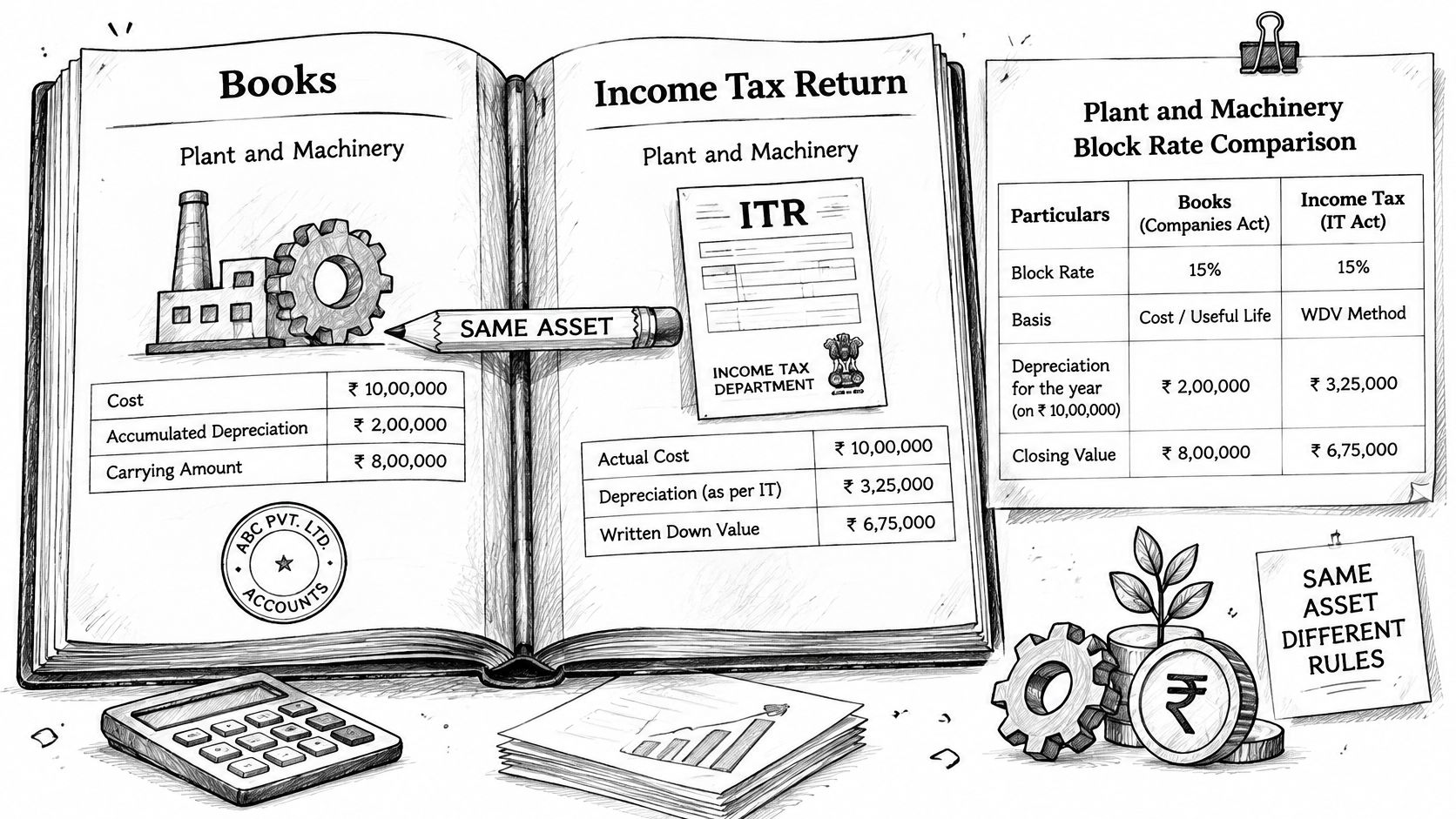
A tax rate should therefore never populate the book-depreciation field by default. Even where the resulting amounts happen to be close, the accountant must be able to support each calculation independently.
### Compare the inputs rather than forcing agreement
| Asset | Schedule II indicative life | Income-tax WDV block rate |
|---|---|---|
| Plant and machinery, general | Confirm the applicable general machinery life | Verify the applicable machinery block |
| Computers, end-user devices | Confirm the end-user-device classification | Verify the applicable computer block |
| Furniture and fittings | Confirm the relevant furniture category | Verify the applicable furniture block |
| Buildings | Establish construction and use classification | Verify the applicable building block |
| Motor cars | Confirm vehicle category and use | Verify the applicable vehicle block and conditions |
Use the [income-tax depreciation provision](https://charterai.in/law/income-tax-act-1961/32) as a separate legal research starting point, checking the law applicable to the period being computed. Don't infer tax eligibility, classification or rate from the book schedule.
Consider a hypothetical computer purchase. The book calculation may allocate cost less residual value across its assessed useful life, while the tax computation uses the applicable block mechanism. Different bases and timing can produce different charges without either calculation being wrong.
The following video provides additional context for reviewing the distinction.
### Reconcile the difference before assessing deferred tax
Keep the tax adjustment distinct from the book journal. The depreciation difference is an input to the deferred-tax assessment under the applicable accounting requirements, not automatically a journal for the same amount.
- **Book schedule:** Retain asset-level cost, residual value, method, life and carrying amount.
- **Tax schedule:** Maintain the relevant block information and applicable tax adjustments.
- **Reconciliation:** Explain the difference between the charges and assess the resulting tax consequences.
Our depreciation schedule tool accepts a pasted asset register and shows books and tax depreciation side by side. That comparison helps identify differences, but the reviewer still needs to confirm the legal classification and assumptions on each side.
## Opening Carrying Amount After the Schedule II Switch
**An existing asset doesn't become a new asset when the depreciation framework changes.** The transition working must preserve the accumulated accounting history and establish the basis for the remaining charge.
Restarting from original cost over a fresh full life can understate subsequent depreciation and extend the allocation beyond the supported service period. Continuing the old annual percentage without assessing the transition can produce a different error.
### Reconstruct the opening position
Start with a reconciliation between the fixed-asset register and general ledger. Resolve missing additions, unrecorded disposals and unexplained accumulated-depreciation balances before calculating the revised charge.
1. **Establish the opening carrying amount.** Reconcile original cost or the relevant carrying base with accumulated depreciation and other recorded adjustments.
2. **Document the useful-life assessment.** Identify the applicable asset category and evaluate the service already consumed.
3. **Determine remaining life.** Use a supported estimate rather than assuming the full class life begins again.
4. **Confirm residual value.** Apply the appropriate estimate to the transition calculation.
5. **Calculate the remaining allocation.** Where straight-line depreciation is appropriate and service life remains, allocate the opening carrying amount less residual value over that remaining life.
6. **Identify exhausted-life cases separately.** Apply the relevant transitional requirements rather than spreading an unsupported balance into later periods.
The working formula is:
**Revised annual straight-line charge = (opening carrying amount − residual value) ÷ remaining useful life**
### Test the opening balance and denominator separately
A transition calculation can fail even when the formula is correct. An overstated opening carrying amount affects the numerator; an unsupported remaining life affects the denominator.
For a plant item already used for a substantial part of its service life, the revised charge needn't match the amount calculated for an identical new asset. The existing asset has a different opening balance and a different remaining allocation period.
Keep a distinct transition working rather than burying the adjustment in the current-year depreciation column. Record the effective transition point, opening carrying amount, remaining life, residual value and resulting charge in the asset register.
That record allows a later reviewer to distinguish a legitimate transition result from a classification error, a change in estimate or a spreadsheet overwrite.
## Related Standards and Disclosures to Check
Schedule II supplies the company-law framework, but the asset register also needs to support the company's applicable accounting standards and financial-statement presentation. **Select the reporting framework before choosing the detailed accounting treatment.**
Don't treat an old accounting manual as proof that every standard named in it remains applicable. Confirm the current requirements for the company and the reporting period, particularly where legacy depreciation guidance has been replaced or incorporated into property, plant and equipment requirements.
### Keep a focused cross-reference file
- **Property, plant and equipment requirements:** Support recognition, the depreciable base, useful life, residual value and the selected allocation method.
- **Impairment requirements:** Support recoverability assessments and any resulting adjustment to carrying amount.
- **Income-tax accounting requirements:** Explain the assessment of deferred tax arising from differences between accounting and tax treatment.
- **Accounting-estimate requirements:** Establish how revised expectations affect the current and subsequent reporting periods.
- **Financial-statement presentation requirements:** Determine the asset-class movements, depreciation information and accounting-policy disclosures to present.
- **Company-law requirements:** Support the Schedule II classification and any justified departure from the indicated life.
Use the [Companies Act reference](https://charterai.in/law/companies-act-2013) alongside the applicable accounting requirements, not as a replacement for them. A depreciation file should connect the register, technical assessment, calculation, journal and disclosures.
### Make the review trail usable
A reviewer should be able to move from the financial-statement balance to the asset class, then to the calculation and its supporting assumptions. Keep approval notes and technical evidence beside the register rather than in a separate correspondence archive.
The final check isn't whether the spreadsheet produces a total. It's whether another accountant can explain why that total is appropriate.
---
Charter AI offers a depreciation schedule tool that accepts a pasted asset register and presents book and tax depreciation side by side. Visit [Charter AI](https://www.charterai.in) to prepare the comparison, then review the asset classifications, useful lives and tax treatment before finalising your depreciation working papers.
## Tags
- [Depreciation rates](https://charterai.in/blog/tag/depreciation%20rates)
- [Schedule II depreciation](https://charterai.in/blog/tag/Schedule%20II%20depreciation)
- [Useful life India](https://charterai.in/blog/tag/useful%20life%20India)
- [Schedule XIV rates](https://charterai.in/blog/tag/Schedule%20XIV%20rates)
- [Companies Act 2013](https://charterai.in/blog/tag/Companies%20Act%202013)
Canonical: https://charterai.in/blog/rate-of-depreciation-as-per-companies-act-2013