# Ind as 115 5 Step Model: A Practical Guide for CAs
Learn the Ind AS 115 5 step model with worked rupee examples, clear judgement checkpoints and the audit trail CAs need.
Published 7 Nov 2026. 15 min read.
You're closing the books, and the sales team has sent across a machine invoice with installation and maintenance bundled into the price. The customer has accepted the invoice, but installation is incomplete and support hasn't started. Your colleague asks whether the whole amount can go to revenue. The answer starts with the contract, not the invoice.
## Table of Contents
- [The Five Steps of Ind AS 115 at a Glance](#the-five-steps-of-ind-as-115-at-a-glance)
- [Where to slow down](#where-to-slow-down)
- [How to Identify the Contract and Its Performance Obligations](#how-to-identify-the-contract-and-its-performance-obligations)
- [Test the output, not the label](#test-the-output-not-the-label)
- [Handling Variable Consideration Without Overstating Revenue](#handling-variable-consideration-without-overstating-revenue)
- [Choose the estimate that fits the uncertainty](#choose-the-estimate-that-fits-the-uncertainty)
- [Make subsequent events part of the review](#make-subsequent-events-part-of-the-review)
- [Allocating the Price in a Bundled Contract Step by Step](#allocating-the-price-in-a-bundled-contract-step-by-step)
- [Build the allocation from observable prices](#build-the-allocation-from-observable-prices)
- [Don't allocate the discount by convenience](#dont-allocate-the-discount-by-convenience)
- [Over Time or at a Point in Time](#over-time-or-at-a-point-in-time)
- [Read the conditions precisely](#read-the-conditions-precisely)
- [Measure progress faithfully](#measure-progress-faithfully)
- [Documenting Judgements and Closing Checks](#documenting-judgements-and-closing-checks)
- [Connect each judgement to the ledger](#connect-each-judgement-to-the-ledger)
- [Prepare disclosures from the same file](#prepare-disclosures-from-the-same-file)
- [Close with accountable review](#close-with-accountable-review)
## The Five Steps of Ind AS 115 at a Glance
Ind AS 115 applies to accounting periods beginning on or after **1 April 2018**, replacing primarily industry-specific revenue guidance with a common, principles-based framework for customer contracts, subject to specified exclusions, under the MCA's amendment rules.
| Step | Question it answers | Output of the step |
|---|---|---|
| 1. Identify the contract | Is there an enforceable agreement with commercial substance? | Accepted contract with identifiable rights and payment terms |
| 2. Identify performance obligations | What distinct goods or services has the entity promised? | List of distinct promises |
| 3. Determine the transaction price | How much consideration is the entity entitled to? | Amount excluding GST and taxes collected for third parties |
| 4. Allocate the transaction price | How much of the price belongs to each obligation? | Amount allocated to each obligation based on standalone selling prices |
| 5. Recognise revenue | When, or as, is each obligation satisfied? | Revenue recognised at a point in time or over time |
Think of the **Ind AS 115 5 step model** as a five-stop checklist taking a sale from agreement to income. Each stop produces a conclusion that the next stop needs. You can't make a defensible allocation until you know what the customer has been promised.
The practical objective is to explain the **nature, amount, timing and uncertainty** of revenue and related cash flows. A reviewer should be able to follow the commercial arrangement through to the ledger without guessing why finance selected a particular treatment.
> **Practical rule:** Treat the invoice as evidence of billing, not as the revenue-recognition conclusion.
An advance invoice may create a **contract liability**, rather than immediate income. Cash collection, invoicing and performance can occur at different stages of the same arrangement.
### Where to slow down
Give particular attention to **identifying performance obligations** in bundled contracts. If installation belongs with the machine rather than being a separate promise, both the allocation and recognition conclusions change. A spreadsheet can calculate the allocation correctly while still producing the wrong revenue because the underlying obligations were identified incorrectly.
## How to Identify the Contract and Its Performance Obligations
Start with the complete commercial record. A signed agreement may need to be read alongside the purchase order, accepted quotation, statement of work and correspondence that changes what the supplier must deliver.
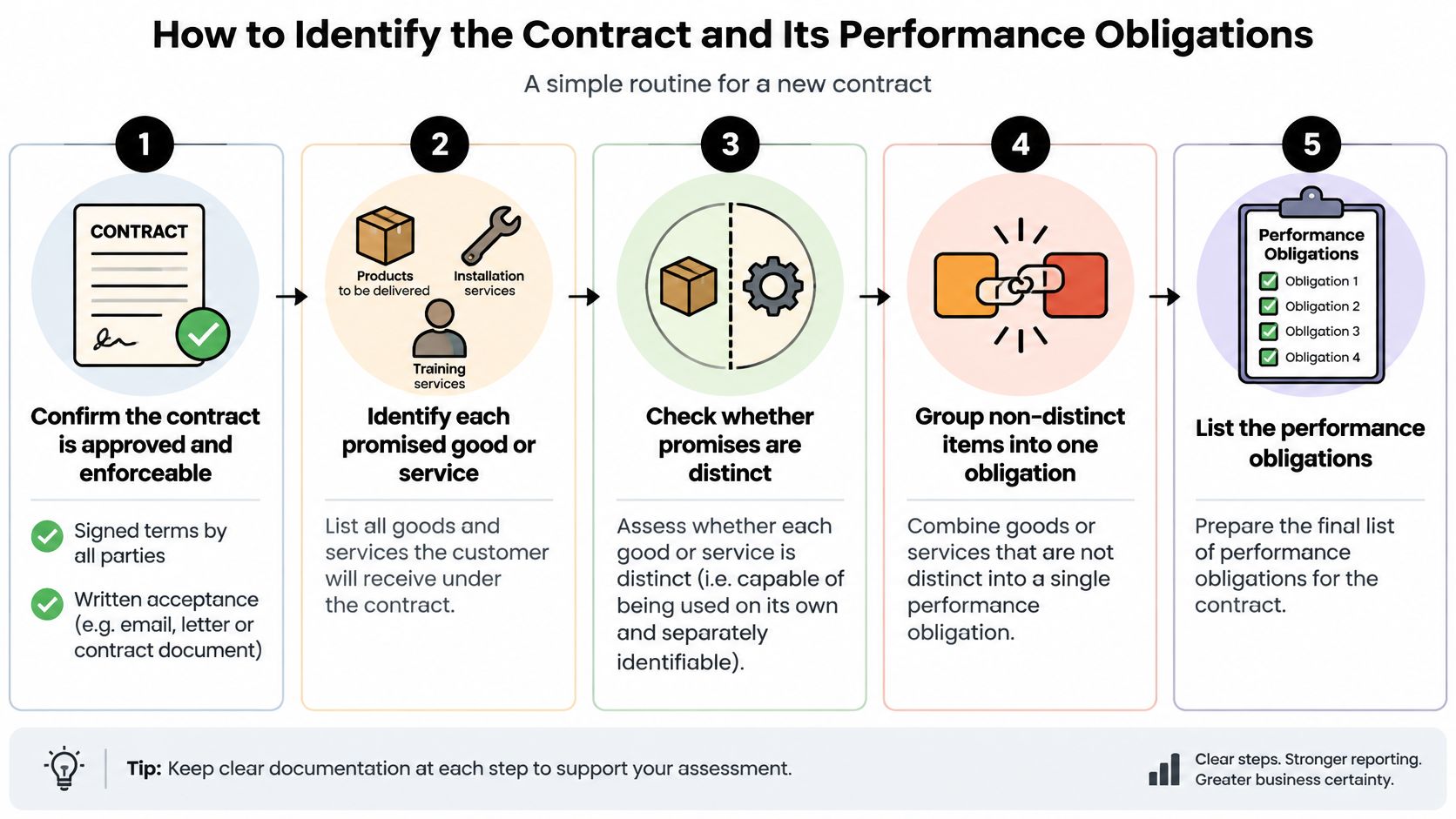
Use this routine when opening a new contract file.
1. **Confirm approval and enforceability.** Look for signed terms or a purchase order accepted in writing, and establish that both parties are committed to performing. A draft quotation or an internal sales forecast isn't enough.
2. **Identify rights and payment terms.** Record what the customer can demand and when consideration becomes payable. Resolve conflicting terms between the purchase order and supplier quotation before drawing an accounting conclusion.
3. **Check commercial substance.** Ask whether the arrangement is expected to change the risk, timing or amount of future cash flows. Document the commercial purpose rather than merely marking the condition as satisfied.
4. **Assess probable collection.** Consider the customer's ability and intention to pay the consideration to which the entity expects to be entitled. If collection isn't probable, don't force the arrangement through the revenue model merely because sales has raised an invoice.
5. **List every promised good or service.** Include installation, training, maintenance, warranties and benefits described outside the main pricing schedule. Distinguish a promised customer deliverable from an internal activity needed to fulfil the contract.
6. **Test distinctness.** The customer must be able to benefit from the item alone or with readily available resources, and the promise must be separately identifiable within the contract. Combine items when the supplier is providing an integrated output rather than clearly separate deliverables.
The workflow below turns that assessment into a list of obligations.
### Test the output, not the label
Say a gym sells membership with locker access and a personal-training session. Membership and the trainer's session may be distinct because the member can benefit from each separately. Locker access might form part of the overall membership service.
Likewise, separately naming installation doesn't automatically make it a separate obligation. If the supplier must substantially integrate or modify equipment to produce the functioning system promised to the customer, the combined output may be the obligation.
Keep the **signed terms, promise inventory and distinctness assessment** together. For every borderline item, write a short explanation of what the customer receives, how it benefits the customer and why the item is separate or combined.
## Handling Variable Consideration Without Overstating Revenue
**Include variable consideration only to the extent that it's highly probable a significant reversal of cumulative recognised revenue won't occur**, a constraint discussed in [Treelife's revenue-recognition guidance](https://treelife.in/finance/ind-as-115-revenue-recognition-for-saas-and-subscription-businesses/). Rebates, returns, incentives, penalties and price concessions therefore need an estimate supported by evidence, not an optimistic assumption.
Separate the exercise into estimating the amount and applying the constraint. A reasonable forecast doesn't automatically establish that the resulting revenue is sufficiently protected against reversal.
| Variable element | Estimation method | Evidence to retain |
|---|---|---|
| Volume rebate | Expected value or most likely amount | Sales history and approved rebate scheme |
| Right of return | Expected value of returns | Past return rates and the credit note trail |
| Liquidated damages | Most likely amount | Delivery schedule and penalty clause |
| Price concession | Most likely amount | Customer correspondence and board-approved policy |
| Channel incentive | Expected value | Scheme terms and receivables ageing report |
The methods in the table are starting points, not mandatory pairings. Select the method that best predicts the consideration for the particular arrangement.
### Choose the estimate that fits the uncertainty
The **expected-value method** weights possible outcomes by their probabilities. It can suit a portfolio of similar sales with several possible return or rebate outcomes.
The **most-likely-amount method** selects the single most likely outcome. It can suit an arrangement with a binary performance bonus or a clearly defined penalty outcome. Don't switch methods merely because another method produces a more favourable result.
For a hypothetical example, suppose a supplier promises a distributor a **2% rebate**, increasing to **4%** once annual purchases pass a contractual threshold. If purchases are close to that threshold, recognising sales using only the lower rebate may overstate the supplier's entitlement. Assess the likely purchasing outcome and whether uncertainty requires a more cautious revenue amount.
The rebate reduces the supplier's transaction price. It isn't additional rebate revenue for the supplier, and the accounting analysis shouldn't confuse the supplier's and distributor's perspectives.
### Make subsequent events part of the review
Trace credit notes issued after year-end to the underlying sales and the original estimate. Ask whether they provide evidence about conditions at the reporting date or arise from a new event.
Keep **price uncertainty** separate from **credit deterioration**. A negotiated concession may change the transaction price; an inability to collect an otherwise valid entitlement calls for an impairment assessment, including for a contract asset.
> A failed collection doesn't, by itself, tell you whether the original revenue estimate was wrong.
Prepare an evidence pack containing the approved scheme, sales forecast, customer correspondence, GST invoice and credit-note trail, ageing analysis and estimate reconciliation. Record who approved the assumptions and what changed since the previous close.
## Allocating the Price in a Bundled Contract Step by Step
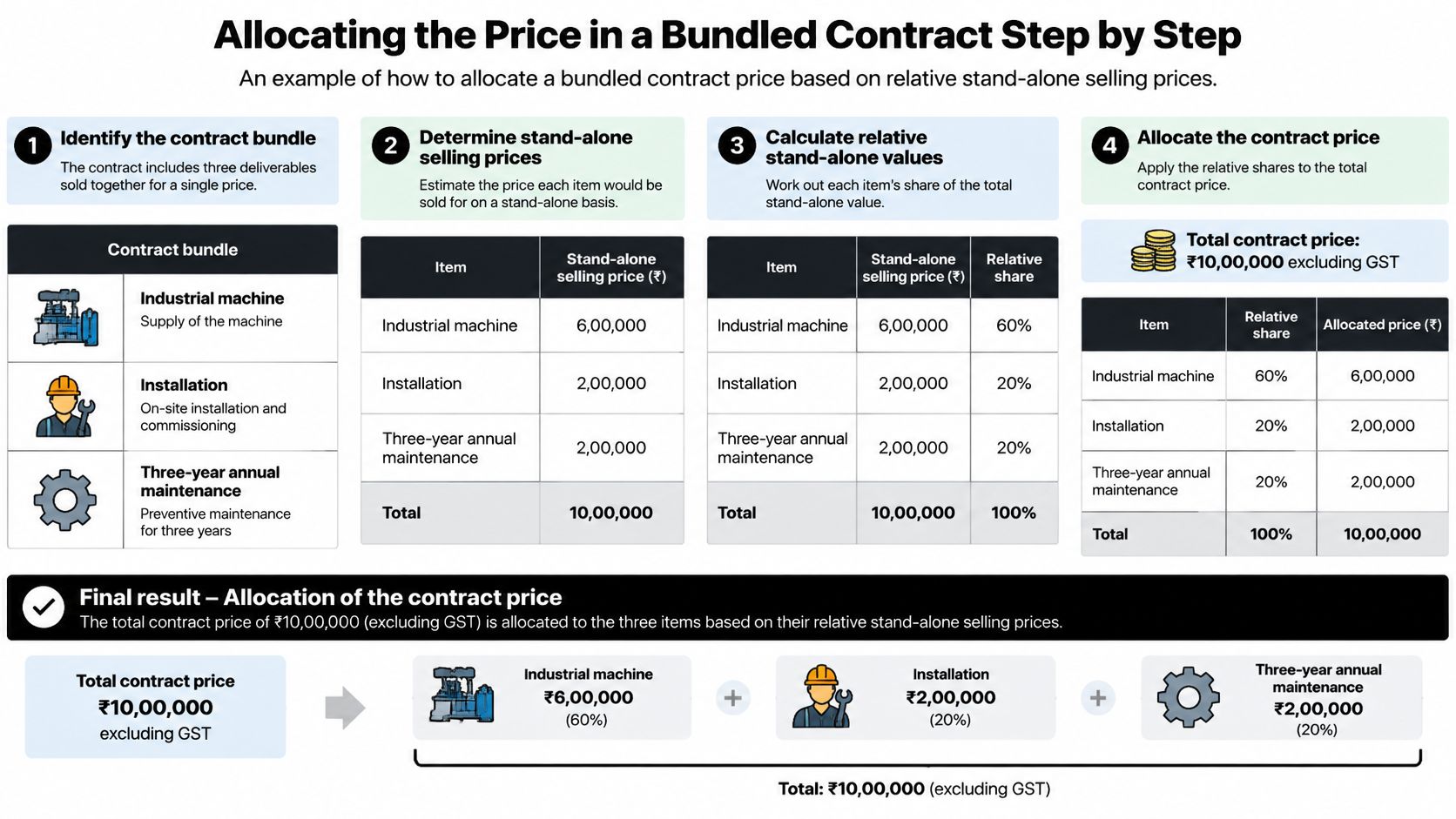
Consider a **hypothetical industrial-machine contract** priced at **₹10,00,000 excluding GST**. It includes machine supply, installation and a three-year annual maintenance contract, or AMC. Assume the distinctness assessment supports treating these as separate obligations.
The supplier also sells them separately: the machine for **₹7,00,000**, installation for **₹1,00,000**, and the AMC for **₹3,00,000**. These are illustrative commercial assumptions, not prescribed prices.
### Build the allocation from observable prices
1. **Separate tax from consideration.** Exclude GST and amounts collected on behalf of third parties from the accounting transaction price. Review the tax valuation independently using [section 15 of the CGST Act](https://charterai.in/law/cgst-act-2017/15), rather than assuming the accounting allocation determines GST treatment.
2. **Confirm the amount being allocated.** For this example, assume the agreed consideration is fixed and no financing adjustment is needed. In a live file, check variable consideration and extended payment terms before finalising that amount.
3. **Establish standalone selling prices.** Use observable separate sales where available. Retain evidence showing that those prices are relevant to comparable customers, circumstances and contract inception.
4. **Apply relative proportions.** Divide each standalone selling price by their combined total, then multiply by the contract transaction price. The customer's negotiated bundle price doesn't automatically establish the standalone price of each component.
The following workings use the hypothetical prices above, rounded to the nearest rupee.
| Obligation | Standalone selling price (₹) | Allocated price (₹) |
|---|---:|---:|
| Machine supply | 7,00,000 | 10,00,000 × 7/11 = 6,36,364 |
| Installation | 1,00,000 | 10,00,000 × 1/11 = 90,909 |
| Three-year AMC | 3,00,000 | 10,00,000 × 3/11 = 2,72,727 |
| Total | 11,00,000 | 10,00,000 |
The allocation path is illustrated below.
### Don't allocate the discount by convenience
In this hypothetical arrangement, the **₹1,00,000 bundle discount** is distributed proportionately. Don't charge the entire discount against maintenance because the salesperson described the AMC as free.
A discount may be allocated specifically to an obligation where the supporting evidence meets the relevant requirements. That conclusion needs evidence about the discount's relationship to the promised goods or services, not just a convenient invoice description.
Allocation also doesn't establish that revenue is immediately recognisable. It determines the consideration attributed to each obligation; the performance assessment determines when that amount enters income.
File the **standalone price evidence, bundle terms and allocation workings** together. Include the rationale for any estimated standalone price, the treatment of rounding and a reconciliation to the agreed consideration. A reviewer should be able to reproduce the calculation without asking the preparer which prices were used.
## Over Time or at a Point in Time
| Test | Timing result | Indian example |
|---|---|---|
| Customer receives and consumes benefits as the entity performs | Over time | Monthly AMC or hosting service |
| Work creates or enhances an asset the customer controls | Over time | Construction on the customer's own land, where control is established |
| No alternative use and enforceable right to payment for work done | Over time | Custom software built for a client, where both conditions are established |
| None of the over-time tests is met | Point in time | Goods delivered, with control passing on delivery or acceptance |
The MCA's Ind AS 115 text requires over-time recognition when at least one of **three conditions** is met; otherwise, recognition occurs at the point when control transfers. The contract's duration doesn't decide the answer.
A caterer serving an office's daily thali service illustrates benefits consumed as performance occurs. A separate wedding-catering engagement needs its own assessment of the promised output and when the customer receives it. Neither the advance booking nor the billing date settles the conclusion.
### Read the conditions precisely
For a customer-controlled asset, establish what the customer controls while the supplier performs. Construction on the customer's land can support that assessment, but the land's ownership isn't a substitute for reading the contractual rights.
For a customised asset, **no alternative use** and an **enforceable right to payment for performance completed to date** must both exist. A bespoke design alone isn't enough. Review termination provisions and obtain legal input where enforceability is uncertain.
If no over-time condition applies, assess control indicators such as the right to payment, legal title, possession, risks and rewards, and customer acceptance. Delivery may be relevant, but substantive acceptance conditions can change the conclusion.
### Measure progress faithfully
For an over-time obligation, select an **output method**, such as certified milestones or units delivered, or an **input method**, such as costs incurred relative to total estimated costs. Choose the measure that faithfully depicts performance transferred to the customer.
Don't use expenditure mechanically if it doesn't represent progress. Update forecasts and explain changes in estimated total costs, scope or completion expectations. Apply the selected method consistently to the obligation and reassess the estimate as circumstances change.
Keep the GST analysis separate. [Section 13 of the CGST Act](https://charterai.in/law/cgst-act-2017/13) addresses time of supply of services; it doesn't replace the accounting assessment of performance and control.
> Which recognition condition does this obligation meet, and which document proves it?
Answer that question for each obligation, not just for the contract as a whole.
## Documenting Judgements and Closing Checks
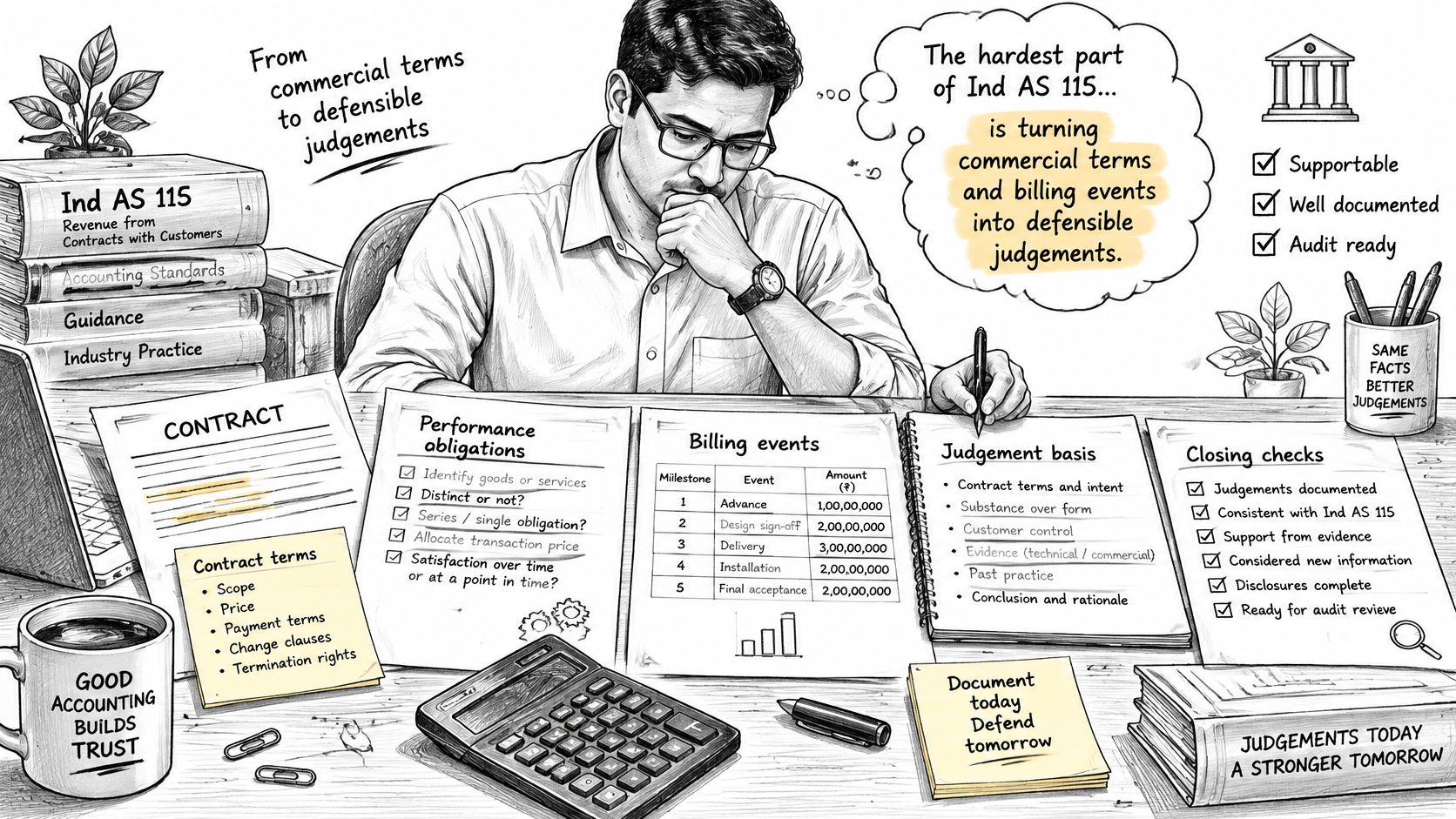
The difficult part is converting commercial terms into accounting conclusions another CA can verify. The [ICAI educational material on Ind AS 115](https://www.icai.org/post/educational-material-on-indian-accounting-standard-ind-as-115-revenue-from-contracts-with-customers-17-08-2018) provides implementation guidance and FAQs; use it alongside the standard when preparing the accounting position.
Organise the file around the contract, the conclusion and its supporting evidence.
### Connect each judgement to the ledger
Every material conclusion should identify:
- **Contract clause relied on.** Attach the executed version and relevant amendments.
- **Standard applied.** Record the relevant Ind AS paragraph and explain its application.
- **Evidence held.** Include acceptance records, price support, progress certificates or customer correspondence.
- **Accounting consequence.** Show the calculation, journal entry and disclosure impact.
For an advance invoice, the following illustrative entry assumes payment is contractually due and the right to consideration is unconditional. Entries below exclude GST, which requires separate accounting.
| Event | Debit | Credit |
|---|---|---|
| Enforceable advance billing before performance | Trade receivable | Contract liability |
| Performance completed before an unconditional billing right arises | Contract asset | Revenue |
| Conditional right subsequently becomes unconditional | Trade receivable | Contract asset |
An invoice alone doesn't establish an unconditional receivable. Equally, work performed before billing doesn't automatically create a contract asset: first establish that revenue qualifies for recognition and that the right remains conditional on something other than time.
For **bill-and-hold arrangements**, retain evidence of a substantive customer request, separate identification of the goods and readiness for physical transfer. Also establish that the supplier can't use the goods or redirect them to another customer. A warehouse label without the underlying commercial conditions isn't sufficient.
The video below offers another way to review the revenue-recognition framework.
### Prepare disclosures from the same file
Prepare disaggregated revenue by meaningful category or timing, opening and closing contract balances, and descriptions of performance obligations and their satisfaction patterns. Include significant judgements and relevant remaining-obligation information, considering applicable requirements and exemptions.
Reconcile the supporting schedules with the financial statements prepared under [section 129 of the Companies Act](https://charterai.in/law/companies-act-2013/129). Don't leave disclosure preparation until after the accounting team has archived the contract workings.
Installation, AMC, financing and warranty arrangements deserve focused review because their commercial labels don't settle their accounting. Extended credit terms may require a financing assessment rather than a separate service obligation. A warranty may provide assurance or an additional service, depending on what's promised.
### Close with accountable review
At month-end, confirm distinct obligations against signed terms, recognition conclusions against current performance evidence, and variable amounts against the latest forecasts and credit notes. Reconcile contract balances and investigate stale items rather than rolling them forward unchanged.
In Charter AI, **numbers are worked out by rules, never by AI, and AI does the words**. Every draft, research answer and citation is a starting point, not a filing; you remain the Chartered Accountant of record, solely responsible for reviewing, verifying and signing off on any output.
Run a live contract containing a bundle or rebate through the model this week. Compare the documented conclusion with the books, and resolve any difference before signing off.
---
Charter AI brings source-linked research, drafting and client documents into one workspace to support your contract-review working papers. Visit [Charter AI](https://www.charterai.in) to research a revenue-recognition question and organise the supporting evidence for your own review and sign-off.
## Tags
- [Ind AS 115](https://charterai.in/blog/tag/Ind%20AS%20115)
- [Five step model](https://charterai.in/blog/tag/five-step%20model)
- [Revenue recognition](https://charterai.in/blog/tag/revenue%20recognition)
- [Performance obligations](https://charterai.in/blog/tag/performance%20obligations)
- [Transaction price](https://charterai.in/blog/tag/transaction%20price)
Canonical: https://charterai.in/blog/ind-as-115-5-step-model