# GST Show Cause Notice Reply: A Step-by-Step Guide
Learn how to draft a GST show cause notice reply: check deadlines, map mismatches to evidence, raise limitation objections and file a clean ASMT-11 reply.
Published 27 Oct 2026. 18 min read.
The client has forwarded a GST notice, the accounts team says the returns reconcile, and the portal shows a deadline nobody has entered in the calendar. You open the ledger and find that the department's figure doesn't agree with the working. Before anyone starts drafting a denial, establish what was served, when the response is due, and which documents explain the difference.
A defensible **GST show cause notice reply** does two jobs. It gives the officer a checkable evidentiary record, and it preserves procedural objections that a spreadsheet alone won't answer.
## Table of Contents
- [Read the Notice and Lock Your Deadline](#read-the-notice-and-lock-your-deadline)
- [Separate the response deadline from the limitation clock](#separate-the-response-deadline-from-the-limitation-clock)
- [How to Draft the Reply in Eight Steps](#how-to-draft-the-reply-in-eight-steps)
- [Assemble the record before drafting arguments](#assemble-the-record-before-drafting-arguments)
- [Draft only after deciding the response route](#draft-only-after-deciding-the-response-route)
- [Turning Mismatches Into an Evidence Record](#turning-mismatches-into-an-evidence-record)
- [Give the officer a reproducible reconciliation](#give-the-officer-a-reproducible-reconciliation)
- [Limitation and Penalty Objections to Raise](#limitation-and-penalty-objections-to-raise)
- [Write a calculation, not a conclusion](#write-a-calculation-not-a-conclusion)
- [Challenge the penalty on its own facts](#challenge-the-penalty-on-its-own-facts)
- [Sample Wording for Facts and Explanations](#sample-wording-for-facts-and-explanations)
- [Identify the file and the factual record](#identify-the-file-and-the-factual-record)
- [Describe the working without conceding liability](#describe-the-working-without-conceding-liability)
- [Protecting Your Reply When the Notice Is Missing](#protecting-your-reply-when-the-notice-is-missing)
- [Separate service from the opportunity to answer](#separate-service-from-the-opportunity-to-answer)
- [Confirm the Reply Before You File It](#confirm-the-reply-before-you-file-it)
- [Record the reviewer's approval](#record-the-reviewers-approval)
## Read the Notice and Lock Your Deadline
Start with the form, not the amount. A scrutiny discrepancy notice isn't interchangeable with a formal demand notice, even when both concern the same return mismatch.
Under [CBIC Instruction No. 02/2022-GST](https://cbic-gst.gov.in/pdf/02-2022-GST-DATED-22032022.pdf), an ASMT-10 discrepancy notice under section 61 calls for an explanation in ASMT-11, and the reply window is generally cited as 30 days from service with the officer able to allow further time. The CBIC assessment rules describe a response period of up to 15 days from service for the same notice, so calendar the shorter date until the officer confirms the applicable period in writing. The instruction also expects ASMT-12 within 30 days of receiving an accepted explanation.
Don't treat the date printed on the PDF as proof of service. The portal record is what starts the clock, and a notice that surfaced in the additional-notices tab days after its printed date gives you a service argument worth preserving alongside the reply. Download the notice, its attachments and the portal record before calculating the response window, and keep screenshots of what appeared and when. Where the notice specifies an earlier deadline, work to that date while seeking written clarification.
### Separate the response deadline from the limitation clock
The reply deadline tells the team when to file. Limitation concerns whether the department can lawfully issue the notice or pass the order. Payment-based closure has its own conditions, so don't assume the reply deadline and the payment-benefit window are identical.
**Notice type, reply window and limitation clock**
| Notice or case | Reply or payment window | Limitation clock | What to check |
|---|---|---|---|
| ASMT-10 discrepancy under section 61 | ASMT-11 explanation; the material supports both a 15-day and a 30-day reading, so file by the earlier date pending written clarification | Track scrutiny closure separately from any subsequent demand proceedings | Notice date, portal service date, DIN/RFN |
| Demand under section 73, without fraud or suppression | DRC-06 representation; evaluate the statutory payment route promptly | Calculate the non-fraud order deadline and required notice lead time | Financial year, annual-return due date, notice date |
| Demand under section 74, alleging fraud, wilful misstatement or suppression | Representation or qualifying payment of tax, interest and penalty | Test the extended-period provision independently | Specific facts supporting the aggravated allegation |
| Section 73 outer limit for issuing the notice | Not a separate reply window | Work backwards from the applicable order deadline | Notice date against the calculated last permissible date |
Keep a deadline sheet containing the notice reference, issue date, portal service date, tax period, amount, DIN/RFN, response date and the date your team opened the notice. Charter AI extracts the section, assessment year, amount, DIN/RFN, issue and deadline from an uploaded notice automatically; a team member must still compare those fields with the PDF and the portal entry before the sheet is locked.
Use the [notice reply deadline calculator](https://charterai.in/tools/notice-reply-deadline) as a working aid alongside the governing provision and the service record, and record any extension request and the officer's response next to the original deadline. If the reply later disputes service, this sheet is the evidence that supports the objection.
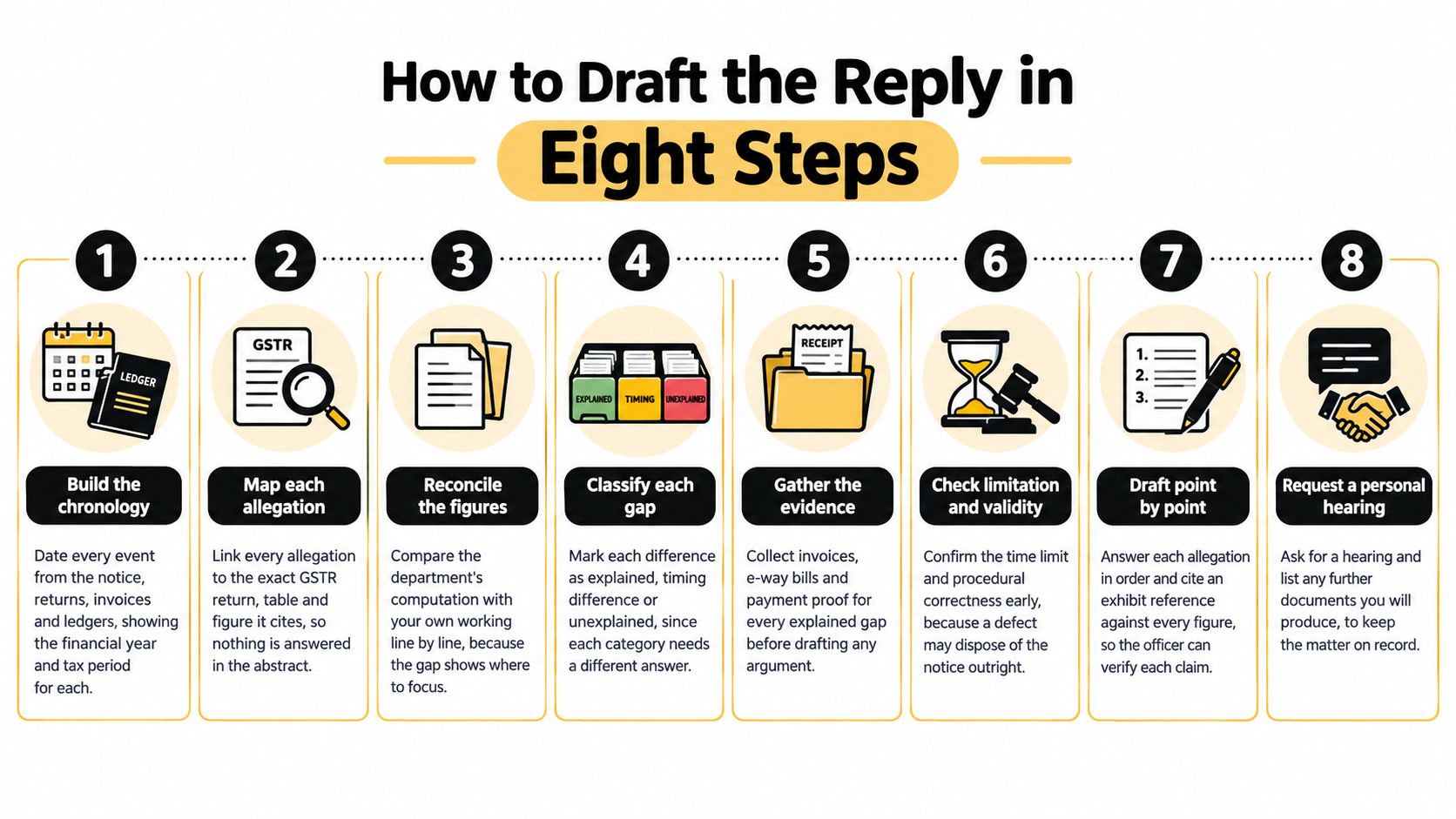
## How to Draft the Reply in Eight Steps
Don't begin with case law. Begin with a file that lets another reviewer reconstruct the transaction, the department's allegation and your answer without asking the preparer what happened.
The process should produce a readable submission and a separate, reproducible working. The following visual is a useful desk reference.
### Assemble the record before drafting arguments
1. **Build a dated chronology.** Extract events from the notice, returns, invoices, ledgers and correspondence, recording the financial year and tax period against each event. This comes first because an accurate chronology exposes reporting shifts and missing documents before they become assertions in the reply.
2. **Classify the allegation.** Identify whether the department alleges ordinary non-payment or fraud, wilful misstatement or suppression, and highlight the supporting passages. Classification must precede the defence because the legal test isn't the same for every notice.
3. **Prepare the limitation working.** Record the relevant annual-return due date, notice date, proposed order deadline and any applicable modification to the statutory timetable. Do this before substantial drafting so the team doesn't overlook a potentially decisive preliminary objection.
4. **Separate tax, interest and penalty.** Maintain distinct workings rather than accepting a combined demand total. This prevents an incorrect penalty assumption or interest period from disappearing inside an otherwise correct tax reconciliation.
5. **Build an issue-wise computation schedule.** Give every allegation a row showing the department's amount, the taxpayer's working, the difference and the proposed treatment. This schedule determines what must be answered, paid, disputed or investigated.
6. **Index the supporting documents.** Assign annexure references and connect them to the relevant schedule row and draft paragraph. Evidence should be assembled before the argument so the drafting doesn't promise documents the team can't produce.
### Draft only after deciding the response route
The [CGST Rules and associated demand-response framework](https://cbic-gst.gov.in/pdf/cgst-rules-01july2017.pdf) prescribe DRC-06 for the representation and provide for payment-based closure where tax and interest under section 73(8), or tax, interest and penalty under section 74(8), are paid within **30 days of service**. Payment is documented through DRC-03, followed by DRC-05 where applicable.
Decide whether to contest, pay or adopt a supported mixed position before settling the body of the submission. A payment decision needs an item-wise liability analysis; paying just because the portal displays a demand isn't that analysis. Equally, contesting an established liability can add cost without improving the taxpayer's position.
7. **Draft point by point.** Put preliminary objections before the factual position, then address the statutory provisions, relevant notifications, applicable judgments and each disputed computation. This order preserves threshold objections while giving the officer a complete alternative answer on the merits.
8. **End with a precise prayer and written hearing request.** Identify exactly what should be dropped, corrected or reconsidered, and request a personal hearing in writing. The cited framework requires a hearing when requested in writing, so don't leave the request only in an internal checklist.
Our drafting process organises the reply into facts, legal position, grounds, arguments and prayer, with the reconciliation working annexed when the notice turns on a difference. The reviewer still has to assess whether the legal propositions apply to the actual tax period and facts.
> **Drafting test:** Can an unfamiliar reviewer locate the source document and reproduce each disputed amount without speaking to the preparer?
A long submission that fails that test isn't ready. Neither is a short reply that answers the arithmetic but says nothing about an unsupported extended-period allegation.
## Turning Mismatches Into an Evidence Record
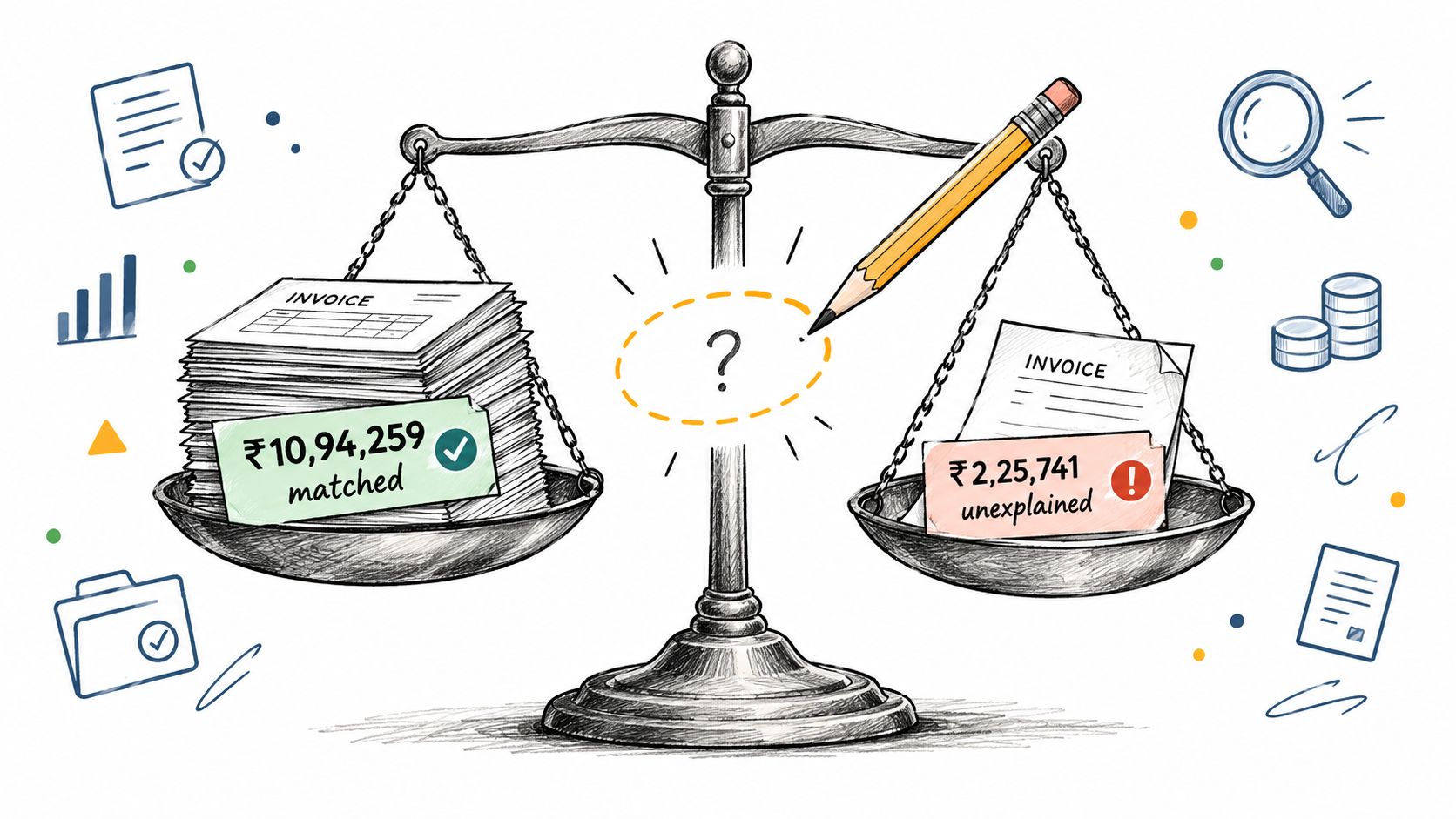
In our sample ASMT-10 working, the notice alleged ₹13,20,000, the working accounted for ₹10,94,259, and ₹2,25,741 remained unexplained. The important result isn't that most of the difference was traced. It's that the residual still required a factual answer.
Use the comparison below as a reminder that matched entries and explained discrepancies aren't the same thing.
The [CBIC assessment rules](https://cbic-gst.gov.in/assessment-audit-rules.html) describe an ASMT-10 explanation process with a specified response period not exceeding 15 days from service. That wording makes it particularly important to resolve the operative deadline rather than assume every scrutiny communication provides the same window.
### Give the officer a reproducible reconciliation
Use a spreadsheet with a row for each allegation and period, supported by invoice-level detail. Place GSTR-1, GSTR-3B, GSTR-2A/2B and the books side by side where relevant, but don't compare unlike fields merely because they contain tax amounts.
Add supplier or customer GSTIN, invoice reference, taxable value, tax head, reporting period, difference, reason and evidence reference. Preserve the original downloaded files separately from the working spreadsheet. A manually adjusted workbook without the underlying return extracts is difficult to verify.
A projected illustration in our sample reply uses an invoice dated in August 2026 and reported in September 2026. The reconciliation identifies a month-level reporting difference within the same financial year. That explains where the entry went; it doesn't, by itself, establish that no interest or other consequence requires examination.
**Mismatch causes and the evidence each one needs**
| Mismatch cause | What the reply must prove | Evidence to annex |
|---|---|---|
| Timing difference across months | Actual supply date, reporting periods and treatment within the financial year | Invoice, e-way bill where relevant, return extract and filing acknowledgement |
| Credit note or amendment | Original transaction, adjustment and correct net taxable value | Credit note, original invoice and amended return entries |
| Reverse charge | Correct RCM treatment without omission or double counting | Purchase invoice, RCM ledger and return working |
| Blocked or ineligible credit | Whether credit was excluded, reversed or incorrectly retained | Eligibility analysis, ledger reversal and return working |
| Supplier did not file GSTR-1 | Transaction evidence and the period-specific legal basis for the credit claim | Invoice, delivery proof, bank payment record and supplier correspondence |
| Import document difference | Connection between the bill of entry and IGST claimed | Bill of entry, IGST payment evidence and credit ledger |
| Residual amount with no identified cause | Further working that explains or narrows the residual | Line-wise exception annexure with the status of each entry |
A supplier's filing lapse needs more than a statement that the purchase is genuine. Establish the transaction and separately examine the credit conditions applicable to the period. For an ITC-specific communication, use the [Rule 88D mismatch response guide](https://charterai.in/notice/gst-itc-mismatch-intimation-rule-88d-drc-01c) to distinguish the response workflow from a general outward-supply reconciliation.
This video provides a further walkthrough to use alongside the working papers.
Tag every difference **explained, partly explained or unexplained**. A reason code without a supporting document isn't an explained difference, and a ledger match isn't automatically proof of eligibility or timely payment.
## Limitation and Penalty Objections to Raise
The difference between the ordinary and extended limitation periods isn't an invitation to accept whichever provision the officer has cited. The [CBIC GST FAQ framework](https://cbic-gst.gov.in/aces/Documents/faq-on-gst.pdf) describes a section 73 order period generally running to three years from the relevant annual-return due date, with notice at least three months earlier, compared with five years and six months respectively under section 74.
On that ordinary section 73 calculation, the notice's outer limit is generally two years and nine months from the relevant annual-return due date. Before relying on it, check the correct statutory regime for the tax period, the relevant due date, and any legally applicable extension or exclusion.
### Write a calculation, not a conclusion
Place the limitation objection before the factual response. Use a compact working that identifies:
- **Starting point.** The relevant financial year and applicable annual-return due date, or the appropriate erroneous-refund trigger.
- **Governing provision.** The provision applicable to the period and allegation.
- **Adjusted deadline.** Any valid extension or exclusion, with its legal basis.
- **Comparison.** The notice date and calculated last permissible issue date.
A usable paragraph reads:
> The relevant annual-return due date is [verified date]. Applying [provision and applicable modification], the order deadline is [calculated date] and the notice deadline is [calculated date]. The notice was issued on [verified date], after that deadline; the taxpayer therefore objects to its issuance as time-barred.
Our sample ASMT-10 response includes an objection that the section 73(10) order period has expired. That argument needs careful positioning: a scrutiny communication isn't itself the adjudication order, and a template limitation paragraph doesn't establish that every scrutiny notice is invalid.
### Challenge the penalty on its own facts
For an extended-period allegation, ask what the notice identifies as fraud, wilful misstatement or suppression. A mismatch establishes a question to investigate; it doesn't replace an explanation of the alleged conduct.
Address penalty separately from the underlying tax. Even where the tax working is partly correct, the notice may not establish the factual or legal basis for the proposed penalty.
Keep jurisdiction, inadequate particulars, natural justice and quantification objections short and specific. Argue limitation first, then respond on the merits in the alternative, without turning a reconciliation explanation into an admission of liability.
## Sample Wording for Facts and Explanations
A useful reply distinguishes what happened, what the working establishes and what remains disputed. Don't use language such as "the demand is restricted to the reconciled amount" unless that amount is admitted as payable. **Reconciled doesn't mean payable.**
### Identify the file and the factual record
**Purpose: connect the submission to the correct notice.**
> This explanation responds to notice [reference], issued in Form GST ASMT-10 under section 61, concerning [tax period], specifying [reply deadline] and alleging the discrepancy described in the accompanying schedule.
Our projected sample uses the period April to September 2026, a response deadline of 30 October 2026 and an alleged amount of ₹13,20,000. Those are illustrative file particulars, not a deadline or limitation conclusion for another taxpayer.
**Purpose: distinguish service from actual discovery.**
> The notice records [issue date]. The portal service record shows [date], while the taxpayer first accessed the notice on [discovery date], as supported by Annexure [reference]. The taxpayer's position on service is set out in the preliminary objections.
Use placeholders until the dates have been verified. Don't convert the client's recollection into an asserted portal fact.
### Describe the working without conceding liability
**Purpose: state what the reconciliation establishes.**
> The reconciliation accounts for the entries identified in Annexure [reference], rows [references], through the transaction and reporting explanations stated against those entries. Accounting for those entries does not constitute acceptance of the proposed tax treatment.
**Purpose: deal candidly with the residual.**
> The residual identified in the exception schedule remains under verification and is not admitted as tax payable. The taxpayer requests time to submit the specified outstanding documents and supplementary reconciliation.
That wording isn't a permanent answer. Identify the missing documents and pursue them; reserving a position doesn't prove it.
**Purpose: preserve identified objections.**
> These submissions are made without prejudice to the specific objections concerning jurisdiction, limitation, service, natural justice, quantification and penalty set out in this reply, none of which is waived by the alternative submissions on merits.
**Purpose: ask for an actionable outcome.**
> The taxpayer requests acceptance of the explanation and closure of the discrepancy. Alternatively, the taxpayer requests consideration of the annexed reconciliation, exclusion of amounts demonstrated not to be payable, disclosure of any remaining computation, and a personal hearing before an adverse decision.
Avoid adjectives about the department and blanket denials. Place an annexure and row reference immediately after every factual assertion that depends on a document.
## Protecting Your Reply When the Notice Is Missing
A notice may be accessible under Additional Notices and Orders but absent from the screen the client routinely checks. Don't assume that proves defective service, and don't dismiss it as an excuse without examining the portal evidence.
A [LiveLawBiz indirect-tax digest](https://www.livelawbiz.com/digests/weekly-digests/livelawbiz-indirect-tax-weekly-round-up-october-19-october-25-2026-556076) reports that the Bombay High Court set aside a ₹62.42 lakh demand where notices appeared in that additional-notices area and the taxpayer lacked a meaningful opportunity to respond. Check the underlying judgment and its facts before relying on the digest in a submission.
### Separate service from the opportunity to answer
Ask distinct questions. Was the notice legally served? Did it contain sufficiently specific allegations and computations? Did the taxpayer have a meaningful opportunity to respond?
A taxpayer may have accessed a document but still lack the attachments needed to answer it. Conversely, unfamiliarity with a portal tab doesn't automatically invalidate otherwise lawful service.
**Portal and service problems, evidence and action**
| Portal or service problem | Evidence to preserve | Action in the reply |
|---|---|---|
| Notice shown only under Additional Notices and Orders | Dated screenshots of both areas, page address and download details | State precisely where it appeared and file a protective response |
| Notice not visible on the dashboard | Actual discovery date, login records and email alerts | Request restoration of the hearing or additional response time |
| DIN/RFN missing or unclear | Original notice PDF and portal reference | Raise the specific identification or validity concern without assuming automatic invalidity |
| Response window apparently expired before access | Portal service record and evidence of actual discovery | Challenge service separately and explain the resulting prejudice |
| Portal layout changed after issue | Screenshots showing the layout actually used | Describe the interface and its relevance to discovery |
Preserve the original PDF, download metadata and screenshots showing the relevant page context, not just a cropped error message. Record who checked the portal, when they checked it and what they could access.
> **Protective approach:** Contest defective service while responding to the available allegations. Don't make silence the method of asserting a service objection.
If attachments are missing, list them and explain which allegation cannot be answered without them. File within the available window where possible, request an extension or restoration of the hearing in writing, and retain the acknowledgement. If an adverse order already exists, assess the appropriate remedy rather than assuming a late reply alone will reopen proceedings.
## Confirm the Reply Before You File It
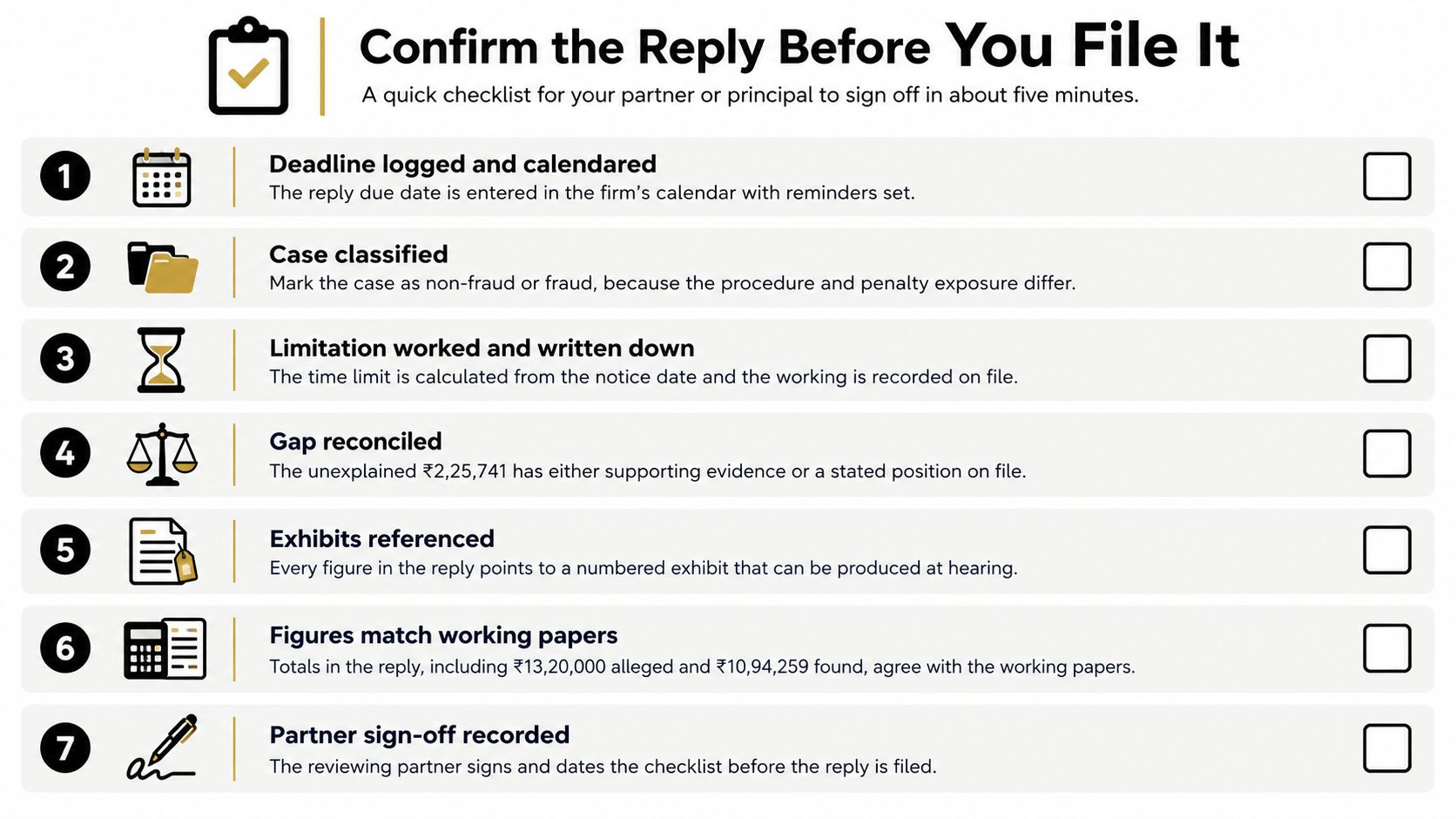
Would the signing partner defend every factual sentence and computation if the officer asked for its source? That's the sign-off question, not whether the draft sounds persuasive.
Use the checklist as a review aid, then inspect the underlying documents.
### Record the reviewer's approval
- **Deadline controlled.** Service evidence, the operative response date and any extension are recorded.
- **Legal route checked.** The provision applies to the period, and the limitation calculation is written down.
- **Allegations answered.** Each disputed item has a position, reason and supporting annexure reference.
- **Exceptions visible.** Residual amounts and outstanding documents are expressly identified.
- **Rights preserved.** Relevant preliminary objections remain in the final version.
- **Hearing requested.** The written request is included; prepare the [personal-hearing submissions](https://charterai.in/notice/gst-written-submissions-for-personal-hearing-s-75-4) from the same evidence record.
- **Filing complete.** The authorised signatory is identified, attachments are readable, and the acknowledgement and submitted version are saved.
Our notice-handling process runs from upload and research through preparation to check and approval. The final approval belongs to a named human reviewer who checks each figure against its source, not merely against another draft.
Don't guess to make the reconciliation look complete. If a figure remains unexplained at the deadline, state its status accurately and seek time for the identified evidence; if the full response isn't ready, file a protective reply rather than leave the notice unanswered.
---
Charter AI brings notice extraction, source-linked legal research, reconciliation and annexure-linked drafting into a workspace for CA firms. Visit [Charter AI](https://www.charterai.in) to prepare a GST notice reply whose figures, documents and legal grounds your team can review before approving it for filing.
## Tags
- [Show cause notice](https://charterai.in/blog/tag/show%20cause%20notice)
- [GST SCN reply](https://charterai.in/blog/tag/GST%20SCN%20reply)
- [ASMT 10 reply](https://charterai.in/blog/tag/ASMT-10%20reply)
- [GST limitation period](https://charterai.in/blog/tag/GST%20limitation%20period)
- [GSTR-2B mismatch](https://charterai.in/blog/tag/GSTR-2B%20mismatch)
Canonical: https://charterai.in/blog/gst-show-cause-notice-reply