# E Way Bill Reconciliation
E way bill reconciliation - Master E-Way Bill Reconciliation for CA firms in 2026. Match GST registers with e-invoices, rank mismatches by tax exposure, and
Published 17 Nov 2026. 17 min read.
A purchase register ties to the ledger, the invoice numbers line up with GSTR-2B, and the review is ready to sign. Then someone asks for the e-way bill extract for the same period and nobody pulled it. The goods moved, the credit was taken, and the movement document that should sit behind both was never checked.
That gap is what e way bill reconciliation, done properly, is built to catch. The matching you've already done answers one question, whether the supplier reported the invoice. It says nothing about whether the goods travelled on a valid document, whether the vehicle and transporter details agree, or whether the bill was still alive when the consignment reached your client's godown.
Treat the exercise as **exception triage** rather than matching and the output changes. Instead of a tick against every invoice, you get a file that separates three things: records that create tax exposure, records with a logistics explanation and evidence behind it, and records nobody has looked at yet.
## Table of Contents
- [Six Outcomes Every E-Way Bill Reconciliation Should Produce](#six-outcomes-every-e-way-bill-reconciliation-should-produce)
- [Validity, Threshold and Timing Rules Behind Each Exception](#validity-threshold-and-timing-rules-behind-each-exception)
- [The clock runs on distance, not on the calendar](#the-clock-runs-on-distance-not-on-the-calendar)
- [Cancellation is a narrow door](#cancellation-is-a-narrow-door)
- [Running the Reconciliation and Setting Automation Limits](#running-the-reconciliation-and-setting-automation-limits)
- [Where the automation has to stop](#where-the-automation-has-to-stop)
- [Telling Real Tax Exposure From Logistics Timing Differences](#telling-real-tax-exposure-from-logistics-timing-differences)
- [Part B updates explain more than they hide](#part-b-updates-explain-more-than-they-hide)
- [The evidence that closes each conclusion](#the-evidence-that-closes-each-conclusion)
- [Run One Month Through This Workflow Before Scaling](#run-one-month-through-this-workflow-before-scaling)
## Six Outcomes Every E-Way Bill Reconciliation Should Produce
Two answers aren't enough. Marking each row matched or mismatched at month end closes files that should stay open, and it sends a rounding difference up to a partner. The review needs six outcomes. Each one has a defined trigger, a next action, and a stated exposure.
The rules decide what you're testing. The [GST portal's e-way bill system](https://services.gst.gov.in/services/ewaybill/ewaybillsystem) went live on **1 April 2018**. A bill is generally mandatory for inter-State movement when consignment value crosses **₹50,000** and the goods travel in a motorised conveyance. Validity follows the distance slabs in [rule 138 of the CGST Rules 2017](https://charterai.in/law/cgst-rules-2017/138): one day below 100 km, three days for 100 to 300 km, and longer periods as the distance grows. Extension is possible online before expiry. Read the slab from that rule. A flat one day for every 200 km misjudges the mid-range runs.
Those facts give three tests. Does the invoice value cross the threshold? Do the supplier, recipient, transporter, vehicle number, document date and movement details agree across systems? Did the bill stay valid through the whole transit, not only on the dispatch day?
Run the tests against the purchase register, the sales register, the e-invoice register, delivery challans and the returns. Every row lands in exactly one outcome.
| Outcome | What triggers it | Next action | Tax exposure |
| --- | --- | --- | --- |
| **Exact match** | GSTIN, invoice number, date, taxable value and tax values agree across books, e-invoice and e-way bill | Close the record and keep the source row | None identified |
| **Tolerable variance** | Difference sits inside the rounding tolerance set by firm policy | Accept with a logged reason | Low, if the reason is documented |
| **Missing e-way bill** | Movement above ₹50,000 with no matching bill found | Check the movement date, exemption status and whether goods actually moved, then confirm with the transporter | Potential, if the movement was taxable and needed a bill |
| **Duplicate** | Same bill or invoice number repeated inside one financial year | Hold both rows and trace the original record | High, because the record itself is unreliable |
| **Cancellation or extension issue** | Bill cancelled, expired or extended after the document date | Pull portal status, the cancellation or extension reason and the timestamps | Settled by the movement evidence |
| **Substantive mismatch** | Value, GSTIN or quantity differs beyond tolerance | Investigate against the invoice and supplier correspondence | High until resolved |
The split that matters is the last two rows. A **substantive mismatch** is tax exposure. When a value difference flows into the outward return, the client can be answering a [Rule 88C intimation in DRC-01B](https://charterai.in/notice/gst-liability-mismatch-intimation-rule-88c-drc-01b) before anyone has traced the movement that started it. A **cancellation or extension issue** is usually a logistics timing difference. It settles once delivery evidence, portal status and timestamps sit on the row. Keep that evidence with the outcome. Without it, a timing difference looks like a lapse.
Exact match and tolerable variance can close only with the source row or the logged reason still attached. A missing bill is not an automatic default: check the movement date, exemption status and whether the goods moved, then confirm with the transporter. A duplicate stays open until the original record is traced, because the document itself is unreliable.
The test I'd apply at review is narrow. No row may sit unclassified. The outcome, not the reviewer's instinct, decides whether the record closes, gets explained, or escalates.
## Validity, Threshold and Timing Rules Behind Each Exception
The first question at any exception isn't what the numbers say. It's whether the movement needed a bill at all. A bill is generally required only where the movement is inter-State, by motorised conveyance, and above the value threshold. Handcart and cycle-cart deliveries, and the goods categories the rules leave out, sit outside the system, so an unmatched register row for those is an explanation rather than a lapse. Getting it wrong in the other direction costs just as much, because a team that treats every large invoice as a movement ends up chasing documents for supplies that never needed one.
### The clock runs on distance, not on the calendar
The [CBIC e-way bill rules](https://cbic-gst.gov.in/ewaybill-rules.html) set validity in distance slabs: one day for movements below 100 km, three days for 100 to 300 km, and progressively longer periods as the distance grows. Take the slab from the notified rule, [rule 138 of the CGST Rules 2017](https://charterai.in/law/cgst-rules-2017/138), rather than from a help-text summary you remember. A check programmed around a single per-kilometre allowance misjudges mid-range runs, and it misjudges them without warning, which is the worst kind of error in a reconciliation file.
The same rules close cancellation off once transit has been verified. Generation is also refused where the document date is more than **180 days** from the current date, so an old invoice can't be covered by a fresh bill when the audit query lands. Both turn a timing question into a documentary one: you need the portal record and the delivery evidence, in that order.
### Cancellation is a narrow door
Cancellation is generally available only within **24 hours** and is unavailable after transit verification, as the [IRP guidance for the e-invoice and e-way bill systems](https://einvoice6.gst.gov.in/content/faq-powered-by-irisirp/) sets out. A bill can't be deleted. It's either cancelled inside that window or superseded by evidence of what happened on the road.
| Check | Rule to apply | Exception to raise |
| --- | --- | --- |
| **Inter-State threshold** | Bill generally needed for inter-State movement by motorised conveyance above ₹50,000 | Inter-State movement above ₹50,000 with no bill |
| **Document date age** | Bill cannot be generated when the document date is more than 180 days from the current date | Old invoice moved without a bill, or a bill that cannot be generated |
| **Validity period** | Distance-based; use the slab in the current CBIC rules, with extension possible online before expiry | Delivery after expiry with no extension recorded |
| **Cancellation window** | Cancellation generally allowed only within 24 hours and not after transit verification | Cancelled bill outside the window or after transit verification |
| **Invoice number in year** | Same invoice number repeated in one financial year is treated as a duplicate | Duplicate flag on both rows |
Work the table row by row and be explicit about which kind of exception you're holding. Threshold and exemption failures are tax questions from the start. Document date, validity and cancellation failures are timing questions until the movement evidence runs out, and only then do they become tax questions too.
> **Practical rule:** ask for the delivery proof and the extension record before you ask the client to explain a tax position. Most timing exceptions die at that first request, and the ones that survive deserve the escalation.
## Running the Reconciliation and Setting Automation Limits
A book of forty clients breaks the spreadsheet that one client can still survive for a month. The volume explains the arithmetic. The GST system's [nine-year e-way bill statistical report](https://tutorial.gst.gov.in/offlineutilities/gst_statistics/9YearsReport.pdf) records **7,91,78,27,900 bills** generated from April 2018 through May 2026, with **1,55,96,08,676** in the financial year 2025-26 alone, of which 53,03,52,922 were inter-State and 1,02,92,55,754 intra-State. Daily generation commonly runs between **25 lakh and 55 lakh bills**. The same report cautions that the figures are system-generated and neither reconciled nor audited. Read them as operational volumes, not assured financial data.
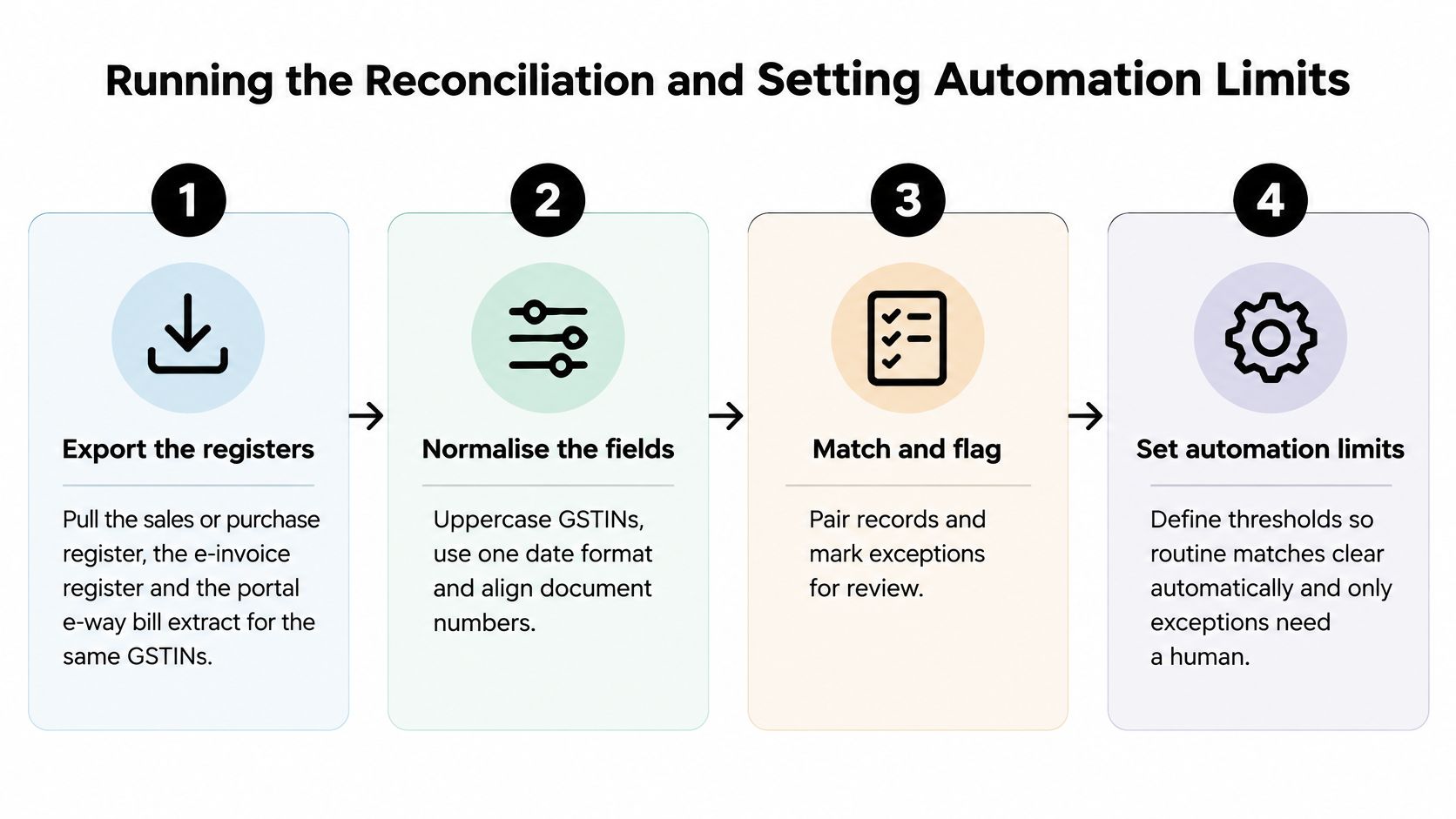
The process that handles those volumes runs as the numbered steps below, which are worth drawing once before you run them.
1. **Export the same period three times.** Pull the sales or purchase register, the e-invoice register and the portal e-way bill extract for the same GSTINs and the same date range. Pull the cancelled bills list as well as the generated list. A cancelled bill drops out of a generated-only export, and that is how a cancellation exception stays hidden for a whole quarter.
2. **Normalise before you compare.** Uppercase the GSTINs, force one date format, round values to two decimals, and strip trailing spaces and leading zeros from invoice numbers. Do this before any key is built. A format difference is not a tax difference, and leaving it in the file sends clean rows into the exception queue.
3. **Build deterministic keys and order them by confidence.** Use GSTIN, financial year, document type, invoice number, invoice date, taxable value and the tax amounts. Match on GSTIN plus invoice number plus date first, then GSTIN plus invoice number, then GSTIN plus date plus value where the supplier's numbering is unreliable. Never fuzzy-match the value. An approximate key hides the variance you are being paid to find.
4. **Classify and log the rule that fired.** Every row lands in one of the six outcomes, and the log records which rule produced it. Split the non-matches as you classify them. A value or GSTIN break is tax exposure until the documents agree. A stale document date, an expired validity, or a cancellation still inside its window is a logistics timing question until the movement evidence runs out. The key also carries a uniqueness test: a repeated invoice number inside one financial year is a duplicate, and a duplicated key collapses two movements into a single row.
5. **Route every non-exact row to the exception queue.** Keep the source row, the matched candidate, the variance amount, the rule triggered, the reviewer decision and the resolution evidence on the same line. Park value differences, cancellations and stale-document cases in separate queues. Different people work them, at different speeds, and a mixed queue lets a timing case sit beside an open tax exposure with no owner.
6. **Rerun after corrections and tie the population out.** Run it again before GSTR-1 or ledger finalisation. The control total has to tie the reconciled population back to the register total and the portal extract. If it does not tie, the population is wrong. Row-level review does not repair a wrong population.
### Where the automation has to stop
Three things can run unattended: exact matches, rounding variances inside a tolerance written into firm policy, and format fixes. Each accepted difference carries a logged reason, so the file explains itself a year later without anyone rebuilding the logic.
Four things never auto-close: duplicate numbers, substantive value or GSTIN mismatches, cancellations after transit verification, and bills generated from stale document dates. Each needs a named reviewer who signs off with a date, and the evidence that supports the call stays on the row. A timing exception can close on a delivery proof or an extension record. A tax exposure stays open until the corrected document is in the file.
> The boundary I draw: if a reviewer's name and date aren't against the exception, it's still open, whatever colour the spreadsheet shows.
Run the match on rules. Charter's reconciliation runs on rules, not AI, so the same returns always give the same result, and an exception log survives a second review by someone else.
The matching and exception cycle is easier to follow when you watch it run end to end.
A clean run has two properties and no others. There are no unclassified rows, and the control total ties exactly. A long list of explained exceptions, each with its evidence, is a normal month.
## Telling Real Tax Exposure From Logistics Timing Differences
An invoice carries an IRN and no e-way bill. The first read is non-compliance, and it's frequently wrong. Before anyone writes a note, four questions need answers: did the goods move, was the movement within an exemption, was the bill generated from a different document date, and did the vehicle change mid-route? Each answer points to a different conclusion, a different piece of evidence, and sometimes a different conversation with the client.
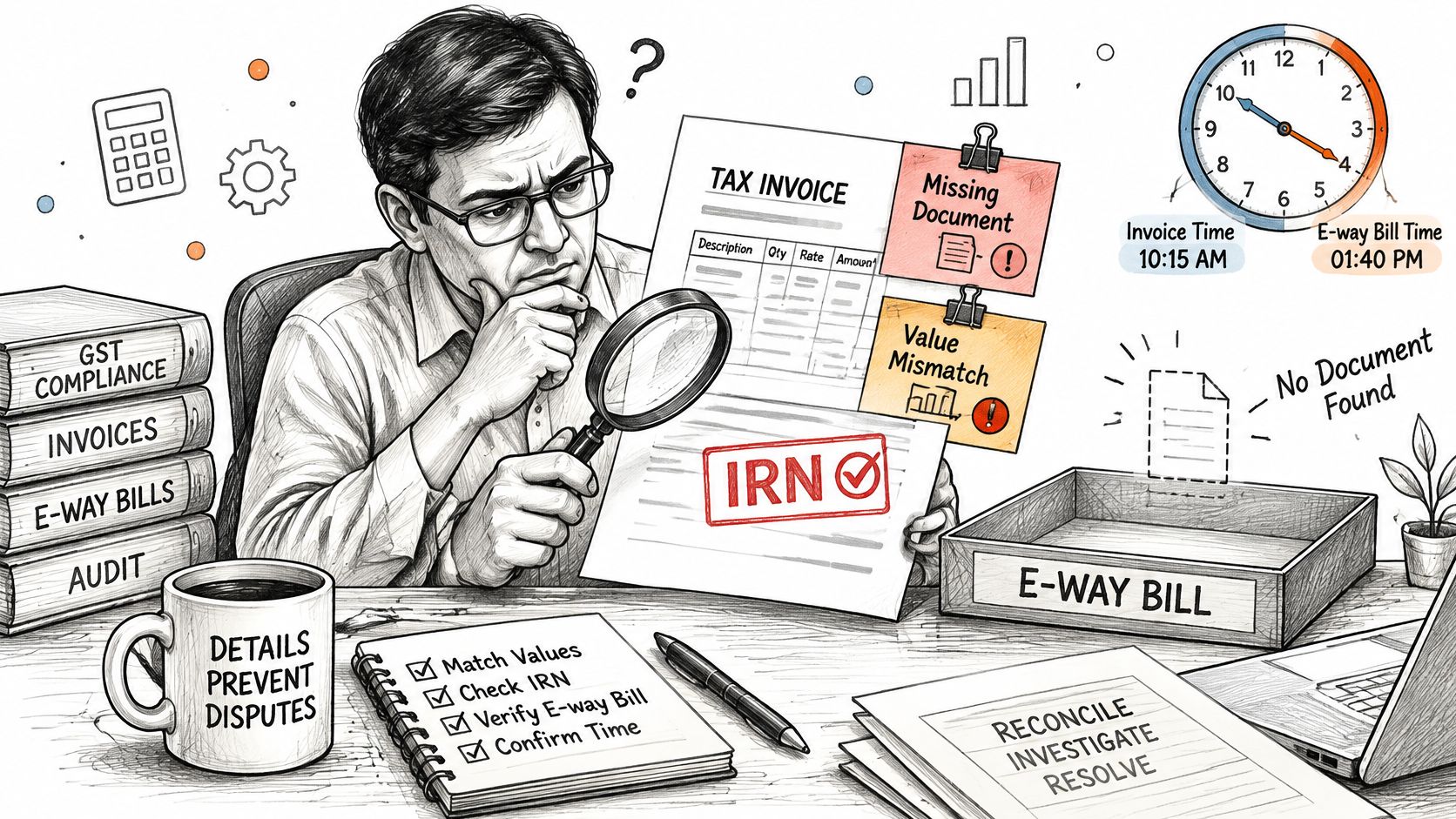
Keeping those answers straight means a reason code on every exception, chosen from a fixed list rather than written freehand. Ten codes cover nearly everything a month throws up.
| Reason code | Typical cause | Classification | Evidence to keep |
| --- | --- | --- | --- |
| **Missing document** | IRN present but no e-way bill found | Exposure if the movement is above ₹50,000 with no exemption, otherwise explanation | Movement proof and transporter confirmation |
| **Value mismatch** | Taxable value or tax amount differs | Exposure if it changes the tax | Invoice and supplier correspondence |
| **GSTIN mismatch** | Supplier or recipient GSTIN differs | Exposure | Corrected document |
| **Quantity mismatch** | Quantity differs from the invoice | Exposure unless a logistics reason is documented | Delivery challan and goods receipt |
| **Cancelled bill** | Bill cancelled | Exposure only where goods moved after cancellation | Cancellation reason and portal timestamp |
| **Expired validity** | Delivery after validity end with no extension | Timing issue if an extension or delivery proof exists, exposure otherwise | Extension record and delivery proof |
| **Route or vehicle update** | Route changed or vehicle number corrected | Explanation if the Part B update supports it | Part B update history |
| **Replaced bill** | Fresh bill generated after cancellation | Explanation if one movement is evidenced | Original and replacement bills |
| **Duplicate number** | Same invoice number repeated in one financial year | Exposure until the original is traced | Both rows and the trace of the original |
| **Exempt movement** | Specified goods or non-motorised transport | Explanation | Exemption basis recorded |
### Part B updates explain more than they hide
A vehicle number that changes between generation and delivery looks alarming in a raw comparison. In practice the transporter updates Part B when a truck breaks down, when a transhipment happens, or when a different vehicle handles the last leg. The supply didn't change, the invoice didn't change, and the only thing that moved is the conveyance. Treat the Part B history as evidence and the exception usually closes in one review. Treat it as a red flag and you'll raise a dozen false escalations a month, which is how a reconciliation file loses its audience.
The rows that carry real exposure are narrower than they look. A taxable movement with no bill and no exemption is the fact pattern behind a [detention and seizure notice under section 129(3)](https://charterai.in/notice/gst-detention-seizure-notice-s-129-3-mov-07), and it's the one a client remembers two years later. A duplicate number and a value mismatch that changes the tax are the other two that travel into returns and assessments. The rest of the list stays a timing question until the delivery evidence fails.
### The evidence that closes each conclusion
- **Original bill record.** The bill as generated, not a screenshot of a summary screen.
- **Cancellation or extension reason.** The stated reason plus the portal timestamp that goes with it.
- **Part B history.** Vehicle and transporter updates with their dates.
- **Delivery proof.** Proof of delivery, goods receipt note or gate entry, whichever the client holds.
- **Reviewer line.** Who decided, when, and on what basis.
> Write the conclusion and the evidence on the same line. Matched is not a conclusion and mismatched is not a finding; both are the start of a review the file should record.
## Run One Month Through This Workflow Before Scaling
Don't pilot on the whole client book. Pick one GSTIN, pick one month, and run the full cycle once with people watching the screen rather than a dashboard.
1. **Agree the tolerance in writing first.** Two decimals on rounding, and a stated rupee limit for what counts as tolerable. Without it every reviewer invents a threshold and the exception counts stop being comparable across clients.
2. **Pull the three exports for that GSTIN and month.** Register, e-invoice data, and the portal e-way bill extract in both generated and cancelled form.
3. **Run the cycle and count outcomes.** How many rows in each of the six, how many auto-closed, how many went to a named reviewer. At this stage the counts tell you more than percentages.
4. **Check the control total.** It has to tie to the register total and to the portal extract. If it doesn't, fix the export before you touch the process.
5. **Log the hours by step.** The first run is the only baseline you'll ever have, and it's the number that justifies automating the second client.
6. **Read the exception log back.** Sample the records the workflow classified and check whether the classification matches what a reviewer would have concluded by hand. Where it diverges, the rule is wrong, not the reviewer.
Some clients won't have a clean register to export. In that case run the test on the portal extract alone and build the book side from the invoices, because the point of the first month is to expose data gaps, not to produce a perfect file.
> **Before the first run:** decide who signs off on a duplicate, an unreconciled value mismatch and a cancellation after transit verification. If the answer is whoever is free, the automation boundary isn't a boundary.
Review the rule set whenever a notification changes validity, cancellation or document-date terms, and rerun the affected period rather than carrying old logic forward. Scale to the remaining clients only when the one-month test produces a control total that ties exactly and an exception log a partner is willing to sign.
---
Charter AI reconciles e-way bills, e-invoices and GSTR-2B against your client's books in one workspace, and it sorts the differences into matched, missing in books, missing in 2B and amount mismatch so the exception list is where the work starts rather than a spreadsheet you rebuild every month. The matching runs on rules rather than a model, so a partner rerunning the same returns gets the same result and can defend the file later. Take one client, one month and one e-way bill register to [Charter AI](https://www.charterai.in) and check whether its exception list matches the one your team built by hand.
## Tags
- [E way bill reconciliation](https://charterai.in/blog/tag/e-way%20bill%20reconciliation)
- [GST reconciliation](https://charterai.in/blog/tag/GST%20reconciliation)
- [E invoice matching](https://charterai.in/blog/tag/e-invoice%20matching)
- [Purchase register](https://charterai.in/blog/tag/purchase%20register)
- [GST compliance](https://charterai.in/blog/tag/GST%20compliance)
## Related guides
- [How do I reconcile GSTR-2B against my purchase register step by step?](https://charterai.in/guides/gst-reconciliation/gstr-2b-purchase-register-reconciliation-steps)
- [Why does my GSTR-2B not match my purchase register: what are the common root causes?](https://charterai.in/guides/gst-reconciliation/gstr-2b-mismatch-root-causes)
- [My invoice number format doesn't match what the supplier filed: will Tally still match it?](https://charterai.in/guides/gst-reconciliation/tally-invoice-number-format-mismatch-2b)
- [How do I import the GSTR-2B JSON file into Tally Prime?](https://charterai.in/guides/gst-reconciliation/import-gstr-2b-json-tally-prime)
- [How do I reconcile GSTR-2A/2B in Zoho Books?](https://charterai.in/guides/gst-reconciliation/zoho-books-gstr-2b-reconciliation)
Canonical: https://charterai.in/blog/e-way-bill-reconciliation