# Compliance Calendar Software for Indian CA Firms
Compliance calendar software for Indian CA firms: client-specific GST, TDS and ITR dates, digests, status tracking and workspace fit.
Published 1 Nov 2026. 16 min read.
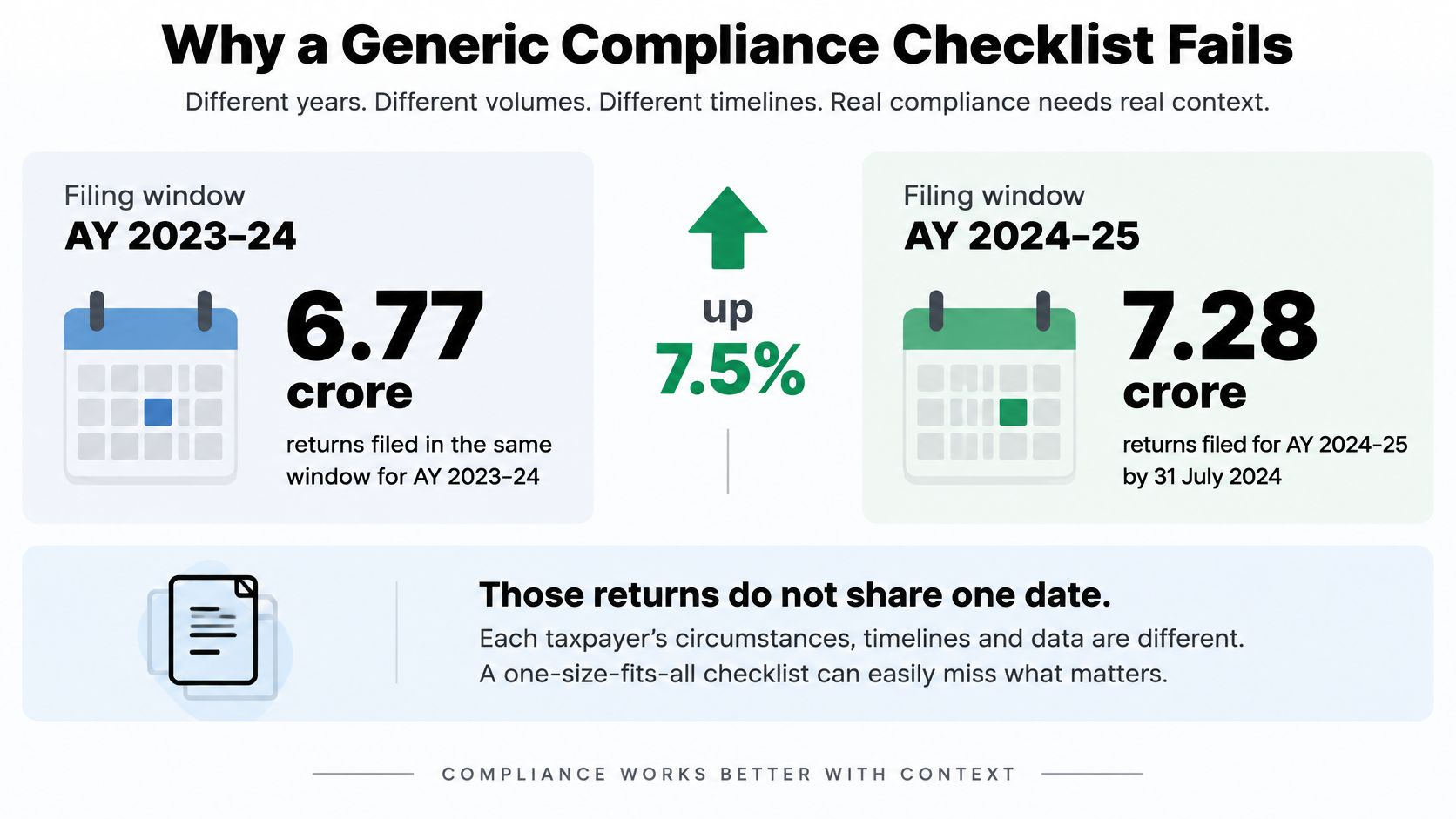
**7.28 crore income-tax returns** were filed for AY 2024–25 by 31 July 2024, up **7.5%** from 6.77 crore in the corresponding window for AY 2023–24, according to the [Press Information Bureau's filing update](https://www.pib.gov.in/PressNoteDetails.aspx?NoteId=155163&ModuleId=3). For a CA partner, the operational lesson isn't just that filing volumes are growing. It's that a firm-wide list of dates can't tell staff which client needs work, what's blocking that work or who must resolve it.
## Table of Contents
- [Why a Generic Compliance Checklist Fails](#why-a-generic-compliance-checklist-fails)
- [Start with the client master](#start-with-the-client-master)
- [Deadline Map by Client and Obligation](#deadline-map-by-client-and-obligation)
- [Read the exception before accepting the date](#read-the-exception-before-accepting-the-date)
- [Keep statutory and internal clocks separate](#keep-statutory-and-internal-clocks-separate)
- [How Client Deadlines Get Auto-Populated](#how-client-deadlines-get-auto-populated)
- [From profile to filing readiness](#from-profile-to-filing-readiness)
- [Make changes inspectable](#make-changes-inspectable)
- [Digests and Reminders That Match the Workload](#digests-and-reminders-that-match-the-workload)
- [Compare the alert patterns](#compare-the-alert-patterns)
- [Give each message an action](#give-each-message-an-action)
- [Status Tracking Inside the Client Workspace](#status-tracking-inside-the-client-workspace)
- [Make each row defensible](#make-each-row-defensible)
- [Keep completion reversible](#keep-completion-reversible)
- [An October Workload Across Mixed Clients](#an-october-workload-across-mixed-clients)
- [Allocate the month in date order](#allocate-the-month-in-date-order)
- [Handle a change within the cycle](#handle-a-change-within-the-cycle)
- [Choose the Calendar That Matches the Firm](#choose-the-calendar-that-matches-the-firm)
- [Select for the hand-offs](#select-for-the-hand-offs)
## Why a Generic Compliance Checklist Fails
Say your practice handles a proprietor, an audited business, a company and a GST registration with quarterly filing obligations. A shared calendar might show every relevant deadline, yet still leave the article clerk to decide which ones apply. That's not automation. It's a reference sheet with notifications.
**Compliance calendar software should generate client-specific work**, not distribute the same checklist to everyone. The distinction matters whenever a client's audit status, registration profile or engagement changes.
The filing-volume comparison illustrates the scale behind that operational problem.
### Start with the client master
Before importing deadlines, give each client a compliance profile that records:
- **Entity type and audit status**, including the applicable income-tax filing category.
- **GST registration and filing frequency**, maintained at registration level rather than assumed across the client.
- **TDS deductor category and transaction type**, so payment exceptions aren't lost.
- **Engaged obligations**, separating the firm's filing responsibilities from advisory work and client-owned tasks.
An original return, a belated return and a revised return also need distinct task identities. Replacing an unfinished original-return task with another date conceals what happened and makes the review trail harder to defend.
> **Practical rule:** A deadline should answer why it applies to this client before it tells anyone when to act.
Assign a calendar administrator as well as filing owners. The administrator maintains registration changes and rule updates; the filing owner prepares and completes the obligation. Without that separation, staff can mistake a stale client profile for an authoritative statutory date.
For company work, the same discipline must continue after submission. A filing acknowledgement and an accepted outcome aren't interchangeable, so the calendar must accommodate work that remains open beyond the act of uploading a form.
## Deadline Map by Client and Obligation
**Statutory clocks a compliance calendar must generate**
| Obligation | Who it applies to | Usual due date | Exception the software must model |
|---|---|---|---|
| ITR original, non-audit | Many non-audit taxpayers | Applicable non-audit original-return deadline | Separate belated and revised windows |
| ITR original, audit | Business or profession whose accounts need audit | Applicable audit-category deadline | Must not inherit the non-audit date |
| ITR original, company or TP | Companies, transfer-pricing cases and specified audited taxpayers | Deadline for the applicable filing category | Category must be verified, not inferred from a broad label |
| GSTR-3B monthly | Normal monthly filers | Following-month monthly filing deadline | Applicable extensions and taxpayer return tile |
| GSTR-3B quarterly | Eligible quarterly filers | State or UT-specific quarterly deadline | Must not inherit the monthly filing rule |
| TDS payment | General deductors | Generally the 7th of the following month | March for non-government deductors generally uses 30 April |
| TDS challan-cum-statement | Specified property, rent, contractor or professional, VDA transactions | 30 days from month-end | Not calculated from the transaction date |
| GST bank details, Rule 10A | Many newly registered taxpayers | Registration-triggered deadline or earlier outward-supply trigger | One-time obligation, not a recurring return |
For the TDS rows, the [Income Tax Department's tax-payment guidance](https://www.incometax.gov.in/iec/foportal/help/all-topics/e-filing-services/tax-payments) states the general **7th-of-the-following-month** rule, the **30 April** March exception for non-government deductors and the **30-day month-end** rule for specified challan-cum-statement cases.
Use this map before evaluating the appearance of a dashboard. A product can display attractive monthly tiles while applying the wrong legal clock underneath them.
### Read the exception before accepting the date
Ask staff to distinguish **the event that starts the clock** from **the date the software displays**. A deduction month, a registration event and a tax period aren't interchangeable inputs. Nor should a challan-cum-statement task be treated as an ordinary monthly deposit.
For example, test a non-government deductor's March payment separately from an ordinary deduction month. Then test a qualifying transaction that uses the month-end mechanism. A system that adds a reminder to every transaction date fails the second case even if its ordinary TDS rows look correct.
Use the [client due-date reference](https://charterai.in/due-dates) as a working checkpoint when reviewing generated obligations. Staff should reconcile the client's profile, the applicable rule and the displayed task rather than accepting a generic annual list.
### Keep statutory and internal clocks separate
The statutory deadline is the outer boundary. Your practice should also set an internal preparation target, reviewer hand-off and client-document request date.
- **Statutory date**, maintained from the applicable rule and notified changes.
- **Preparation target**, chosen by the firm to leave room for reconciliation and review.
- **Client commitment**, recorded separately when the client promises missing information.
Don't move the statutory date because a client sends books late. Record the delay as a dependency and escalate it through the task. Otherwise, the calendar may look orderly precisely when the firm needs a visible exception.
Reject any calendar that applies a universal monthly reminder to these different obligations. The useful comparison is not how many dates it contains, but whether it selects the right clock for each client.
## How Client Deadlines Get Auto-Populated
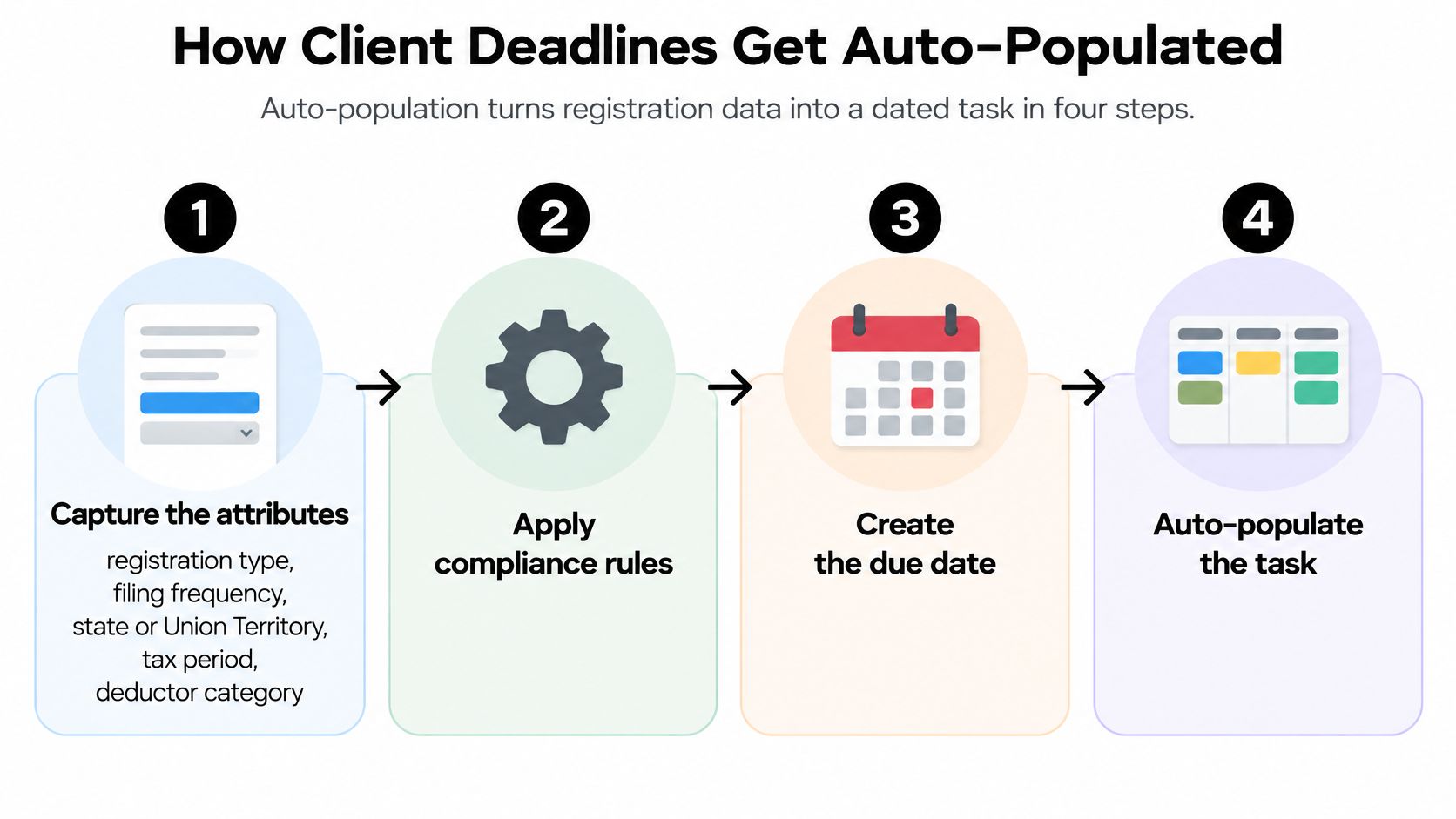
**Auto-population should be a reproducible calculation**, not an unexplained suggestion. Staff should be able to inspect the inputs and understand why a task exists.
The process starts with registration data and ends with an actionable task.
### From profile to filing readiness
1. **Capture the attributes.** Store registration type, filing frequency, state or Union Territory, tax period, deductor category, payment mechanism, transaction section and financial year. Keep notified extensions and source-return availability as separate fields.
2. **Apply the matching rule.** Identical metadata should produce the same result. A change to filing frequency must affect only obligations governed by that attribute.
3. **Attach the dependencies.** Give staff usable states such as awaiting GSTR-1, GSTR-2B generated, reconciliation pending and ready for GSTR-3B.
4. **Save the explanation.** Retain the rule, relevant client attributes, source, review date and calculation history alongside the generated task.
The [GST portal's GSTR-3B guide](https://tutorial.gst.gov.in/userguide/returns/GSTR3B.htm) describes normal monthly deadlines generally falling on the **20th of the following month**, quarterly deadlines generally falling on the **22nd or 24th** under applicable state or UT schedules, and system-populated information from GSTR-1/1A and GSTR-2B. That makes filing frequency, location and prerequisite data operational inputs, not optional notes.
At Charter AI, our unlimited compliance calendar is auto-populated from each client's registration type. Our due dates come from **statutory rules, not AI**, and each shows its source and the date it was last reviewed.
### Make changes inspectable
When a rule changes, require the calendar to retain the earlier calculation, identify the replacement and list affected registrations. A user should be able to distinguish a government extension from a staff correction to the client master.
Custom deadlines belong beside statutory tasks, but they must be labelled **custom**. A partner's review target must never acquire the appearance of a legal filing deadline merely because both appear in the same calendar.
> A silent date change can be worse than a maintained spreadsheet. The spreadsheet at least gives its owner a chance to explain the alteration.
For a demonstration, change the filing frequency on a sample registration and inspect the resulting tasks. Only affected obligations should change, and the earlier calculation should remain available for review.
Use the workflow demonstration to assess how easily staff can inspect the calendar while working.
## Digests and Reminders That Match the Workload
A reminder on filing morning is too late if the preparer still needs books, reconciliation and approval. Sending every possible alert to everyone isn't better. Staff soon learn to skim messages that don't tell them what to do.
Partner-only notifications create a different problem: the person accountable for the practice receives the message, while the person preparing the return never receives a clear assignment.
### Compare the alert patterns
| Alert pattern | Operational weakness | Better approach |
|---|---|---|
| Due-date morning email | Leaves preparation and review unresolved | Start the reminder cycle before filing day |
| Separate ping for every client | Makes exceptions difficult to identify | Consolidate work into a daily digest |
| Partner-only notification | Separates the alert from the preparer | Notify the owner and escalate selectively |
| Workload-aware digest | Requires maintained statuses | Group due soon, blocked and overdue work |
Our calendar sends reminders **7 days before, 1 day before and on the day** a deadline is due. That cadence gives the team a preparation prompt, a final check and a deadline-day signal without treating every stage as the same message.
The daily digest lists what is due for specific clients. A useful entry reads: **GSTR-3B due on 20 October for Mehta Traders LLP, Kaveri Textiles Private Limited and Patel Agro Exports.** The preparer shouldn't need to open an anonymous task count to discover whose work is involved.
### Give each message an action
A **due-soon** entry should identify the client, obligation and owner. A **blocked** entry should name the missing input, such as an unavailable source return or unresolved reconciliation mismatch. An **overdue** entry should state who must intervene and whether the delay is awaiting the client, the reviewer or a portal action.
Keep client chases separate from internal escalation. A request for purchase invoices isn't the same communication as a partner's decision about a disputed reconciliation item.
- **Record reminder history**, including the recipient and sending outcome, so staff can investigate a missed notification.
- **Escalate by materiality and responsibility**, rather than copying the whole firm into every unresolved task.
- **Track notice work independently**, using the [notice reply deadline tool](https://charterai.in/tools/notice-reply-deadline) to establish the relevant reply timeline before assigning preparation work.
During the **7 days before a statutory due date**, we treat support as urgent, with a first response within **2 business hours** and a same-day fix or workaround for anything blocking a filing.
A delivered reminder isn't proof of readiness. The task's preparation and review status must determine whether staff proceed.
## Status Tracking Inside the Client Workspace
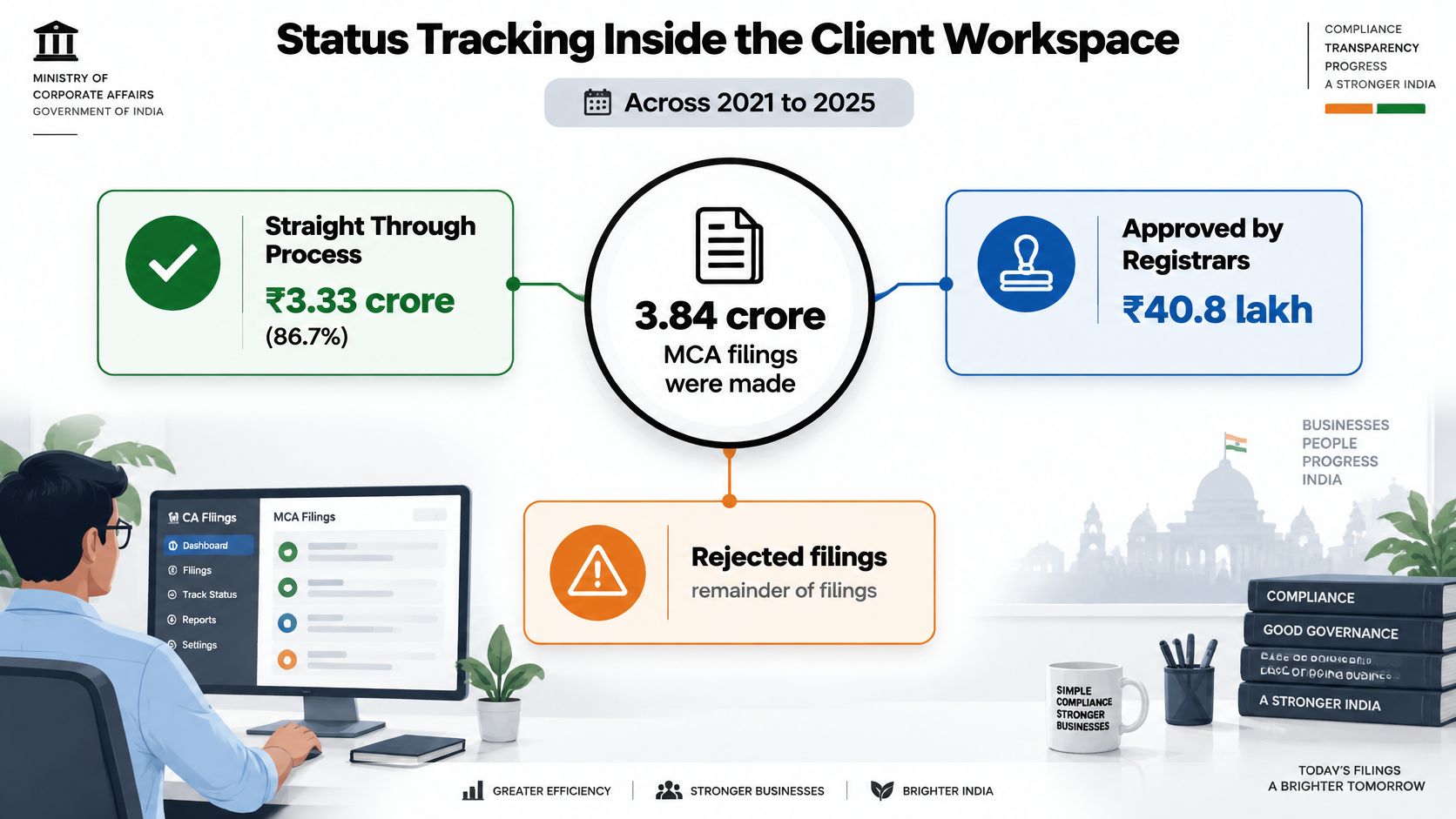
**8.3 lakh MCA filings were rejected by concerned officers** across 2021 to 2025, during which approximately **3.84 crore filings** were made, according to a [Press Information Bureau release on MCA processing](https://www.pib.gov.in/PressReleaseDetail.aspx?PRID=2226017®=6&lang=1). That's a direct reason not to equate submission with completion.
A tick against the calendar date proves very little unless the reviewer can open the filing evidence and see its subsequent outcome. Corporate filings need outcome tracking, while return preparation needs visibility into prerequisites and unresolved working-paper issues.
The processing routes illustrate why a workspace must preserve more than a submission date.
### Make each row defensible
A calendar row should contain the following working information:
- **Owner**, naming the person responsible for the next action, not merely the engagement partner.
- **Dependency status**, showing whether preparation is waiting for information, reconciliation or review.
- **Filing outcome**, distinguishing submitted, pending approval, accepted and rejected where relevant.
- **Evidence attachment**, containing the acknowledgement, challan or other completion record.
- **Reminder history**, preserving the communication trail.
- **Client-file connection**, opening the relevant books, reconciliation, documents and notice material.
These fields serve different purposes. The owner allocates action; the evidence supports completion; the outcome establishes whether further work remains. Combining them into a single done checkbox removes information the partner needs.
### Keep completion reversible
A preparer may mark a task complete before discovering an open mismatch or attaching the wrong acknowledgement. Reopening it should preserve the original action and the reason for reversal, rather than erase the sequence.
Our calendar supports **mark done with undo**, displays client GSTR-3B and TDS dates, and adds GST dates when the client's registration type is set. The [client workspace](https://charterai.in/workspace) keeps the calendar alongside the work it relates to, rather than making staff maintain another disconnected tracker.
Bookkeeping, reconciliation, Tally export, the compliance calendar and the client vault are unlimited and use no tokens, with no caps on statements, invoices, reconciliations or clients. That removes a usage constraint, but the firm still needs disciplined completion criteria and a named reviewer.
> **Control standard:** A date without an owner and supporting evidence is a reminder. A date connected to both can support a reviewable control.
On deadline morning, the partner should see each client and obligation as **completed, blocked, rejected or unassigned**, with access to the underlying record. A green dashboard isn't reassuring if staff achieved it by closing tasks prematurely.
## An October Workload Across Mixed Clients
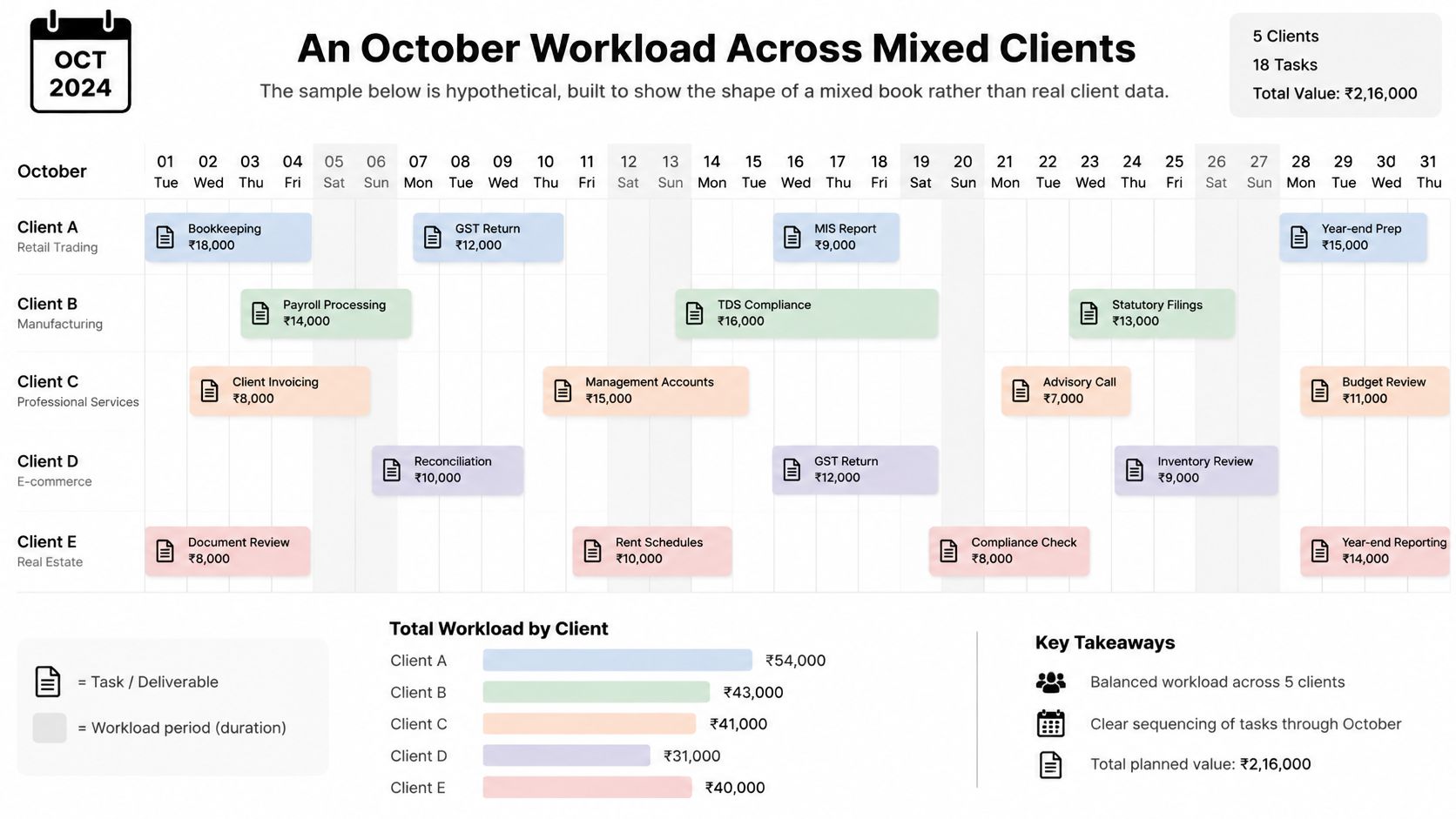
A mixed-client calendar is easiest to evaluate as a staffing problem. The sample below is hypothetical, built to show the shape of a mixed book rather than real client data.
Our sample calendar for **October 2026** contains different obligations for different client profiles. Treat these entries as a product scenario, not a substitute for checking the applicable statutory rule and notifications for a live engagement.
The visual shows how those obligations can be arranged for workload planning.
### Allocate the month in date order
- **On the 7th**, the sample lists TDS payment challans for Mehta Traders LLP and Gupta Pharma Distributors.
- **On the 11th**, GSTR-1 entries appear for Kaveri Textiles Private Limited and Mehta Traders LLP.
- **On the 20th**, monthly GSTR-3B entries cover Mehta Traders LLP, Kaveri Textiles Private Limited and Patel Agro Exports.
- **On the 22nd and 24th**, the sample shows quarterly GSTR-3B and a PMT-06 payment respectively for Sharma & Sons Hardware.
- **On the 31st**, it shows TDS return and ITR filing work for Gupta Pharma Distributors and Reddy Constructions.
The reviewer must validate the PMT-06 entry against the relevant period and payment mechanism rather than infer a universal quarterly-client rule. Likewise, the sample's ITR entry doesn't establish a deadline for every entity bearing a similar name.
For staffing, the distinction is straightforward: the quarterly filer must not be escalated merely because monthly clients have reached their filing date. Nor should staff postpone monthly-client work to match the quarterly registration.
### Handle a change within the cycle
The [GST system's eight-year report](https://tutorial.gst.gov.in/offlineutilities/gst_statistics/8YearsReport.pdf) describes Rule 10A's requirement for many newly registered taxpayers to furnish bank details within **30 days or before filing outward-supply details, whichever is earlier**, and reports that from the **November 2025 tax period**, certain inter-State supplies would be auto-populated and non-editable in GSTR-3B, with corrections routed through GSTR-1A.
For an affected registration, the immediate assignment may therefore be **correct the source return first**, not prepare GSTR-3B. The working record should identify the applicable change, the affected client and the preparer responsible for clearing it.
Staff should work the blocked queue while partners receive material exceptions and overdue decisions. This is ordinary mixed-practice work, not an unusual edge case that deserves a separate spreadsheet.
## Choose the Calendar That Matches the Firm
Choose the setup that resolves your actual operating problem. Buying a full workspace won't repair an inaccurate client master, and buying a reminder tool won't connect filing evidence to a task unless that connection is part of the workflow.
**Calendar setups compared by situation**
| Setup | Best when | Rule and source per date | Digest and alerts | Status, owner and evidence |
|---|---|---|---|---|
| Well-owned spreadsheet | Handful of clients; one person knows every registration | Manual change log only | None unless built by hand | Not linked to client files in the basic setup |
| Dedicated reminder tool | Missed pings are the main pain; documents live elsewhere | Require an inspectable rule reference or maintain it separately | Reminders and digests | Require task ownership and document links |
| Client-workspace calendar | GST, TDS and ITR rules differ across the book; the same team reconciles and files | Require rule, source and last review per date | Require due-soon, blocked and overdue groups | Require linked owner, evidence and vault records |
Treat the workspace row as an **acceptance standard**, not a claim that every product in that category meets it. A reminder tool with strong task links may be sufficient; a workspace with opaque deadline generation may not be.
### Select for the hand-offs
A spreadsheet is reasonable when a named person can maintain registrations, record changes and review every open obligation. Keep using it if that process remains dependable. Don't replace a controlled sheet with software nobody owns.
A dedicated reminder tool suits a practice whose documents and working papers already sit somewhere staff use consistently. The essential question is whether the reminder opens the right work, rather than creating another place to search.
Charter AI represents the combined-workspace approach, bringing drafting, research, books, GST, Tally, and the compliance calendar together. The operational benefit is the proximity of the deadline to the preparation work, not just the existence of another calendar view.
> If a generated date cannot show its rule, don't trust the automation.
Before committing, test a monthly GST filer, a quarterly GST filer and a non-government March TDS deductor from your own client book. Inspect the generated obligations, change a relevant attribute, reopen a completed task and locate its evidence. Accept the system only when your preparer and reviewer can both explain the result without relying on a sales demonstration.
---
Charter AI offers an unlimited, registration-based compliance calendar with source-visible statutory dates, daily digests and reminders alongside client work. Visit [Charter AI](https://www.charterai.in) and test your own mixed-client workflow, from generated deadline to preparation, review and completion evidence.
## Tags
- [Compliance calendar software](https://charterai.in/blog/tag/compliance%20calendar%20software)
- [CA practice India](https://charterai.in/blog/tag/CA%20practice%20India)
- [GST deadlines](https://charterai.in/blog/tag/GST%20deadlines)
- [TDS calendar](https://charterai.in/blog/tag/TDS%20calendar)
- [Client workspace](https://charterai.in/blog/tag/client%20workspace)
Canonical: https://charterai.in/blog/compliance-calendar-software