
Asset Disposal Account: Journal Entries and Tax Rules
Learn how an asset disposal account works — journal entries, gain or loss calculation, Section 50 tax rules and a worked example for Indian CA firms.
Published 14 min read
An asset disposal account is a temporary clearing account that gathers an asset's original cost, accumulated depreciation and sale proceeds, so the balancing figure is the isolated gain or loss on disposal. If an asset costs ₹10 lakh and has ₹7 lakh of accumulated depreciation, its net book value is ₹3 lakh; selling it for ₹3.6 lakh gives a book gain of ₹0.6 lakh, while selling it for ₹2.4 lakh gives a book loss of ₹0.6 lakh.
A familiar close-time problem: a client sells an old delivery van mid-year, but the fixed-asset register still shows its original cost and depreciation schedule. The sale proceeds are in the bank, yet the asset and its accumulated depreciation remain in separate ledger accounts. You need to clear the asset from the books and identify the book result, then separately test the sale under the income-tax rules. Those are connected tasks, but they don't produce the same answer.
Table of Contents
- Why the Asset Disposal Account Exists
- How the Asset Disposal Account Works
- Move the balances into the clearing account
- Apply the accounting derecognition rule
- Journal Entries for an Asset Disposal
- Post the four linked entries
- A Worked Example With Real Numbers
- Entries when the asset sells for ₹3.6 lakh
- How Section 50 Changes the Tax Answer
- Held for Sale Is Not the Same as Disposed
- Support the classification date
- Building a Clean Disposal Trail With the Right Tools
Why the Asset Disposal Account Exists
A client sells a machine during the year. The bank receipt is posted, but the fixed-asset account still carries the machine's original cost, and accumulated depreciation remains in its own ledger. If the bookkeeper records only the money received, the books show cash from a sale without clearly removing the asset that was sold.
The asset disposal account provides a temporary place to bring those parts together. Think of it as a holding pen: the asset's cost and accumulated depreciation move into it, and the sale proceeds are recorded there too. Once the entries are complete, the balance left in the disposal account is the gain or loss to recognise in the books.
The confusion often starts because the information is scattered. The fixed-asset register holds the asset details, the ledger holds cost and depreciation, and the bank or customer account records the proceeds. The clearing step gathers them for one calculation, then removes the asset from the relevant records.
Practical rule: Treat the disposal account as a working account for one transaction, not as a permanent home for an asset balance.
That distinction matters in Indian CA work because the book result is only one part of the disposal. The accounting entry supports removal from the financial statements; the income-tax computation for depreciable assets may instead depend on the asset's tax block. A planned sale can also raise a separate held-for-sale classification question before the actual disposal takes place.
The reliable sequence is to establish the accounting carrying value, post the disposal entries, and then reconcile the tax computation and supporting documents. That way, the fixed-asset register, financial statements and tax working papers each tell the right part of the story.
How the Asset Disposal Account Works
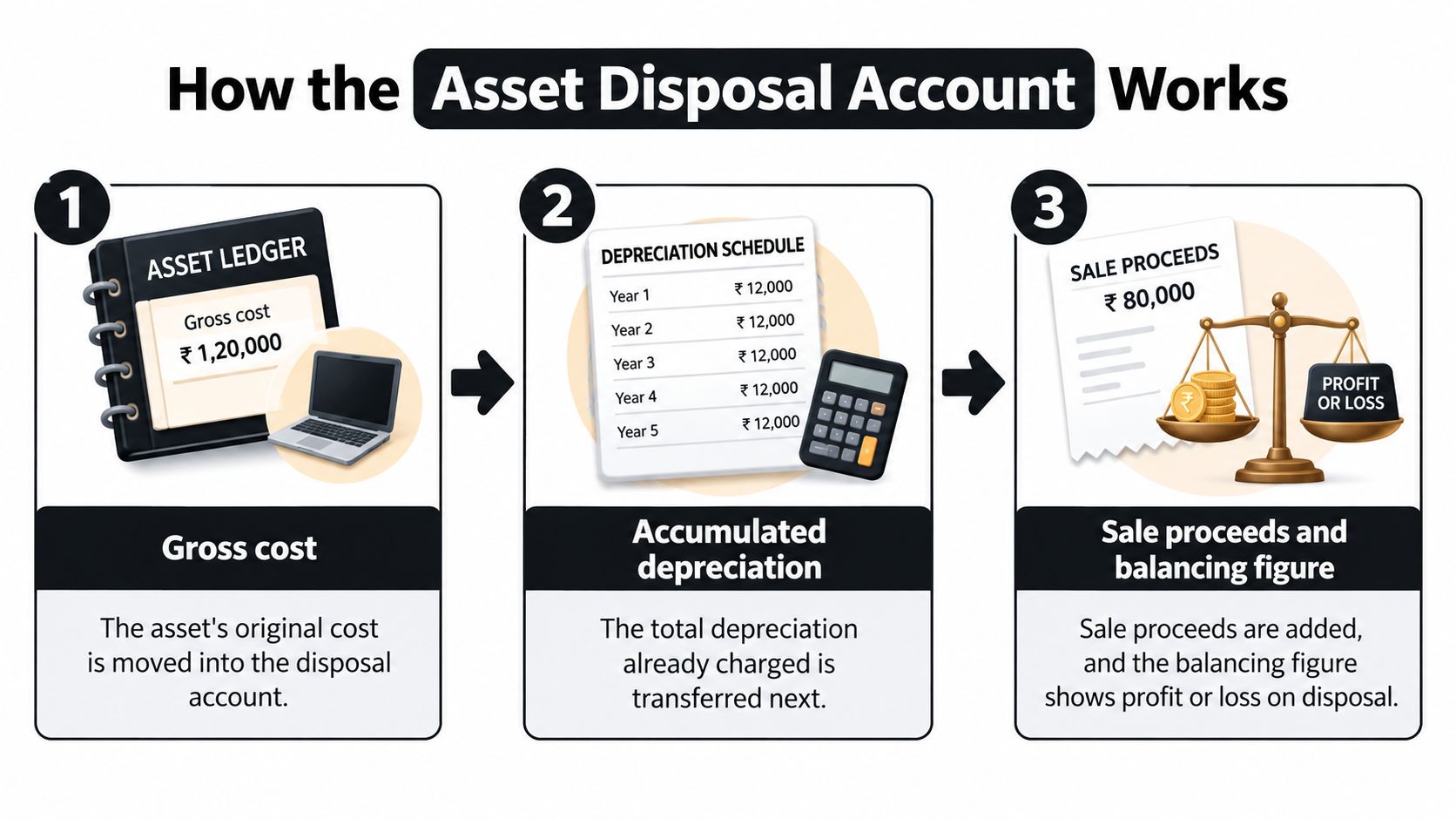
Clearing an asset is like emptying a drawer before discarding it. You first gather everything that belongs to the drawer, then deal with the contents together. For a disposal, the “contents” are the asset's gross cost, accumulated depreciation and sale proceeds.
Move the balances into the clearing account
Start by transferring the asset's original cost out of the fixed-asset account. In the disposal account, debit the gross cost; credit the fixed-asset account to remove that cost from the books.
Next, transfer accumulated depreciation. Debit the accumulated depreciation account to clear its existing credit balance, and credit the disposal account. The amount remaining after these transfers is the asset's net book value.
Then record any sale proceeds in the disposal account. Debit the bank or receivable account for the amount due, and credit the disposal account. Compare the credits and debits in the disposal account. If the proceeds exceed net book value, the disposal account has a debit balance before closing, representing a gain. If net book value exceeds proceeds, it has a credit balance, representing a loss. The closing entry transfers that balancing amount to the relevant profit and loss account, leaving the disposal account at zero.
Apply the accounting derecognition rule
In India, AS 10, Property, Plant and Equipment, requires an asset to be removed from the financial statements when it is disposed of. If the asset has been retired from active use but is being held for disposal, it is reported separately and measured at the lower of its net book value and net realisable value. Any expected loss is recognised immediately in the profit and loss statement. For assets accounted for under the historical-cost model, gains or losses on disposal are generally recognised in profit and loss (AS 10 on property, plant and equipment).
The clearing account isn't the accounting result itself. It is the mechanism that makes the result visible and verifies that the cost and depreciation have both been removed. If it doesn't close to zero after the gain or loss is posted, check for a missing balance, incorrect sign or unrecorded proceeds.
Journal Entries for an Asset Disposal
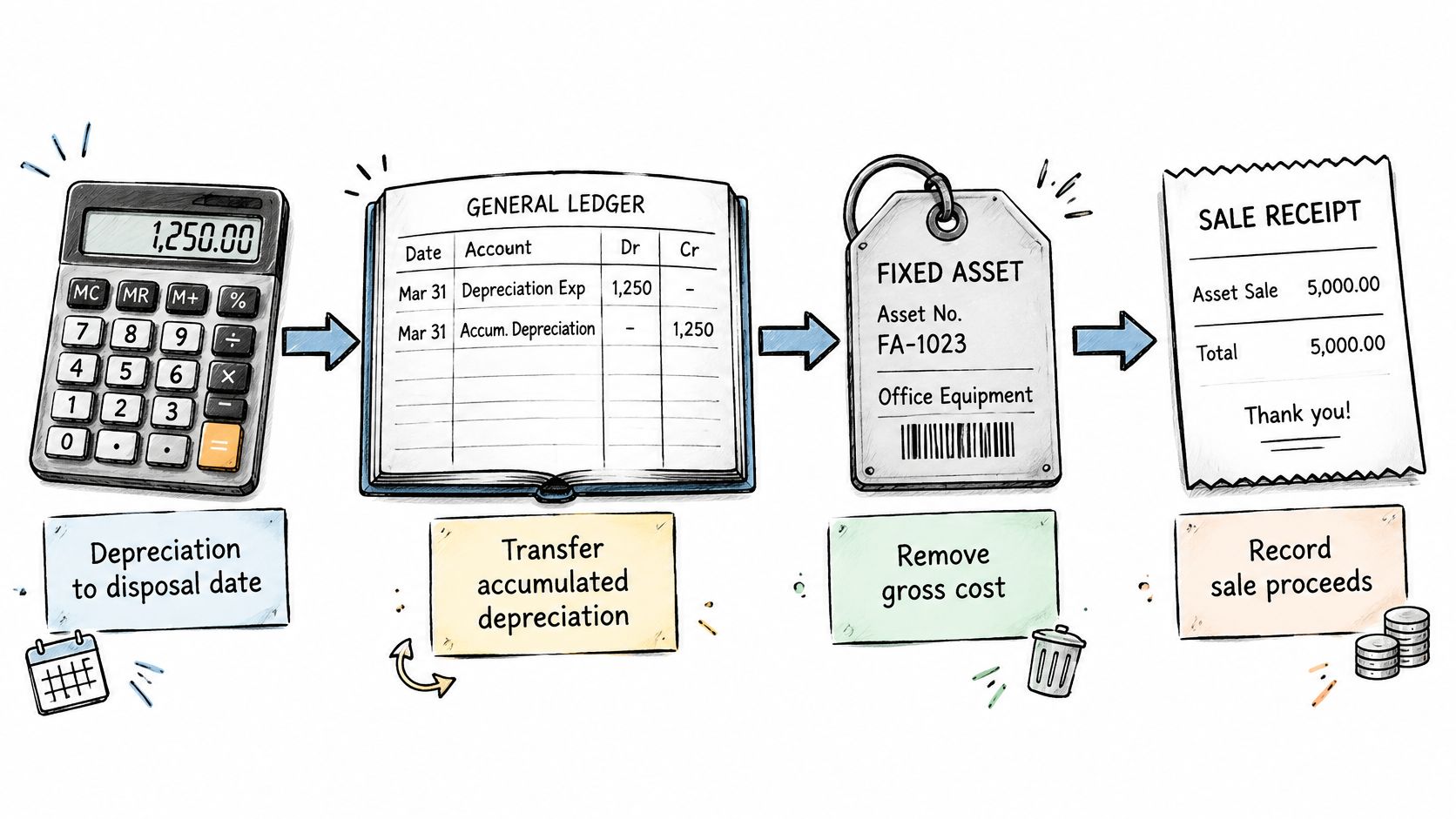
A clean disposal posting follows the asset through its final period of use. If the asset is sold partway through the year, calculate depreciation up to the disposal date first. Then transfer accumulated depreciation, remove the gross cost, and record proceeds and the balancing gain or loss.
Post the four linked entries
First, record depreciation through disposal. Debit depreciation expense and credit accumulated depreciation for the charge up to the date the asset is sold, discarded, demolished or destroyed. Indian depreciation rules require the disposal-year amount to be calculated on a pro-rata basis through that date, rather than applying a full-year charge after the asset has left the business's use (Schedule II depreciation provisions).
Second, transfer accumulated depreciation. Debit accumulated depreciation and credit the asset disposal account for the full balance relating to the asset, including the depreciation just posted. This clears the contra-asset balance.
Third, remove the gross cost. Debit the disposal account and credit the fixed-asset account for the asset's original cost. At this point, the disposal account contains the gross cost and accumulated depreciation needed to calculate carrying value.
Fourth, record the proceeds and close the account. Debit bank or receivables and credit the disposal account for sale proceeds. Then post the balancing amount to gain on disposal or loss on disposal, as appropriate. For a gain, debit the disposal account and credit the gain; for a loss, debit the loss and credit the disposal account.
Check the dates, not just the year-end totals. An asset disposed of during the year shouldn't keep accumulating depreciation after its disposal date.
Additions and disposals need their own dates in the schedule. A year-end net adjustment can hide a late disposal, depreciation charged after sale, or an addition recorded without the right period's depreciation treatment. For a TallyPrime workflow, preserve each leg as a traceable voucher and tie it back to the underlying asset record.
For an asset scrapped or written off without sale proceeds, the same clearing mechanics apply, but no cash or receivable is recorded. The remaining balance is a loss, subject to the applicable accounting treatment. After posting, check that the asset is no longer active in the register and that depreciation doesn't continue against it.
The accompanying video offers another visual walkthrough of the posting sequence.
A Worked Example With Real Numbers
Use the figures from the opening example. The asset's original cost is ₹10 lakh, accumulated depreciation is ₹7 lakh, and net book value is therefore ₹3 lakh. Assume the sale proceeds are ₹3.6 lakh. The amount received exceeds carrying value by ₹0.6 lakh, so the books recognise a gain.
The table shows the disposal entries after depreciation through the disposal date has already been included in the accumulated depreciation balance. The credit to the disposal account for accumulated depreciation offsets part of the debit for gross cost; sale proceeds then complete the comparison.
Entries when the asset sells for ₹3.6 lakh
| Entry | Account Debited | Account Credited | Amount (₹ lakh) |
|---|---|---|---|
| Transfer gross cost | Asset disposal account | Fixed asset | 10 |
| Transfer accumulated depreciation | Accumulated depreciation | Asset disposal account | 7 |
| Record sale proceeds | Bank or receivable | Asset disposal account | 3.6 |
| Recognise gain and close disposal account | Asset disposal account | Gain on disposal | 0.6 |
The disposal account has a debit of ₹10 lakh and credits totalling ₹10.6 lakh before the closing gain entry. The ₹0.6 lakh credit excess is closed by debiting the disposal account and crediting gain on disposal. The disposal account then balances to zero.
If the asset instead sells for ₹2.4 lakh, the cost and accumulated depreciation transfers stay the same. The proceeds are lower than the ₹3 lakh net book value, so the difference is a ₹0.6 lakh loss.
| Sale proceeds (₹ lakh) | Net book value (₹ lakh) | Book result |
|---|---|---|
| 3.6 | 3 | Gain of 0.6 |
| 2.4 | 3 | Loss of 0.6 |
For the loss scenario, debit the bank or receivable for ₹2.4 lakh and credit the disposal account for the same amount. The disposal account then has a debit balance of ₹0.6 lakh. Debit loss on disposal and credit the disposal account to close it.
Use this simple check before posting: original cost less accumulated depreciation equals net book value; proceeds compared with net book value give the book gain or loss. A depreciation schedule or a fixed-asset depreciation tool can help organise the asset-level calculation, but the final entry still needs to agree with the sale evidence and ledger balances.
How Section 50 Changes the Tax Answer
The book gain in the worked example is not automatically the taxable gain. For depreciable assets on which depreciation has been allowed, Section 50 of the Income-tax Act, 1961 uses a block-of-assets computation. That means the tax working doesn't compare this asset's sale proceeds with its individual book carrying amount.
For the relevant block, compare the aggregate sale consideration for assets transferred during the previous year with the following amounts:
- Transfer expenses relating to the transfer.
- Opening written-down value, or WDV, of the block.
- Actual cost of additions to that block during the year.
Where sale consideration exceeds those amounts in the statutory computation, the excess is deemed to be short-term capital gains. If all assets in the block are transferred and the block ceases to exist, the computation instead uses the opening WDV plus additions, with the resulting income also deemed to be short-term capital gains under the section's conditions. The rule applies where depreciation has been allowed on the block, and the individual asset's holding period doesn't determine that statutory characterisation (Section 50 of the Income-tax Act).
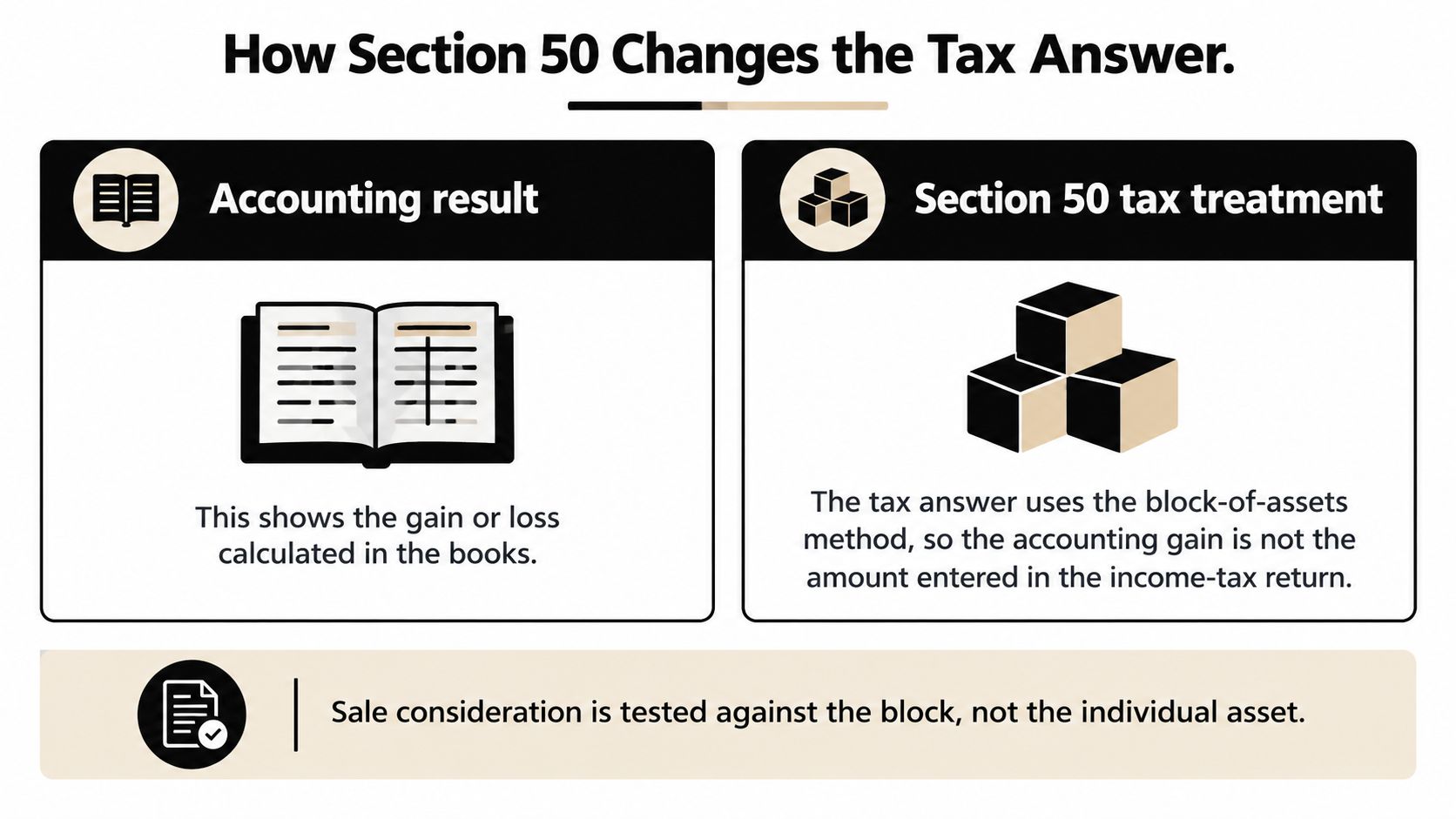
The book calculation follows the individual asset's carrying value. The tax calculation follows the relevant block's tax WDV and activity. As a result, a book loss on one machine can coexist with a different tax result for its block, especially where other assets were sold or added in the same year.
Keep two schedules, not one blended answer. The disposal ledger supports book derecognition; the tax fixed-asset schedule supports the Section 50 computation.
Reconcile the block's opening WDV, additions, transfer expenses and total sale consideration to the tax working. Keep the individual asset details available as well, so the sale invoice and disposal entry can be traced to the correct block. The Section 50 reference and computation context can help practitioners check the statutory basis, but it doesn't replace the client-specific block schedule.
Held for Sale Is Not the Same as Disposed
An asset can be designated as held for sale before a sale is completed. That classification is not the same as derecognition after an actual disposal. Under Ind AS 105, an asset or disposal group qualifies as held for sale when its carrying amount will be recovered principally through sale, it is available for immediate sale in its present condition, and the sale is highly probable (ICAI Ind AS 105 teaching material).
Once the classification applies, measure the asset at the lower of its carrying amount and fair value less costs to sell. Stop depreciation or amortisation and present the asset or disposal group separately in the balance sheet. The date matters: stopping depreciation before the criteria are met can overstate profit, while delaying the classification may leave impairment or presentation issues unresolved.
Support the classification date
A file note should show why the asset was ready for immediate sale and why completion was highly probable at the classification date. Relevant evidence can include board approval, active marketing, the expected sale timeline, valuation support and subsequent events. These records help a reviewer distinguish an approved and actionable sale from a general intention to sell at some point.
If negotiations fail or the buyer's conditions change, reassess whether the held-for-sale criteria continue to be met and apply the relevant accounting treatment. Don't leave a discontinued classification in place because a sale was once expected. Equally, don't treat an asset as disposed of until derecognition is supported by the actual transaction and applicable accounting requirements.
Keep the accounting classification separate from GST and income-tax treatment. A held-for-sale decision affects the accounting presentation before completion; it doesn't by itself replace the tax computation or establish that a taxable sale has occurred.
Building a Clean Disposal Trail With the Right Tools
A disposal is easier to review when each record leads to the next. Start with the fixed-asset register and depreciation schedule, then tie the general-ledger disposal account to the sale invoice and bank receipt. On the tax side, retain the GST invoice where relevant and map the transaction to the appropriate income-tax block schedule.
The supporting file should preserve asset-level details that explain both calculations:
- Asset identity and dates: description, invoice date, disposal date and original cost.
- Book balances: accumulated depreciation through disposal and resulting carrying amount.
- Transaction evidence: sale invoice, receipt and transfer expenses.
- Tax mapping: the relevant block, opening WDV, additions and aggregate consideration.
This trail helps a reviewer see why the book result differs from the tax answer without forcing them to reconstruct the transaction from scattered spreadsheets. It also makes common exceptions easier to catch: an asset still marked active after sale, depreciation posted beyond the disposal date, proceeds that don't agree with the invoice, or an omitted transfer expense in the tax working.
Charter AI provides bookkeeping workflows for invoice and bank-statement ingestion, suggested ledgers, voucher preparation and TallyPrime export, alongside a client document vault. Those features can support an organised trail, while a trial-balance-to-balance-sheet utility can help with related account review. The underlying register, vouchers and tax schedule still need professional checking.
Take one concrete step at your next review: choose the most recent disposal in the fixed-asset register and trace it from the sale invoice through the bank receipt, disposal voucher, depreciation schedule and tax block. Resolve any break in that chain before the working papers are finalised.
Charter AI offers Indian CA firms bookkeeping, document-management and TallyPrime export workflows that can help keep disposal records connected. Visit Charter AI to explore how its workspace can support your invoice-to-tax-block audit trail.