# AI Accounting Software India: The CA Firm Guide
AI Accounting Software India. Compare AI accounting software in India for CA firms. Discover tools with verifiable sources, GST reconciliation, and Tally
Published 14 Oct 2026. 16 min read.
At month-end, a CA firm can have invoices in email threads, purchase registers in spreadsheets, GSTR-2B data in another system, and client explanations arriving over messaging apps. Staff spend hours extracting fields, correcting GSTINs, matching invoice values, selecting ledgers, and retyping vouchers into TallyPrime. The partner's final review then begins with a basic question: **Can every important figure be traced back to a document or an official source?**
That question is more important than whether an AI tool produces a draft quickly. For Indian practices, the buying decision centers on the **evidence gap**. AI accounting software India solutions should combine document reading and drafting with deterministic tax checks, source-linked citations, approval controls, and an audit trail that survives client review or a departmental query.
| Evaluation area | What a CA firm should verify | Why it matters |
|---|---|---|
| Document ingestion | Invoices, bank statements, PDFs, spreadsheets, and GST records | Reduces retyping while preserving the original evidence |
| Accounting workflow | Ledger suggestions, voucher preparation, rules-based posting, and TallyPrime export | Keeps automation connected to the existing system of record |
| GST reconciliation | Matched, missing, and mismatched classification across relevant records | Converts a large data set into a reviewable exception queue |
| Compliance control | Deadline alerts, client ownership, and escalation history | Prevents a missed reporting window from becoming a filing problem |
| AI drafting | Structured replies, opinions, appeals, and representations | Accelerates preparation without replacing professional judgement |
| Verification | Exact source locations, reviewer approval, and immutable history | Makes an output defensible rather than merely fluent |
## Table of Contents
- [The Shift to AI in Indian Accounting Practices](#the-shift-to-ai-in-indian-accounting-practices)
- [Why basic digitisation no longer solves the whole problem](#why-basic-digitisation-no-longer-solves-the-whole-problem)
- [Core Capabilities of AI Accounting Software](#core-capabilities-of-ai-accounting-software)
- [Document ingestion and ledger preparation](#document-ingestion-and-ledger-preparation)
- [Rules before probability](#rules-before-probability)
- [GST reconciliation as an exception system](#gst-reconciliation-as-an-exception-system)
- [Leading AI Accounting Solutions in India](#leading-ai-accounting-solutions-in-india)
- [Comparing the decision criteria](#comparing-the-decision-criteria)
- [Security and practice management](#security-and-practice-management)
- [Trust and Verification in AI-Generated Outputs](#trust-and-verification-in-ai-generated-outputs)
- [The evidence chain a reviewer needs](#the-evidence-chain-a-reviewer-needs)
- [Keep deterministic controls distinct](#keep-deterministic-controls-distinct)
- [Practical Use Cases for CA Firms](#practical-use-cases-for-ca-firms)
- [Weekly GST exception management](#weekly-gst-exception-management)
- [Notice replies and representations](#notice-replies-and-representations)
- [Tally preparation and review](#tally-preparation-and-review)
- [Deadline control](#deadline-control)
- [How to Choose the Right Platform for Your Practice](#how-to-choose-the-right-platform-for-your-practice)
## The Shift to AI in Indian Accounting Practices
The pressure usually becomes visible during reconciliation. A staff member downloads purchase data, compares it with the books, searches for an invoice that may be missing, and sends follow-up messages to vendors. The same process repeats across clients, often with different file formats and naming conventions. By the time exceptions reach the senior reviewer, the firm has limited time to obtain corrections before return finalisation.
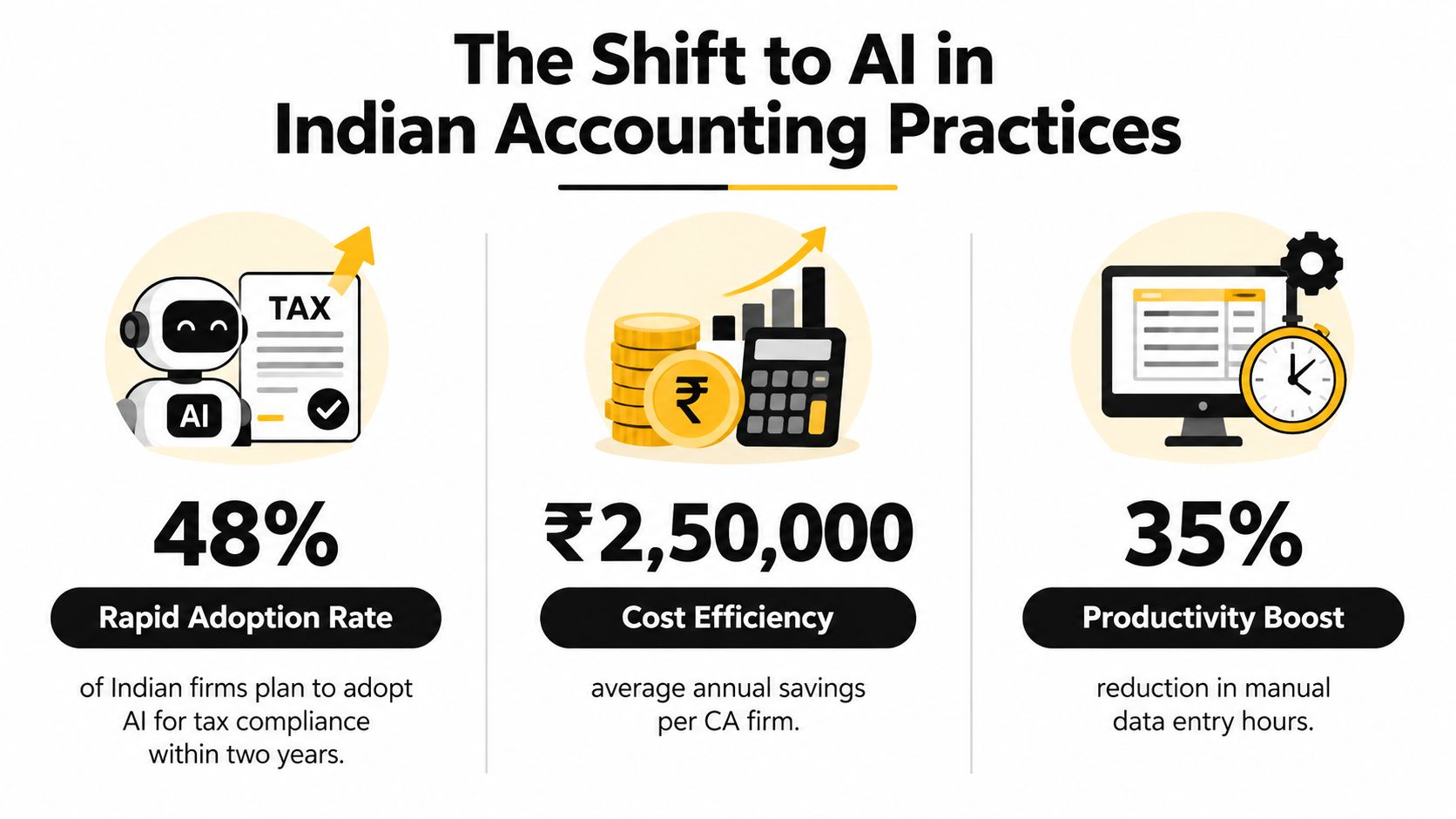
Indian businesses already use digital finance tools at meaningful scale. A FICCI survey of more than **600 Indian manufacturing SMEs across 14 cities** reported in October 2023 found that **48% used digital tools for finance**, while **37% used cloud-based business applications** such as infrastructure, platform, or software-as-a-service tools. Accounting applications including Tally, Vyapar, and Busy were among the commonly used business applications, which indicates that the starting point for many firms is not paper bookkeeping but fragmented digital bookkeeping. ([FICCI survey reporting](https://www.dtnext.in/news/business/indian-smes-embrace-digitalisation-sustainability-ficci-743049))
### Why basic digitisation no longer solves the whole problem
A ledger application can record a transaction. It doesn't necessarily explain whether the supporting invoice appears in the relevant GST data, whether the supplier's GSTIN is valid, or whether the value difference needs client follow-up. Cloud access can make files easier to share, but it doesn't by itself create a controlled review process.
GST has made this distinction more important. India introduced GST nationally on **1 July 2017**, and compliance increasingly depends on electronic records, including GSTR filings, e-invoices, and e-way bills. A 2026 academic analysis using GSTN-linked data for July 2017 to March 2024 reported that e-invoice penetration among eligible taxpayers rose from **12% in the fourth quarter of 2020 to 78% in the first quarter of 2024**. The same analysis reported that on-time filing rose from **67% to 82%**, while the mismatch rate between GSTR-1 and GSTR-2B fell from **8.4% to 4.2%**. ([GST digitisation analysis](https://www.tandfonline.com/doi/full/10.1080/23311886.2026.2700043))
Those figures don't mean an AI layer can replace a CA's review. They show why a modern workflow must interpret structured tax data rather than merely type information into a ledger. The useful system is the one that joins existing accounting software with evidence collection, reconciliation, compliance tracking, and accountable human approval.
> **Practical rule:** Treat AI as a controlled workbench around the books, not as an autonomous authority for posting or filing.
The shift is therefore operational rather than fashionable. A firm with growing client volume needs fewer isolated tasks and more connected workflows. The strongest business case comes from shortening the distance between source document, accounting entry, exception, reviewer decision, and final export.
## Core Capabilities of AI Accounting Software
A practical platform for Indian CAs should begin with the firm's existing workflow. Replacing TallyPrime isn't automatically progress if staff still have to download documents, re-enter voucher details, and manually validate GST fields. The better design lets the accounting system remain the system of record while automation works upstream and around it.
### Document ingestion and ledger preparation
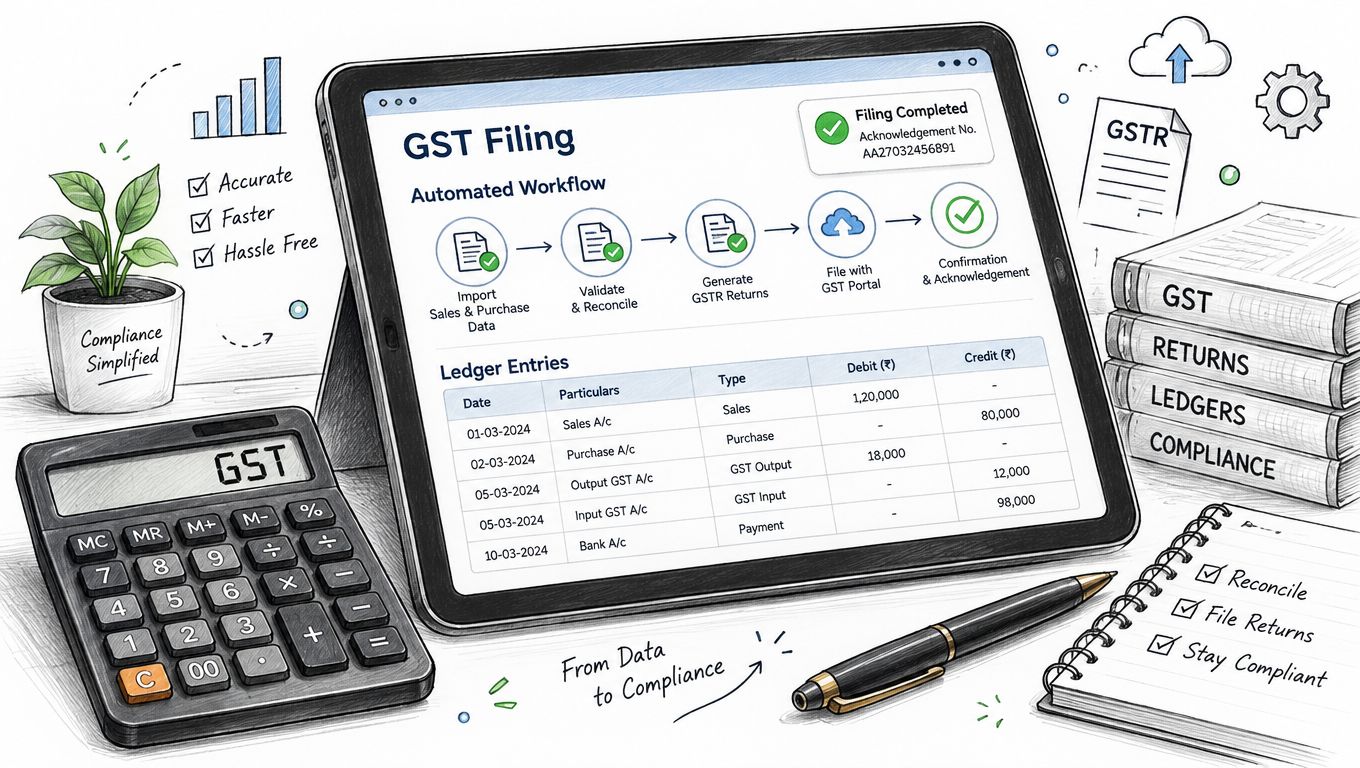
OCR and document interpretation should extract supplier details, invoice numbers, dates, taxable values, tax amounts, and totals from invoices, PDFs, receipts, and statements. Extraction isn't the final accounting decision. The platform should show the original document beside the extracted fields, identify uncertain values, and allow a reviewer to correct them before voucher preparation.
Ledger suggestions can reduce repetitive selection, but the system should explain why a ledger was suggested. A rule such as supplier, expense category, GST treatment, and prior approved mapping is more useful than an unexplained prediction. Staff should be able to accept, amend, or reject the suggestion, with the decision recorded for later review.
### Rules before probability
AI is useful for reading varied layouts and recognising inconsistent descriptions. It is less suitable as the sole control for arithmetic, duplicate detection, debit-credit balancing, GSTIN format, tax-code validation, or tolerance thresholds. Those checks should be deterministic, repeatable, and visible to the reviewer.
A reliable posting pipeline should therefore:
- **Normalise fields:** Standardise invoice numbers, dates, supplier names, and references before matching.
- **Validate arithmetic:** Compare taxable value, tax components, and invoice total using explicit rules.
- **Detect duplicates:** Flag repeated invoice numbers, suppliers, values, or document fingerprints.
- **Prepare vouchers:** Create a review-ready entry without posting it to the books.
- **Export safely:** Validate the output schema before TallyPrime import or export.
Teams assessing a bookkeeping workspace can review the workflow through the [Charter AI workspace](https://charterai.in/workspace), including document ingestion, suggested ledgers, voucher preparation, and client-level organisation.
### GST reconciliation as an exception system
Reconciliation shouldn't produce only a match percentage or a green dashboard. It should classify records into **matched, missing, and mismatched**, then expose the reason for each exception. Useful fields include GSTIN, invoice number, taxable value, tax amount, supplier response status, and the source record used for comparison.
That design matters because a missing invoice, an incorrect GSTIN, and a value mismatch require different actions. One may need document collection, another may require a supplier correction, and a third may be resolved by checking whether the books or return contain the error. AI can help group similar exceptions and draft follow-up messages, but the decision rules must remain inspectable.
A demonstration of the surrounding workflow can be useful, but firms should test whether the product supports their own files, Tally configuration, approval sequence, and GST edge cases rather than relying on a polished presentation.
The practical performance measures are not vague claims about intelligence. Track the percentage of vouchers exported without retyping, the post-export rejection rate, ledger-suggestion acceptance, duplicate-voucher rate, and the time from document receipt to review-ready books.
## Leading AI Accounting Solutions in India
There isn't one sensible shortlist for every CA firm. A practice handling appeals and notice replies needs a different control environment from a bookkeeping team focused on high-volume invoice processing. Comparison should therefore begin with the workflow and risk, not with a feature count.
| Platform category | Strong fit | Questions for evaluation | Main caution |
|---|---|---|---|
| Tally-centred automation | Firms that want to retain TallyPrime while reducing upstream entry | Can it prepare validated vouchers and export without retyping? | A connector may automate movement without improving review quality |
| GST reconciliation tools | Practices managing purchase matching and supplier follow-up | Does it expose the source and reason for every mismatch? | A dashboard can hide unresolved exceptions |
| Document extraction platforms | Firms receiving varied invoices, PDFs, and statements | How are low-confidence fields reviewed and logged? | OCR accuracy doesn't equal accounting correctness |
| Tax research and drafting workspaces | Litigation, notices, opinions, appeals, and representations teams | Are citations tied to exact official text or uploaded evidence? | Fluent drafting can conceal unsupported propositions |
| Integrated CA practice platforms | Firms seeking bookkeeping, compliance, research, and client workspaces together | Are permissions, calendars, exports, and audit logs connected? | Broad functionality can be shallow in a critical module |
### Comparing the decision criteria
For bookkeeping-led firms, TallyPrime compatibility is a practical gate. The platform should support document intake, ledger mapping, voucher preparation, validation, and controlled export. A system that forces staff to retype the final entry has shifted the work rather than removed it.
For GST specialists, reconciliation depth matters more than the presence of an AI label. The workflow should accept relevant GSTR-2A or GSTR-2B data, e-invoices, e-way bills, and books data, then classify exceptions in a way that assigns ownership. The firm should also be able to retrieve the evidence behind a proposed adjustment.
For litigation and advisory teams, source-linked research and structured drafting become central. A usable notice-reply workflow should separate facts, legal position, grounds, arguments, annexures, and prayer. It should let a reviewer open the paragraph, notification, judgment, return figure, or uploaded document supporting the draft.
Charter AI is one example of an integrated platform positioned for Indian CA workflows. Its stated capabilities include source-linked research across **3 Crore+ judgments**, CBIC notifications, circulars, and statute text, AI-assisted drafting for notices and appeals, bookkeeping with suggested ledgers and rules-based posting, GST reconciliation, TallyPrime voucher export, client workspaces, and compliance tracking. Those are product capabilities to verify in a controlled pilot, not reasons to skip due diligence.
### Security and practice management
Client workspaces should separate organisations, restrict access by role, preserve document versions, and maintain a meaningful activity history. Encryption is useful, but it doesn't answer every governance question. Partners should ask how the platform handles deletion, exports, access reviews, incident response, and whether client data is used to train models for other customers.
The most revealing test is an end-to-end exercise. Give each shortlisted platform the same invoice set, GST records, Tally export, and notice documents. Ask it to produce an exception queue and a draft response. Then require a reviewer to trace every material output back to its source.
## Trust and Verification in AI-Generated Outputs
A fluent answer can still be professionally unsafe. An AI system may state a legal proposition confidently while omitting a later amendment, confusing facts from two documents, or citing a source that doesn't support the conclusion. For a CA firm, the issue isn't whether a draft sounds plausible. It's whether another professional can reproduce the reasoning from the evidence.
ICAI's survey of approximately **1,100 members** found that nearly half rarely or never used AI for routine tasks. Only **19.6% reported thorough AI training**, while **23.6% reported basic training**. ICAI-related guidance also highlights data quality, ethical concerns, and the continuing need for auditors to interpret technology-generated insights rather than accept them automatically. ([ICAI AI guidance and survey discussion](https://ai.icai.org/articles_details.php?id=20))

### The evidence chain a reviewer needs
A defensible output should separate at least four layers:
- **Source material:** The uploaded invoice, return, notice, contract, judgment, notification, or circular.
- **Extracted fact:** The figure, date, GSTIN, paragraph, or transaction identified from that source.
- **Rule or interpretation:** The arithmetic check, statutory condition, or professional reasoning applied to the fact.
- **Approval record:** The person who reviewed, amended, accepted, or rejected the result.
This structure changes the buying question from “How accurate is the AI?” to “Can the firm prove why this output was accepted?” Accuracy testing still matters, but a percentage without traceability doesn't tell a partner whether an error can be found and corrected.
> A system that cannot show the evidence behind a proposition has created a draft, not a defensible work product.
### Keep deterministic controls distinct
Rules should perform arithmetic, identify duplicates, validate mandatory fields, check GSTIN structure, and apply configured thresholds. AI is better suited to reading unstructured documents, grouping similar exceptions, summarising records, and drafting text from approved facts.
That separation reduces a common failure mode. A model may infer a plausible tax treatment from a document, but it shouldn't override a rule that flags an incorrect tax calculation. The user should see the conflict, the supporting data, and the required decision.
Version awareness matters in legal research as well. A citation should identify the official source and relevant text, while the research record should preserve the version or date used. For uploaded PDFs, evidence traceability should point to the exact page or passage, not merely the file name.
A firm should also insist on immutable review history. If a junior changes a figure, a partner changes the legal position, or a client supplies a replacement invoice, the system should preserve the sequence. That history is part of the professional file, not a technical luxury.
## Practical Use Cases for CA Firms
The most useful implementations start with a narrow workflow that already causes measurable friction. They don't begin by giving an AI agent unrestricted write access to the books. They begin with controlled reading, classification, and review.
### Weekly GST exception management
A six-month case study at a Pune-based GST advisory firm reported that GSTIN errors and invoice-value mismatches accounted for more than half of reconciliation exceptions. After the firm moved from monthly to weekly reconciliation, combined with structured vendor follow-up and automation, its matched-invoice rate increased from **84% to 95%**. The result is a case-study outcome, not a universal benchmark, but it provides a region-specific reference point for pilot design. ([Pune GST reconciliation case study](https://ijrpr.com/uploads/V7ISSUE9/IJRPR70275.pdf))
A CA firm can operationalise the lesson with this sequence:
1. **Ingest the records:** Bring in books data, GSTR-2A or GSTR-2B, e-invoices, and e-way bills through a normalised invoice model.
2. **Run deterministic checks:** Validate GSTIN format, invoice-number normalisation, tax arithmetic, duplicates, and configured tolerances.
3. **Classify exceptions:** Separate matched, missing, and mismatched records.
4. **Assign ownership:** Give each exception to a staff member with a due date and supplier status.
5. **Preserve evidence:** Store the source record, correspondence, correction, and reviewer decision.
6. **Export the review pack:** Produce a reconciled file that a senior can inspect before return finalisation.
A bank workflow can use the same control philosophy. Firms assessing transaction matching and exception review can examine [bank reconciliation tools for CA work](https://charterai.in/tools/bank-reconciliation), then test whether the system handles their statement formats, narration patterns, contra entries, and approval rules.
### Notice replies and representations
Notice work has a different risk profile. The system must distinguish the client's facts from the legal proposition and from the argument proposed in response. A useful workflow extracts figures from returns and annexures, identifies the notice issue, links each factual statement to evidence, and produces a structured draft for professional review.
For an ASMT-10 response, the reviewer should be able to inspect the relevant return data, reconciliation, invoices, and correspondence behind each explanation. The AI may organise the draft and suggest language, but the CA decides whether the explanation is accurate, complete, and strategically appropriate.
### Tally preparation and review
A Tally-focused pilot should measure the steps that normally require retyping. Staff can upload documents, review extracted fields, accept or correct ledger suggestions, prepare vouchers, and export a validated file. The pilot should then record rejected exports, amended vouchers, duplicate entries, and the time taken for senior review.
A study of TallyPrime adoption among Indian accounting users reported **44% regular use** and **50% very high awareness**. GST functionality was the most-used feature at **30%**. Respondents perceived manual-work reduction at **82%**, financial-statement accuracy improvement at **76%**, and data-security improvement at **78%**, while **34% reported technical errors** and **32% reported cost concerns**. Because these are user-perception findings, firms should treat them as adoption questions to validate, not guaranteed outcomes. ([TallyPrime adoption study](https://ijrpr.com/uploads/V7ISSUE4/IJRPR62820.pdf))
### Deadline control
From **1 April 2025**, taxpayers with aggregate annual turnover of **₹10 crore or more** have had to report e-invoices within **30 days** of the invoice date. The Invoice Registration Portal rejects invoices reported after that window. ([Official e-invoice reporting limit](https://einvoice6.gst.gov.in/content/revised-time-limit-for-e-invoice-reporting-for-businesses-with-aato-of-%E2%82%B910-crores-above/))
That rule turns a bookkeeping issue into a monitoring issue. The software should identify affected clients, calculate invoice age, flag approaching breaches, record escalation, and distinguish a missing e-invoice from an ordinary book-to-return mismatch. Generative drafting can't repair a missed statutory window, so deadline logic and data exchange deserve priority.
## How to Choose the Right Platform for Your Practice
Choose the platform against the failure you want to control. If the problem is retyping, test extraction, ledger suggestions, voucher validation, and Tally export. If it's GST risk, test exception reasons, ownership, source evidence, and alert latency. If it's litigation work, test citation traceability, document versions, and reviewer sign-off.
Ask vendors for a controlled pilot using representative client files. Measure review-ready output, post-export corrections, unresolved exceptions, evidence retrieval time, and staff adoption. Don't compare subscription prices without including training, migration, integration, and the cost of maintaining a fragmented workflow.
Review the available [Charter AI pricing information](https://charterai.in/pricing), then ask whether the commercial model matches your document volume and review process. The final selection should favour **deterministic controls around probabilistic assistance**, clear permissions, source-linked evidence, and an export path that preserves professional responsibility.
Start with read-only ingestion and reconciliation. Add draft preparation after staff can verify the evidence chain. Enable posting or export only after schema checks, approval gates, and audit logging work reliably in a pilot.
---
Charter AI combines source-linked tax research, structured notice and appeal drafting, bookkeeping, GST reconciliation, TallyPrime export, client workspaces, and compliance tracking for Indian CA practices. Visit [Charter AI](https://www.charterai.in) to evaluate whether its verification-first workflow fits your firm's evidence, review, and compliance requirements.
*Made with [the Outrank app](https://outrank.so)*
## Tags
- [AI accounting software India](https://charterai.in/blog/tag/AI%20accounting%20software%20India)
- [CA firm software](https://charterai.in/blog/tag/CA%20firm%20software)
- [GST reconciliation](https://charterai.in/blog/tag/GST%20reconciliation)
- [Tally integration](https://charterai.in/blog/tag/Tally%20integration)
- [Tax drafting AI](https://charterai.in/blog/tag/Tax%20drafting%20AI)
## Related guides
- [How do I reconcile GSTR-2B against my purchase register step by step?](https://charterai.in/guides/gst-reconciliation/gstr-2b-purchase-register-reconciliation-steps)
- [Why does my GSTR-2B not match my purchase register: what are the common root causes?](https://charterai.in/guides/gst-reconciliation/gstr-2b-mismatch-root-causes)
- [My invoice number format doesn't match what the supplier filed: will Tally still match it?](https://charterai.in/guides/gst-reconciliation/tally-invoice-number-format-mismatch-2b)
- [How do I import the GSTR-2B JSON file into Tally Prime?](https://charterai.in/guides/gst-reconciliation/import-gstr-2b-json-tally-prime)
- [How do I reconcile GSTR-2A/2B in Zoho Books?](https://charterai.in/guides/gst-reconciliation/zoho-books-gstr-2b-reconciliation)
Canonical: https://charterai.in/blog/ai-accounting-software-india